What Should You Know About Buying in West Yellowstone?
A town of 1,272 people that hosts more than four million visitors a year prices like no other place in Gallatin County. Here is how to read it, and what changes on the day the park gate closes.
Looking at West Yellowstone and finding three different "median" prices that disagree by more than $600,000? None of them is a typo. This guide explains which number measures what, how the seasonal economy shapes ownership, what the rental-income math looks like under Montana's property tax changes for 2026, and what winter asks of a property 90 miles from Bozeman.
West Yellowstone is the last incorporated town in Gallatin County this blog had not covered, and it is the one least like the rest of the valley. It sits at 6,667 feet, was incorporated in 1966, and counted 1,272 residents in the 2020 census. The Town itself reports that visitation tops four million people a year. Almost everything about buying here follows from that ratio.
| The number you will see | What it measures | Why it looks the way it does |
|---|---|---|
| About $450,000 median (2025 sales, per the 2026 Gallatin Valley Housing Report) | Closed sales across a full year, all property types | A full year includes cabins, condominiums, and in-town lots, which pull the middle down |
| $649,000 median sale price (three months ending July 2026, Redfin) | Closed sales in a 90-day window | One closing in the window, a single in-town house. A single sale can move a small-town median by hundreds of thousands |
| About $1.095 million median list price (August 2026, Movoto) | What sellers are asking today | Lakefront and larger homes list at the top; modest homes sell and leave the list |
Why Do West Yellowstone's Price Numbers Disagree So Sharply?
Because each number samples a different slice of a very small market. The 2026 Gallatin Valley Housing Report from the Southwest Montana Association of Realtors and UM's Bureau of Business and Economic Research puts West Yellowstone's median at about $450,000 on 2025 sales, the lowest in the county alongside Three Forks. Redfin's market page shows a $649,000 median for the three months ending July 2026, up 20.2 percent year over year, on exactly one closed sale. And the median asking price sat near $1.095 million in August 2026 per Movoto's listing data.
This is the same lesson Gallatin Gateway taught at a larger scale: in a market with a few dozen transactions a year, the median is a description of what happened to sell, not a price for the house in front of you. A year that closes three lakefront homes reads as a boom. A year that closes three cabins reads as a slump. Nothing changed but the mix.
The practical consequence is that a West Yellowstone buyer prices a property, never the town. Comparable sales get pulled by property type, by whether it sits inside town limits or out on the Hebgen Lake side, and by whether it carries an existing rental registration. The county-level context in what $1 million buys across the Gallatin Valley is a useful calibration for the top of this market, and a poor one for its middle.
What Does the Seasonal Economy Mean for an Owner?
It means the town runs on two seasons with a quiet shoulder between them, and the property's use, income, and access all follow the park's calendar. Yellowstone National Park recorded 4,762,988 recreation visits in 2025, and the West Entrance was the busiest of the five gates, with 778,075 counted in 2025 in the park's entrance breakdown, the second-highest year in the park's history. Entrance counts use a different basis than the recreation-visit total, so the two numbers do not add; the point is that more traffic enters through this town than through any other gate.
The park's road schedule sets the rhythm. Per the National Park Service road status page, the West Entrance to Madison road is open to regular vehicles from April 17 through October 31, 2026. Most park roads then close to cars from early November until late April. The oversnow season, when the West Entrance reopens to guided snowmobiles and snowcoaches, runs December 15, 2026 through March 15, 2027.
So the year has four parts. Summer, when the town is full and every service runs. Roughly six weeks in November and early December, when the gate is closed and much of Main Street goes dark. A winter season built on oversnow travel. And a spring gap from mid-March to mid-April with no park access at all. An owner who plans to rent, to visit, or to live here full-time should plan around those four parts, not around a generic "Montana summer and winter."
Air service follows the same pattern. Yellowstone Airport, two miles north of town on US 191 and operated by the Montana Department of Transportation, offers seasonal Delta and United service to Salt Lake City and Denver, roughly late spring through early fall; carriers and dates are set each season, so confirm the current schedule before relying on it. The rest of the year, the airport is Bozeman.
How Far Is West Yellowstone From the Rest of Gallatin County?
About 89 miles from Bozeman by US 191, and the road matters as much as the distance. The route runs north from town, through 20 miles of Yellowstone National Park and then down the Gallatin River canyon past Big Sky before reaching the valley floor. Two-lane, canyon-walled, and shared with everyone else headed the same way.
That drive is the honest measure of what "isolated" means here. Town has a grocery store, fuel, a K-12 school (West Yellowstone K-12 School District), and clinic-level medical care. Hospital care, a full hardware store, a big-box retailer, and most specialist appointments mean a drive to Bozeman or into eastern Idaho, well over an hour and a half to Bozeman in good conditions and longer when the canyon is snowing. Buyers relocating from a metro area sometimes underestimate how often that drive comes up: a furnace part, a prescription, a veterinary emergency. Those who have owned in Big Sky will recognize the pattern; the Big Sky guide covers the same trade from 40 miles closer.
What Does the Rental-Income Math Look Like After 2026?
Thinner than the listing sites imply, because up to four taxes and licenses stack on a short-term rental here depending on where it sits, and the state's 2026 property tax change moved the largest one. Take each in order.
Property tax. Under the 2025 Legislature's property tax reform, in effect for tax year 2026, a residential property that does not qualify for the homestead or long-term rental reduced rate "will be taxed at the flat rate of 1.9% for 2026," in the words of the Montana Department of Revenue's homestead FAQ. The Department's homestead and long-term rental page sets the two ways to qualify: the property is the owner's principal residence, lived in at least seven months of the year, or it is rented to tenants for 28 days or more at a time for at least seven months of the year. Qualifying homes pay tiered rates by value rather than the flat rate. Montana Free Press's December 2025 explainer walks through how that lands on a bill. A West Yellowstone cabin used a few weeks a summer and rented nightly in between would not meet either test as the Department describes them. Enrollment is annual, and the FAQ is explicit that a home not enrolled for a given year is taxed at the flat rate for that year, so a buyer should ask the Department how the enrollment calendar lines up with a closing date rather than assume the seller's rate carries over. A buyer who moves in full-time can enroll for the following year; the DOR page notes enrollment for 2027 is open now. The full mechanics, including how a rate change lands on a tax bill, are in do you qualify for Montana's reduced homestead rate.
State lodging tax. As of 2026, Montana collects a combined 8 percent lodging facility sales and use tax on stays under 30 days, per the Department of Revenue. Booking platforms collect and remit it on the sales they facilitate; direct bookings are the owner's responsibility. Inside town limits it stacks with the resort tax below, 12 percent on the nightly rate before anything else.
Resort tax. Inside town limits, as of 2026, West Yellowstone adds a 4 percent resort tax, the original 3 percent collected since 1986 plus 1 percent approved by voters in 2019 for water, wastewater, and street infrastructure. A business that sells anything subject to the resort tax, which includes lodging, posts a refundable $500 resort tax bond with its Town business license.
Health license. Montana licenses short-term rentals as public accommodations. The state's public accommodations program names tourist homes and short-term rentals explicitly, and in this county the Gallatin City-County Health Department inspects them. The health department's lodging page states that licenses are owner and site specific, so a seller's license does not come with the house, and that a plan review may be required.
The do-this-week specific: before you write an offer that depends on rental income, ask the listing agent for twelve months of gross bookings, the current public accommodation license, and, if the home is inside town limits, the Town registration. Then run the gross number through 8 percent lodging tax, 4 percent resort tax where it applies, management and cleaning, and a property tax bill at 1.9 percent of assessed value rather than the seller's old bill. The result is the number the property has to clear. Sellers' pro formas rarely include the fourth line.
Where Is a Short-Term Rental Allowed, and Where Is It Not?
Inside town limits, the Town of West Yellowstone decides; outside town, Gallatin County zoning decides, and the two do not match. This is the single most consequential due-diligence item for a buyer here, and the answer changes at the town boundary.
Inside town, short-term rentals run through the Town's business license, resort tax, and zoning code, which treats uses differently by district. Because the Town has been revising its short-term rental rules since 2024, and the current municipal code runs through ordinances passed in September 2025, please confirm the specific district and registration requirements for any address with Town Hall at (406) 646-7795 before relying on rental income. Do not assume a registration transfers with a sale.
Outside town, the Hebgen Lake Zoning District governs most of the lake basin. Gallatin County's short-term rental FAQ is unusually clear. It lists the handful of zoning districts whose regulations address short-term rentals at all, Hebgen Lake among them, and in Hebgen Lake a short-term rental is a conditional use in the C and RP sub-districts, which means a conditional use permit and a public hearing. The FAQ's stronger rule matters more: "If short-term rentals are not mentioned in the specific zoning district regulation, they are not permitted anywhere in that zoning district." In unzoned parts of the county, the planning department places no restriction on the use, though the health department's licensing still applies everywhere. Here is the mechanism that matters: a permitted use is a right that runs with the land, while a conditional use is a permission that can be conditioned, and a cabin in a sub-district where rentals are not listed at all may simply not be rentable nightly. Pull the zoning sub-district for the parcel before pricing it as an income property.
What Should You Know About Hebgen Lake Property?
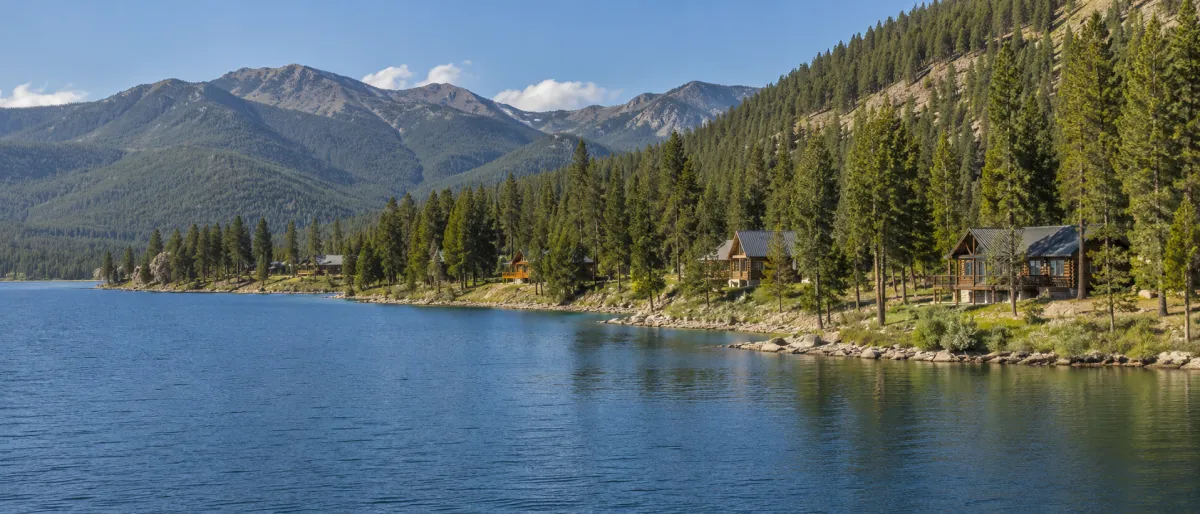
That it is a working reservoir, a nationally known stillwater fishery, and the site of a major earthquake, and that each of those facts shows up in a title review. Hebgen Lake runs about 15 miles long, covers 12,563 acres, and reaches 70 feet deep at an elevation of 6,539 feet. NorthWestern Energy owns Hebgen Dam, completed in 1915, and operates the reservoir's 386,000 acre-feet of storage to regulate flows into the Madison River for its downstream hydroelectric plants. Water level follows the utility's operations and its regulatory obligations, not a fixed natural shoreline.
On August 17, 1959, a magnitude 7.5 earthquake struck the basin. The dam held, but a landslide 27 miles northwest of town blocked the Madison River, killed 28 people, and created Quake Lake. The Forest Service's Earthquake Lake Visitor Center on US 287 tells that history each summer. Buyers should know it because the basin is seismically active and because lakeshore parcels carry the regulatory layers that come with a reservoir: setbacks, dock rules, and the district zoning above.
Most lakefront development sits on the eastern and southern shores, and the land around it is the Custer Gallatin National Forest's Hebgen Lake basin, where the south side holds the campgrounds and fishing access sites. The upside of that setting is a boundary that does not change. The trade is that services are the owner's problem: private wells, septic systems permitted through Gallatin County Environmental Health, propane, and a plowed road that someone has to pay for. Inside town limits, by contrast, the municipal water system is gravity-fed from Whiskey Springs, carries naturally high fluoride, and the Town notes potential limits on water and sewer capacity for new connections. Two different ownership models, about ten miles apart.
What Does Winter Ask of a Property Here?
More than anywhere else in Gallatin County, in cold and in depth of snow. West Yellowstone holds the coldest recorded temperature for any residential community in the contiguous United States, minus 66 degrees Fahrenheit, and typical peak snowpack reaches 3.5 to 4 feet by early March, per the town's climate record. January averages a high near 24 and a low near zero.
For a house, that means the systems a buyer inspects in Bozeman get inspected harder here: roof pitch and snow-load history, heat source and its fuel supply, pipe routing in unheated spaces, and how the driveway and roof shed four feet of snow without burying the propane tank or the egress windows. For a second-home owner, it means a winterization plan or a caretaker for the months the house sits empty, and a candid conversation with an insurer early, since forested settings and long emergency response distances affect underwriting. For anyone relying on the oversnow season for income, it means the December 15 opening date is a business date.
The Bottom Line
West Yellowstone is a small, seasonal, tourism-driven market that publishes prices from $450,000 to $1.1 million for the same town, and a buyer's job is to ignore all of them in favor of the specific property, its zoning sub-district, and its true cost of ownership. The ownership math changed for tax year 2026 when the 1.9 percent non-homestead rate landed on second homes and nightly rentals. The regulatory map changes at the town line. And the calendar is set by a park gate that closes on October 31 and reopens on snow in mid-December. Get those three things right and this can be a sound purchase. Get them wrong and the lakefront listing at $1.1 million and the county median at $450,000 will both feel like they described some other town.
Frequently Asked Questions
Is West Yellowstone in Gallatin County?
Yes. West Yellowstone is an incorporated town in Gallatin County, Montana, located at the West Entrance of Yellowstone National Park and about 89 miles south of Bozeman by US 191. Gallatin County records deeds, assesses property, and administers zoning outside town limits, including the Hebgen Lake Zoning District.
What is the median home price in West Yellowstone?
It depends on the source and the window. The 2026 Gallatin Valley Housing Report shows about $450,000 on 2025 sales, Redfin shows a $649,000 median for the three months ending July 2026 on a single sale, and the median list price ran near $1.095 million in August 2026. In a market this small, price the property, not the town.
Can I run a short-term rental in West Yellowstone?
Sometimes, and the answer changes at the town boundary. Inside town, the Town's business license, resort tax, and zoning by district apply; confirm the specific address with Town Hall. Outside town, the Hebgen Lake Zoning District treats short-term rentals as a conditional use in its C and RP sub-districts, requiring a permit and a public hearing. A state public accommodation license is required everywhere.
How is a second home taxed in Montana in 2026?
Residential property not enrolled for Montana's homestead or long-term rental reduced rate is taxed at a flat 1.9 percent in 2026, and second homes and short-term rentals typically fall in that category. The reduced rate requires a principal residence occupied at least seven months a year, or leases of 28 days or more. Confirm your situation with the Department of Revenue and a tax professional.
When is Yellowstone's West Entrance closed to cars?
Per the National Park Service, the West Entrance to Madison road is open to regular vehicles April 17 through October 31, 2026. Most park roads close to cars from early November until late April. Guided snowmobile and snowcoach travel through the West Entrance runs December 15, 2026 through March 15, 2027.
How far is West Yellowstone from Bozeman?
About 89 miles by US 191, which passes through 20 miles of Yellowstone National Park and then descends the Gallatin River canyon past Big Sky. Allow well over an hour and a half in good conditions and more in winter. Bozeman is the nearest hospital, major retail, and year-round commercial airport.
What is different about buying on Hebgen Lake?
Hebgen Lake is a reservoir owned and operated by NorthWestern Energy, so water level follows utility operations rather than a fixed shoreline. The basin is seismically active, the site of the 1959 magnitude 7.5 earthquake. Lakeshore parcels fall under the Hebgen Lake Zoning District, and most rely on private wells, septic systems, and privately maintained roads.
Does West Yellowstone have year-round air service?
No. Yellowstone Airport, two miles north of town, offers seasonal Delta and United service to Salt Lake City and Denver, roughly late spring through early fall, with dates set each season. The rest of the year, the nearest commercial airport is in Bozeman.
This article is general information, not legal, tax, or accounting advice. AmeriMont Broker Group is not a law firm or an accounting firm, and nothing here should be treated as advice from one. Laws, tax rules, and programs change, and they vary by state and by situation. Before acting on anything covered here, consult a licensed attorney and/or a certified public accountant in your state for current guidance on your specific circumstances.
Nancy Clark is the Broker and Owner of AmeriMont Broker Group, serving Manhattan, Amsterdam, Churchill, and communities across southwest Montana. With more than $135 million in closed sales and over a decade of experience in Montana real estate, Nancy brings the care of a neighbor and the skill of a seasoned professional to every transaction. Reach her at [email protected] or visit nancyclarkbroker.com.
Nancy Clark
Broker/Owner, AmeriMont Broker Group
Manhattan, Montana
[email protected]
nancyclarkbroker.com


