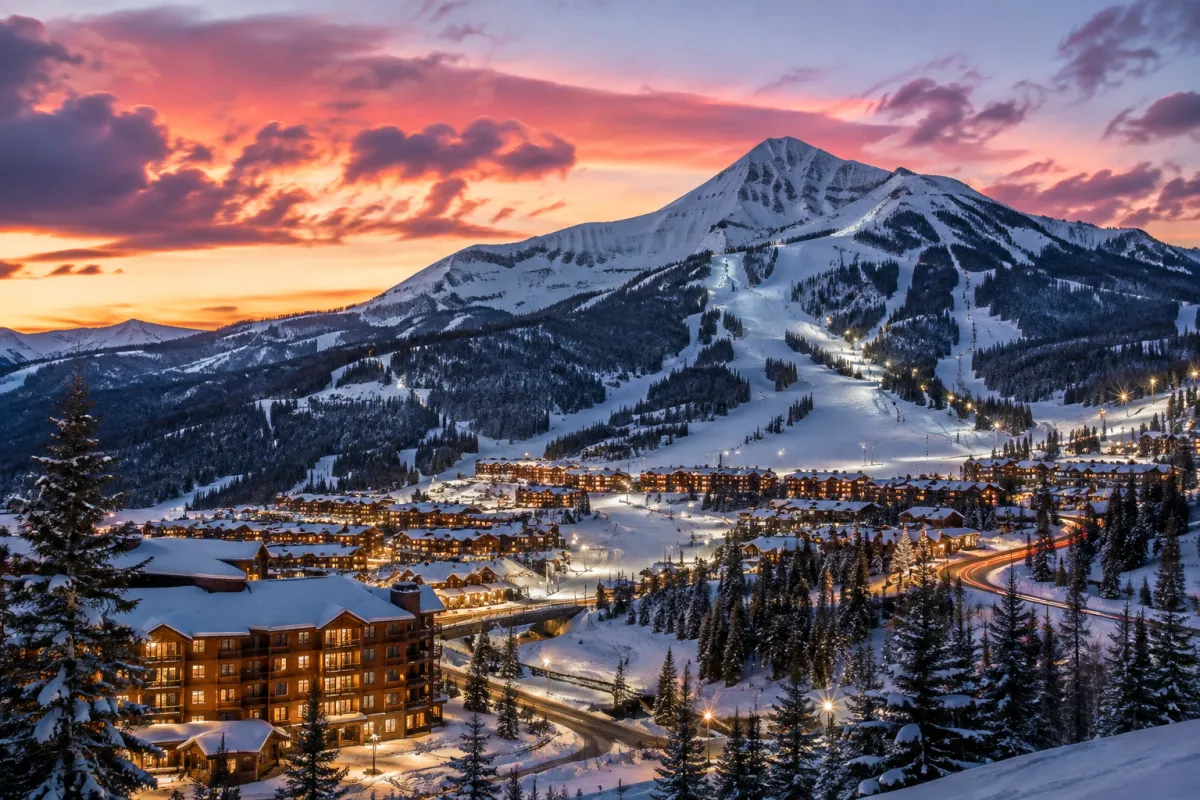
What Should You Know About Buying in Big Sky, Montana?
The mountain gets the postcards. The county line, the resort tax, and the water district decide what ownership actually costs.
The short answer: Big Sky is an unincorporated community split between Gallatin and Madison counties, with a median sale price of $1.9 million as of mid-2026, a 4% resort tax on short-term stays and luxury purchases, a new higher property tax rate on second homes, and layered association costs. Buying well here means pricing the whole stack, not just the house.
Nancy Clark here, Broker and Owner at AmeriMont Broker Group in Manhattan, Montana. Big Sky sits about an hour south of the valley floor up the Gallatin Canyon, and it runs by different rules than Bozeman, Belgrade, or Manhattan. Those rules are knowable. Let's walk through them.
Where Is Big Sky, and Why Does the County Line Matter?
Big Sky is not a town. It is an unincorporated resort community in the Madison Range, about 45 miles southwest of Bozeman, and it straddles the line between Gallatin County and Madison County. There is no city hall and no mayor. Services that a town would normally provide come instead from a stack of special districts, associations, and two different county governments.
Which county your parcel sits in is not trivia. It determines where you pay property taxes, which planning office reviews your permits, where you vote, and which county's rules apply to your land. Much of the Moonlight Basin side sits in Madison County, while the Meadow, the Gallatin Canyon corridor, and other neighborhoods sit in Gallatin County, and Madison County maintains its own Big Sky services page for exactly this reason. Before writing an offer, confirm the county parcel by parcel with the county itself, not from a listing description. The same subdivision name can carry addresses on both sides of the line.
The practical takeaway: in Big Sky, due diligence has one extra step at every stage. First establish which county and which districts govern the property, then run the normal checks inside that frame.
What Does the Big Sky Market Look Like in 2026?
Expensive, thin, and volatile, in the statistical sense. The median sale price across all home types was $1,948,939 for the three months ending June 2026, up 10.6% from the same period a year earlier, with homes averaging 82 days on the market, per Redfin's Big Sky market data. Redfin's snapshot reports none of June's closings above list price.
Read those numbers with care, because the sample is tiny. Redfin counted 38 sales in June 2026. A year earlier, average days on market was 190, not 82. When one month's closings include a few ski-in condos and one legacy ranch parcel, the median swings hard for reasons that have nothing to do with your specific property. Big Sky is the clearest example in our region of a rule that holds everywhere: in small markets, a monthly median is a weather report, not a climate record.
The product mix is its own lesson. The entry point to Big Sky ownership is mostly condos and townhomes near the resort villages and the Meadow, while detached single-family homes and homesites in the club communities price in a different universe. Two properties a mile apart can differ by seven figures because one carries club access and one does not. If your budget lives closer to the valley's price points, our post on what $400,000 to $600,000 buys across the Gallatin Valley shows what the same money does 45 miles north.
What Is the Big Sky Resort Tax, and Will You Pay It?
Big Sky sits inside the Big Sky Resort Area District, which collects a 4% resort tax on luxury goods and services sold within the district, per the district's own collections page. The district describes that 4% as a base 3% resort tax plus an additional infrastructure tax of up to 1% that voters approved in 2020, with the infrastructure portion dedicated to water and sewer improvements. The district publishes a boundary map, and whether a given property or business sits inside those boundaries is one more parcel-level fact to confirm.
Two parts matter to you as an owner. First, daily life: dining out, lift tickets, and other taxed goods and services inside the district cost 4% more than the sticker, which is unusual in a state with no general sales tax. Second, rentals: the tax applies to lodging, and the district's rule covers all rental agreements for lodging facilities except rentals to the same user for thirty consecutive days or more. Rent your condo by the night or the week and you are a resort tax collector, with registration and remittance obligations to the district. Rent it for thirty days or longer to one tenant and that stay falls outside the resort tax, though other taxes and your own covenants may still apply.
The upside of the arrangement is visible everywhere: resort tax dollars stay local and fund infrastructure, emergency services, and transportation in a community with no municipal tax base. It is a real cost, and it buys real things.
What Will Property Taxes Look Like on a Big Sky Second Home?
If the home will not be your primary residence, plan for Montana's new higher rate on non-primary homes. Under the 2025 property tax reforms, residences that do not qualify as a homestead, meaning they are not occupied or leased long-term for at least seven months of the year, are taxed at a flat 1.9% rate beginning in 2026, per the Montana Legislature's summary of HB 231 and SB 542. Qualifying homesteads and long-term rentals instead pay tiered rates that start at 0.76% on the first bands of value and reach 1.9% only on value above roughly $1.5 million, so the gap between the two classifications depends on the home's price, and at Big Sky values both the gap and the bill deserve a real calculation rather than a rule of thumb.
At Big Sky prices, the homestead-versus-second-home distinction moves real money, and short-term rental use counts on the non-homestead side of the line. The rules, the tiers, and the definitions have changed twice in two years and can change again, so before you count on any number, read our plain-English walkthrough of how Gallatin County property taxes work now and confirm your specific situation with the Montana Department of Revenue or your CPA. Remember also that your bill goes to whichever county your parcel sits in, which is one more reason the county line question comes first.
What About HOA, Association, and Club Costs?
Many Big Sky properties carry at least one association layer, and plenty carry three; the exact stack depends on the parcel and subdivision. At the base sits the Big Sky Owners Association, the community's largest and oldest owners association, covering roughly 2,300 properties across both counties per the association's own materials, where membership is automatic and mandatory for properties within its boundaries. On top of that, most neighborhoods add their own sub-association with its own dues, covenants, and architectural rules. And in the club communities, ownership can be tied to private club membership with separate initiation fees and annual dues that can rival the property taxes.
None of this is hidden, but it arrives in separate documents from separate entities, and the stack is easy to underestimate from a listing page. Before you write an offer, get the complete picture in writing: every association the property belongs to, current dues for each, any special assessments underway or planned, and whether a club membership is required, optional, or waitlisted. Our guide to HOAs across Bozeman and the Gallatin Valley covers the five documents worth reading before closing, and in Big Sky you may be collecting that packet from three sources instead of one.
Here is the full cost stack to price before you offer:
| Cost layer | Who charges it | Applies to |
|---|---|---|
| Purchase price | Seller | Everyone |
| Property tax (homestead tiers or 1.9% non-homestead) | Gallatin County or Madison County, per parcel | Everyone; rate class depends on your use |
| Resort tax (4%) | Big Sky Resort Area District | Taxed goods, services, and stays under 30 days |
| Big Sky Owners Association dues | BSOA | Most properties in its boundaries, mandatory |
| Neighborhood sub-HOA dues | Each subdivision's association | Most neighborhoods |
| Private club initiation and dues | Club communities | Where ownership is club-tied |
| Water/sewer or well/septic | District No. 363, or your own systems | In-district vs. outside |
How Do Water and Sewer Work in Big Sky?
Inside the community's core, water and sewer come from the Big Sky County Water and Sewer District No. 363, a special district formed in 1993 that serves the Meadow and Mountain areas and has become a leader in water reuse. Outside the district's boundaries, properties run on private wells and septic systems, with everything that implies for testing, maintenance, and replacement reserves.
Capacity is the word to know. Big Sky's growth has pressed against the district's treatment capacity for years, which is exactly why voters dedicated the 1% infrastructure resort tax to a major water reclamation facility expansion. For a buyer, that history translates into two questions to ask early: is this parcel inside the district, and if it is, what does connection availability look like for what I plan to do with the property? For in-district resales the answer is usually simple. For new construction, additional units, or anything unusual, get the district's answer in writing before you commit. And if the property runs on its own well and septic, the same due diligence applies here as anywhere in the valley: test, inspect, and budget, as we covered in well and septic systems for Gallatin Valley buyers.
Can You Rent It Out When You Are Not Using It?
Often yes, and many Big Sky owners do, but three separate layers have a say before you list it. First, the resort tax: stays under 30 consecutive days are taxable, so short-term rental operators register with the district and collect the 4%. Second, your covenants: BSOA rules, sub-HOA covenants, and club documents can restrict or condition rentals, and those private restrictions bind you regardless of what any government allows. Third, your tax classification: a home used substantially as a short-term rental sits on the non-homestead side of Montana's property tax rules, at the 1.9% rate.
Run the numbers honestly. Big Sky's rental demand is real, and so are management fees, resort tax remittance, higher insurance, wear, and the second-home tax rate. A rental that pencils at optimistic occupancy may not pencil at honest occupancy. Ask for actual trailing revenue numbers on any property marketed on its rental income, not projections.
What Is Year-Round Life in Big Sky Actually Like?
Smaller and more self-contained than visitors assume, with the essentials closer than they used to be. Big Sky School District 72 runs Ophir Elementary, Ophir Middle School, and Lone Peak High School on a single campus serving roughly 360 students per the district, with International Baccalaureate programming at the high school. Bozeman Health operates the Big Sky Medical Center, an eight-bed critical access hospital in Town Center with a 24/7 emergency department. Groceries, a pharmacy, and daily services exist in Town Center and the Meadow.
The tradeoffs are equally real. Bozeman, with its airport, big-box stores, and full hospital, is about an hour down a canyon road that carries heavy seasonal traffic and winter driving conditions. Major medical specialties, most youth sports leagues, and much of ordinary errand-running still mean the canyon drive. Winters are long and snow totals are serious, which is the point for many buyers and a surprise for some. People who thrive in Big Sky year-round tend to be the ones who wanted a mountain town, not a discounted version of Bozeman.
The Bottom Line
Big Sky rewards buyers who price the whole system: the home, the county, the 4% resort tax, the second-home property tax rate, the association stack, the water answer, and the honest rental math. Every one of those items is knowable before you offer, and none of them should be discovered at the closing table. The mountain is spectacular. Go in with the paperwork as clear as the view.
Next Steps
Before touring, decide what the property is for: primary home, second home, or rental. That single answer drives your tax rate, your covenant questions, and your honest budget.
For any property you get serious about, request in writing this week: the county and parcel number, every association it belongs to with current dues, any club obligations, and whether it is inside Water and Sewer District No. 363.
Talk it through with someone who works both sides of the canyon. Nancy helps buyers weigh Big Sky against the valley towns every year. Email [email protected] and get an honest read on whether Big Sky, or somewhere an hour north, is the right fit for the money.
Frequently Asked Questions
Is Big Sky, Montana its own town?
No. Big Sky is an unincorporated community split between Gallatin County and Madison County, with no city government. Services come from special districts and associations, including the Big Sky Resort Area District, Water and Sewer District No. 363, and the Big Sky Owners Association, plus the two county governments.
How much does a home in Big Sky cost in 2026?
The median sale price was $1,948,939 across all home types for the three months ending June 2026, per Redfin, up 10.6% year over year. With only about 38 sales a month, medians swing widely, so read any single month's figure as a snapshot, not a trend.
What is the Big Sky resort tax?
A 4% tax the Big Sky Resort Area District collects on luxury goods and services sold within the district, including lodging stays under 30 consecutive days. The district describes it as a base 3% plus an infrastructure tax of up to 1% approved by voters in 2020 to fund water and sewer improvements.
Do short-term rentals in Big Sky pay the resort tax?
Yes. Rental agreements for stays shorter than 30 consecutive days are subject to the 4% resort tax, and operators register with and remit to the district. Rentals of 30 days or more to the same tenant fall outside the resort tax. Covenants and association rules can also restrict rentals.
How are property taxes different for a Big Sky second home?
Under Montana's 2025 reforms, homes that are not occupied or leased long-term at least seven months a year are taxed at a flat 1.9% rate starting in 2026, while qualifying homesteads pay tiered rates from 0.76% to 1.9% by value. Confirm your classification with the Montana Department of Revenue or a CPA before budgeting.
Which county is Big Sky in?
Both. The community straddles the Gallatin and Madison county line, and much of the Moonlight Basin side sits in Madison County. Your parcel's county determines your tax bill, permits, and voting, so confirm it parcel by parcel with the county rather than relying on a listing.
Does Big Sky have schools and a hospital?
Yes. Big Sky School District 72 serves roughly 360 students across Ophir Elementary, Ophir Middle, and Lone Peak High School, which offers International Baccalaureate programming. Bozeman Health's Big Sky Medical Center in Town Center is an eight-bed critical access hospital with a 24/7 emergency department.
Is buying in Big Sky a good investment?
It depends on honest math more than on the mountain. Prices are high, monthly data is volatile, and carrying costs include the 4% resort tax on short stays, the 1.9% non-homestead tax rate, association dues, and possibly club fees. Buyers who price the full stack and verify rental income with trailing numbers position themselves far better than buyers who price the view.
This article is general information, not legal, tax, or accounting advice. Nancy Clark and AmeriMont Broker Group are not a law firm or an accounting firm, and nothing here should be treated as advice from one. Laws, tax rules, and programs change, and they vary by state and by situation. Before acting on anything covered here, consult a licensed attorney and/or a certified public accountant in your state for current guidance on your specific circumstances.
Nancy Clark is the Broker and Owner of AmeriMont Broker Group, serving Manhattan, Amsterdam, Churchill, and communities across southwest Montana. With more than $135 million in closed sales and over a decade of experience in Montana real estate, Nancy brings the care of a neighbor and the skill of a seasoned professional to every transaction. Reach her at [email protected] or visit nancyclarkbroker.com.
Nancy Clark
Broker/Owner, AmeriMont Broker Group
Manhattan, Montana
[email protected]
nancyclarkbroker.com


