What Is the Ruby Valley Like for Montana Homebuyers?
Three towns of 330, 694, and 219 people, a 1938 irrigation dam that decides how green the valley gets, and a water basin whose court decree is still open. The Ruby Valley from the buyer's side of the table.
Wondering what the Ruby Valley is like to live in year-round, rather than to fish for a week in June? This guide is for buyers weighing Twin Bridges, Sheridan, Alder, or Virginia City against the Gallatin and Madison valleys. It covers the drives, the 2026 price data, how the water works, which county offices you will deal with, and what to check before an offer.
The Ruby Valley is the western half of Madison County, a county that counted 8,623 people in the 2020 census and, per the county's own 2025 growth policy, an estimated 8,742 by 2022. Ennis, on the Madison River side of the county, is covered in what homebuyers should know about Ennis and the Madison Valley. This post is about the other river.
Where Is the Ruby Valley, and What Are Its Towns?
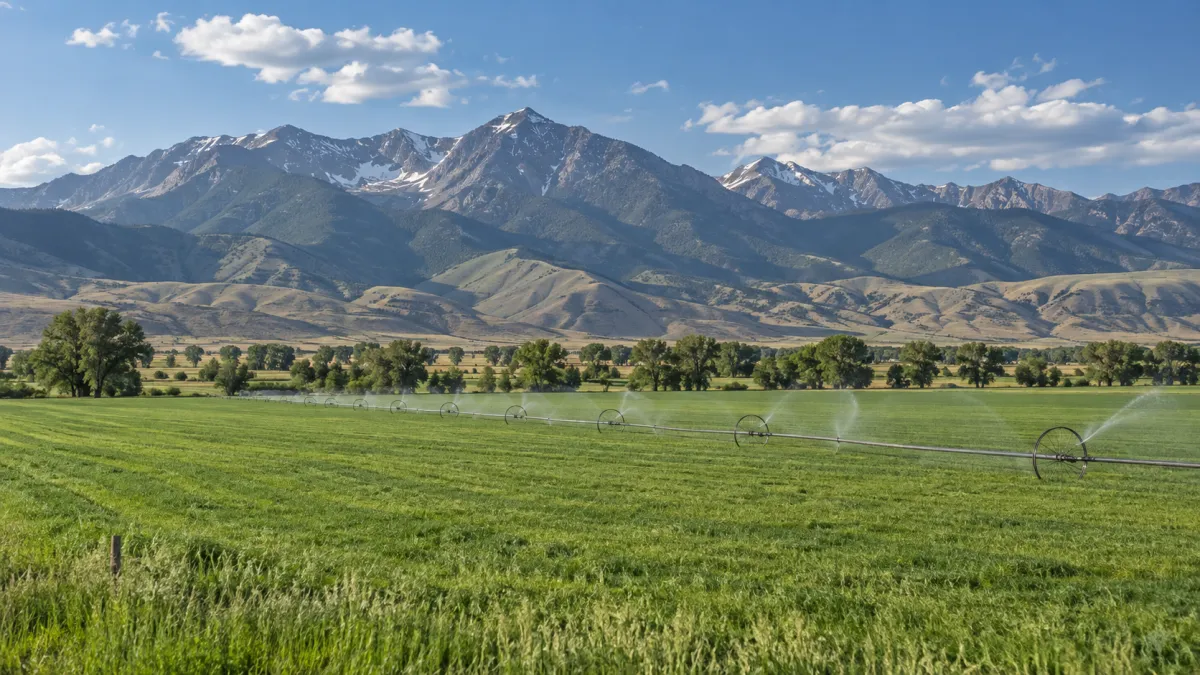
The Ruby Valley follows the Ruby River about 48 miles from Ruby Dam northwest to Twin Bridges, with the Tobacco Root Mountains on its east side and the Ruby Range on its west. Its towns lie along Montana Highway 287: Virginia City at the head of Alder Gulch, then Alder, Sheridan, and Twin Bridges, where the Ruby meets the Beaverhead.
The river's geography comes from Montana Fish, Wildlife and Parks. Its 2023 to 2026 fisheries management plan describes the Ruby rising in the Gravelly and Snowcrest ranges, flowing 41 miles through a narrow canyon to Ruby Reservoir, then meandering "about 48 miles through an agricultural valley to its confluence with the Beaverhead River," draining about 935 square miles in all. At Twin Bridges the Ruby joins the Beaverhead, and about two miles north of town the Beaverhead meets the Big Hole to form the Jefferson River.
The name is a miner's mistake. The river became the Ruby in 1877, named for the garnets miners panned from its gravel while looking for gold; the U.S. Geological Survey records that prospectors took the red garnets for rubies. They are still there: the Bureau of Land Management's Ruby Reservoir recreation site, about ten miles south of Alder, lists garnet collecting along the shoreline.
| Town | 2020 population | Elevation | Water and sewer | Zoning inside town limits |
|---|---|---|---|---|
| Twin Bridges | 330 | 4,626 ft | Town water and wastewater system | Adopted and enforced by the town |
| Sheridan | 694 | 5,128 ft | Town water and sewer system | Adopted November 24, 2025, the town's first, effective December 24, 2025 |
| Alder (unincorporated) | 86 | 5,125 ft | Alder Water and Sewer district; the county growth policy notes Alder runs a public sewer system because of a high water table | None; the county does not zone |
| Virginia City (county seat) | 219 | 5,919 ft | Town system | Adopted and enforced by the town |
Populations and elevations are 2020 census figures as compiled for Twin Bridges, Sheridan, Alder, and Virginia City. Water systems and zoning status come from the county growth policy, covered further down. Notice the elevation column: Virginia City sits about 1,300 feet higher than Twin Bridges, and the valley's weather runs the same direction.
How Far Is the Ruby Valley From Bozeman, Butte, and Dillon?
Far enough that the week has to be planned around it. Twin Bridges sits about 87 road miles from Bozeman, 53 from Butte, and 28 from Dillon; Sheridan adds roughly ten miles to the Bozeman and Butte figures. No interstate enters the valley. Montana 41 runs to Dillon, Montana 55 to Interstate 90 at Whitehall, and Montana 287 over to Ennis.
Three state highways do the work. Montana Highway 287 runs 42.8 miles from Montana 41 in Twin Bridges through Sheridan and Alder, up Alder Gulch to Virginia City, then down Eightmile Creek into the Madison Valley at Ennis. Montana Highway 41 runs 54.5 miles from Dillon through Twin Bridges and Silver Star, and Montana Highway 55 covers the last 13 miles to the Interstate 90 interchange at Whitehall. From Whitehall it is interstate to Butte one way and Bozeman the other.
Measured on a road-routing map from town centers (expect a couple of miles of variance by address): Twin Bridges to Bozeman about 87 miles and an hour and forty minutes; to Bozeman Yellowstone International Airport at Belgrade about 79 miles; to Butte about 53; to Dillon about 28; Sheridan to Ennis about 34 miles and close to an hour, because the Virginia City hill is slow. The county's growth policy puts the county line "approximately 32 miles west of Bozeman and 26 highway miles east of Butte," which describes the county's edge near Three Forks, not its towns.
The practical version: Butte and Dillon are the errand towns, Bozeman is a planned day, and a Gallatin Valley job commuted from Sheridan is two hours each way. Commuting over Bozeman Pass is a shorter drive than this one, and that post's cost table is the right template for pricing it.
What Do Ruby Valley Home Prices Look Like in 2026?
Higher than the valley's size suggests, and measured on samples too small to trust alone. The Montana Department of Revenue's 2025 median residential value for Madison County is $671,000, up 32 percent in one reappraisal and within $14,000 of Gallatin County's. Twin Bridges and the Sheridan zip code each show a single closed sale in Redfin's latest three-month window.
| The number you will see | What it measures | How to read it |
|---|---|---|
| $671,000 (Montana Department of Revenue, 2025 reappraisal median residential value, Madison County) | The middle assessed value of every residential property in the county, Big Sky included | Up from $507,000 in 2024; a valuation, not a sale, and pulled upward by the Madison County side of Big Sky |
| $696,668 (Redfin, Madison County median sale price, three months ending August 2026) | County-wide closings; 26 homes sold in August 2026, 89 median days on market | Flat year over year (down 0.33 percent); still a county number, not a Ruby Valley number |
| $649,000 (Redfin, Twin Bridges, three months ending August 2026) | One closed sale inside the town boundary | The "up 54.8 percent" beside it is one house, not a trend |
| $690,000 (Redfin, ZIP 59749, Sheridan, three months ending August 2026) | One closed sale, 145 days on market | Same warning |
The Department of Revenue's 2025 table is the stable number, and it moved hard: Madison County's median residential value rose from $507,000 to $671,000, up 32 percent, while Gallatin County went from $630,000 to $685,000, up 9 percent, and the statewide median from $311,000 to $378,000, up 22 percent. Part of that is geography. Big Sky sits in both Gallatin and Madison counties, and Big Sky's median, near $1.9 million per the figures in what $1 million buys across the Gallatin Valley, lands in the same county median as a house on Main Street in Sheridan.
The sale-price feeds are thinner still. Redfin's Madison County page shows a $696,668 median for the three months ending August 2026, flat from a year earlier, with 26 homes sold in August and 89 median days on market. Its Twin Bridges page reports $649,000 on one sale, and its 59749 zip page for Sheridan reports $690,000 on one sale after 145 days. Twenty-six county closings in a month against one inside the Twin Bridges town line is the lesson from where your money goes furthest west of Bozeman again: the boundary decides the median, and the valley's own sales mostly sit in the acreage and river parcels the town-line feeds do not count.
What a buyer can take from all of it is direction, not a price. Assessed values jumped a third in a year, listings sit for months rather than weeks, and closings range from in-town homes to river parcels that price on the water. The number that matters is the closed comps for that kind of property in the Ruby Valley itself over the last two years, which the MLS holds and the public feeds do not.
The assessment jump also lands on the tax bill. A home enrolled as a principal residence is taxed on the tiered homestead rates, 0.76 percent on the first $378,000 of value and stepping up from there; second homes, short-term rentals, and vacant residential lots pay a flat 1.90 percent for 2026, per the Department of Revenue. A buyer who closes after the enrollment deadline on a home that was not already enrolled pays the flat rate for 2026 and claims the difference as a refund between January 1 and May 31, 2027. On a $671,000 valuation that difference is real money every year; the mechanics are in do you qualify for Montana's reduced homestead tax rate. A Ruby Valley cabin used for summer weeks does not qualify.
How Does Water Work in the Ruby Valley?
Through a state-owned dam, two canals, and a court decree that is still open. Ruby Dam, built in 1938 and owned by the Montana Department of Natural Resources and Conservation, stores 37,642 acre-feet for 194 irrigation contracts. The Montana Water Court issued the Ruby River basin's preliminary decree on June 25, 2025, so a parcel's water right may still be under objection.
Start at the dam. DNRC's Ruby Dam project page describes an earthen embankment built in 1938, owned by DNRC and operated by the Ruby Water Users Association since that year, with 37,642 acre-feet of storage and irrigation as its primary purpose. The department's 2021 fact sheet adds 970 surface acres at full pool, water delivered through the 12-mile West Bench Canal and the 26-mile Vigilante Canal under 194 contracts for 38,845 acre-feet, and a two-phase rehabilitation between August 2010 and 2014 costing about $17 million. DNRC classifies the dam as high hazard, a statement about what sits downstream, not its condition. If the acreage you are looking at is green in August, this is usually why, and the canal contract that makes it green is a document to ask for.
The river below the dam runs on what the irrigators leave. FWP's plan states that "dewatering of the Ruby River downstream from Ruby Reservoir is a major habitat issue," and reports that the tailwater from the dam to Alder holds about 1,350 brown trout per mile, roughly 6 percent of them over 18 inches; the upper river is managed for wild Arctic grayling conservation. A parcel on the lower river in a dry year can front a very different river than the one you toured.
Now the decree. Montana adjudicates water rights basin by basin; the Ruby River is Basin 41C. The Water Court's June 25, 2025 findings recount that a temporary preliminary decree was issued on November 14, 1990, that objections to it have been resolved, and that the basin runs to "the Ruby River confluence with the Beaverhead River south of Twin Bridges." The court's January 2026 report to the Legislature lists the new preliminary decree at 2,932 claims. The objection period was extended to March 23, 2026 at the request of the United States on behalf of the Forest Service, the Bureau of Land Management, and the Bureau of Reclamation, and no final decree has issued. In plain terms: a Ruby Valley water right's abstract may carry issue remarks or a pending objection, and a water-law attorney should read it before you rely on it. The general path for checking any right is in how water rights work when you buy land in Montana.
Two statutes frame everything else. Under MCA 85-2-343, DNRC "may not grant an application for a permit to appropriate water" in the upper Missouri River basin until final decrees issue for all of its subbasins, and MCA 85-2-342 defines that basin as everything above Morony Dam, which includes the Ruby. New surface water is, with narrow exceptions, not available. Domestic wells still run on the groundwater exception in MCA 85-2-306: outside a designated stream depletion zone, 35 gallons a minute or less and no more than 10 acre-feet a year without a permit, with the caveat that "a combined appropriation from the same source by two or more wells or developed springs" exceeding 10 acre-feet needs one. The well log, the septic permit, and the test results that go with a rural purchase are covered in well and septic systems before you buy in the valley; the offices differ here, the checklist does not.
What Did the Seyler Lane Case Settle About River Access Near Twin Bridges?
That the public may reach the Ruby River from a county bridge right-of-way, and that Montana's stream access law applies below the high-water mark no matter who owns the riverbed. The Montana Supreme Court decided the case in January 2014 over the Seyler Lane bridge near Twin Bridges; a 2016 district court order set that right-of-way at 47.5 feet.
The case is Public Lands Access Association v. Board of County Commissioners of Madison County, 2014 MT 10, decided January 15, 2014 by a 5 to 2 vote, per the Associated Press account. The landowner held fee title to the ground under the 24-foot-wide bridge. The court held that "the areas that are reasonably necessary to support and maintain Seyler Bridge, and to ensure the public's safe and convenient use of it, are included in the Seyler Lane public road right-of-way," and that "any foreseeable uses of a public road right-of-way, including recreational use, are permitted." On remand, the district court set the width at 47.5 feet in September 2016, and FWP built the access fencing over the following two years.
Under the stream access law itself, MCA 23-2-302, "all surface waters that are capable of recreational use may be so used by the public without regard to the ownership of the land underlying the waters," and in the same section, that right "does not grant any easement or right to the public to enter onto or cross private property." For a buyer looking at Ruby River frontage, both halves matter: an angler wading the river in front of the house is within the law, and one crossing the hayfield to get there is not. Where the high-water mark falls on a specific parcel, and which bridges carry public access, is a question for a Montana attorney who handles stream access, not for a listing description.
Who Governs Building, Septic, and Records in Madison County?
The county, from Virginia City, and it does not zone. Its 2025 growth policy states that the county "has not adopted and does not currently enforce Zoning Regulations." Twin Bridges, Virginia City, and Ennis zone inside their limits, and Sheridan adopted its first ordinance in November 2025. Septic permits come from the county sanitarian under wastewater regulations effective February 26, 2026.
The growth policy's own wording is worth reading twice: the county has not adopted zoning, the three incorporated towns other than Sheridan "have adopted and enforce zoning within their jurisdictional boundaries," and "Sheridan has initiated the process of developing and adopting zoning regulations." That last line is already out of date: the policy was written in early 2025, and the Sheridan Town Commission voted unanimously on November 24, 2025 to pass the town's first zoning ordinances, effective December 24, 2025, per The Madisonian. The policy's action table puts informational discussions on county zoning on the planning office's 2026 list. Until that changes, recorded covenants are the only private use restriction on an unincorporated parcel. The county still applies its subdivision regulations when land is split, plus floodplain, wastewater, and airport affected area rules, but nothing governs what a neighbor builds on an existing parcel. Read the covenants. If there are none, understand what that means in both directions.
The offices, all in Virginia City. The Planning Office at 7 Placer Loop, (406) 898-4331, handles subdivision review, the growth policy, and the airport affected area regulations around Twin Bridges Airport. The Sanitarian, same address, (406) 898-4338, issues septic permits: the county's septic page states that "a permit is required for all septic systems or wastewater treatment systems installed in Madison County," that every system "shall be installed by a Madison County Licensed Installer," and that lots under 20 acres need Montana DEQ subdivision approval showing the approved drainfield and well locations. The Clerk and Recorder at 103 West Wallace Street, (406) 898-4406, holds the deeds, plats, and certificates of survey. The county also employs a floodplain administrator, which matters on any parcel near the Ruby, the Beaverhead, or the Big Hole.
What Services Does a Valley of Three Small Towns Carry?
A critical access hospital in Sheridan with 24-hour emergency care, four school districts, a grocery store in Sheridan open since 1889, town water and sewer in Twin Bridges and Sheridan, and the county fairgrounds in Twin Bridges. Specialty care and the airport are in Bozeman, about two hours from Sheridan, or in Butte and Dillon about an hour away.
Health care first. Ruby Valley Medical Center at 321 Madison Street in Sheridan is a critical access hospital with, per its services page, five inpatient beds plus two for observation, advanced life support ambulance service, and a clinic at 207 North Main Street in Twin Bridges; the Town of Sheridan lists its emergency care as 24-hour. The next tier is Barrett Hospital in Dillon, about 28 miles from Twin Bridges, and St. James Hospital in Butte, a 67-bed facility about 53 miles away. Bozeman Health Deaconess, the region's Level III trauma center, is roughly 87 miles from Twin Bridges.
Schools, reported without characterization so you can look them up yourself. Federal district data for 2024-25 shows Twin Bridges K-12 at 223 students across three schools at 216 West 6th Street; Sheridan Elementary, preschool through eighth grade, at 187 students; Sheridan High School at 58; and Alder Elementary, a preschool-through-eighth district on Upper Ruby River Road, at 11 students, with all of Alder inside the Sheridan high school district. Which district a parcel sits in is a question for the county; district lines do not follow town lines.
Daily life runs on a short list. Walters Family Foods at 102 South Main in Sheridan has been the valley's grocery since 1889. The Twin Bridges Public Library is at 206 South Main. The Town of Twin Bridges and the Town of Sheridan each run municipal water and sewer inside their limits, and unincorporated Alder has its own Alder Water and Sewer district; outside those, per the growth policy, residents "typically have private septic systems." The Madison County Fairgrounds sit in Twin Bridges, where the county fair ran August 6 through 9 in 2026, and the Greater Ruby Valley Chamber of Commerce and Agriculture is based there too. The Beaverhead-Deerlodge National Forest's Madison Ranger District manages the Tobacco Root access east of Sheridan, including the ten-site Mill Creek Campground.
Virginia City is the valley's other economy. Gold was found in Alder Gulch on May 26, 1863, the town was the territorial capital from 1865 to 1875, and its historic district) became a National Historic Landmark on July 4, 1961. The state's Montana Heritage Commission has managed about half of Virginia City's historic structures and all of Nevada City since 1997, and the town's visitor site states that Virginia City is open year-round while Nevada City runs Memorial Day weekend through September. For a buyer, the translation is seasonal: Montana 287 through Alder Gulch carries summer traffic, the concessions close in the fall, and the town of 219 goes back to being a town of 219.
What Should You Check Before Writing an Offer in the Ruby Valley?
Seven documents and one drive. Most of what goes wrong on a Ruby Valley purchase is already written down in Virginia City or Helena before the offer; the work is asking for it. Do these this week, before you fall for a view.
- The water right abstract. Pull it from DNRC's water rights query system and read the 41C preliminary decree status: issue remarks, pending objections, priority date, point of diversion, and place of use. Have a water-law attorney read anything you do not understand.
- The canal contract. If the parcel is irrigated from the West Bench or Vigilante canals, ask for the Ruby Water Users Association contract, the acre-feet allotted, and the assessment history.
- The well log. Confirm the well is in the DNRC record, what it was drilled to, what it produced, and whether it stands alone or shares a source with neighboring wells that together approach the 10-acre-foot line.
- The septic permit. Ask the Madison County Sanitarian for the permit and the installer's license, and for lots under 20 acres, the DEQ subdivision approval showing the drainfield.
- The floodplain determination. Ask the county floodplain administrator whether any part of the parcel is mapped, and read what buyers should know about home insurance in Montana before you assume flood coverage is available or affordable.
- The covenants, or the absence of them. With no county zoning, recorded covenants are the only private use restriction outside town limits. Get them from the Clerk and Recorder.
- The tax classification. Decide whether the home will be your principal residence for seven months a year, because the homestead rate and the 1.9 percent rate are the two possible answers, and the difference on a $671,000 valuation is not small.
The drive: come back in the season you did not tour in. A valley that reads one way in July, with the canals full and the fairgrounds busy, reads another in February at 5,000 feet with the concessions closed and Bozeman two hours off. Both are true. Buy the one you will live in.
The Bottom Line
The Ruby Valley is a working irrigation valley with three small towns, a river that anglers know by name, and a county that does not zone. Its prices have moved faster than its size implies, its market data is thin enough that every median needs a footnote, and its water rights are in the middle of an adjudication that is not finished. None of that is a reason to stay away. All of it is a reason to buy with the documents in hand rather than the view in mind.
Frequently Asked Questions
Where is the Ruby Valley in Montana?
The Ruby Valley is the western half of Madison County in southwest Montana. It follows the Ruby River about 48 miles from Ruby Dam northwest to Twin Bridges, between the Tobacco Root Mountains and the Ruby Range. Its towns, along Montana Highway 287, are Virginia City, Alder, Sheridan, and Twin Bridges, where the Ruby joins the Beaverhead just before the Beaverhead meets the Big Hole to form the Jefferson River.
How far is Twin Bridges from Bozeman?
About 87 road miles, roughly an hour and forty minutes, by Montana 41 and Montana 55 to Interstate 90 at Whitehall and then east. Bozeman Yellowstone International Airport at Belgrade is about 79 miles. Butte is about 53 miles and Dillon about 28 miles from Twin Bridges. Sheridan adds about ten miles to the Bozeman and Butte drives, and Ennis is about 34 miles from Sheridan over the Virginia City hill.
What is the median home price in the Ruby Valley?
There is no reliable one. Montana's Department of Revenue set Madison County's 2025 median residential value at $671,000, up 32 percent, but that figure includes the Madison County side of Big Sky. Redfin reported one sale each in Twin Bridges ($649,000) and the Sheridan zip code ($690,000) for the three months ending August 2026, against a $696,668 county median on 26 August closings. Price the specific property on Ruby Valley comps, not on any of these.
Is the Ruby Valley in Gallatin County?
No. The Ruby Valley is in Madison County, whose county seat is Virginia City. Deeds, plats, planning, septic permits, and floodplain questions run through the county offices at 7 Placer Loop and 103 West Wallace Street in Virginia City, not through Bozeman. Madison County's median residential value and its offices, timelines, and rules differ from Gallatin County's, so assumptions carried over from the Gallatin Valley need checking.
Does Madison County have zoning?
Not county-wide. Madison County's 2025 growth policy states that the county has not adopted and does not enforce zoning regulations. Twin Bridges, Virginia City, and Ennis enforce zoning inside their town limits, and Sheridan adopted its first zoning ordinance in November 2025. Outside those limits, recorded covenants are the only private use restriction; the county's subdivision, floodplain, wastewater, and airport rules still apply, but nothing governs what a neighbor builds on an existing parcel.
Is there a hospital in the Ruby Valley?
Yes. Ruby Valley Medical Center in Sheridan is a critical access hospital with five inpatient beds and two observation beds, 24-hour emergency care, advanced life support ambulance service, and a clinic in Twin Bridges. Larger hospitals are Barrett Hospital in Dillon, about 28 miles from Twin Bridges, St. James Hospital in Butte, about 53 miles, and Bozeman Health Deaconess, a Level III trauma center about 87 miles away.
Who owns Ruby Reservoir, and what is it for?
The Montana Department of Natural Resources and Conservation owns Ruby Dam, an earthen embankment completed in 1938 and operated by the Ruby Water Users Association. It stores 37,642 acre-feet over 970 surface acres and supplies irrigation water through the West Bench and Vigilante canals under 194 contracts. A rehabilitation completed in 2014 cost about $17 million. The Bureau of Land Management manages a recreation site on the shoreline where garnets can be collected.
Can the public fish the Ruby River through private land?
Yes, below the ordinary high-water mark. Montana's stream access law, MCA 23-2-302, allows recreational use of surface waters capable of it "without regard to the ownership of the land underlying the waters," while granting no right to cross private property to reach them. The 2014 Montana Supreme Court decision on the Seyler Lane bridge near Twin Bridges confirmed public access from that county road right-of-way, later set at 47.5 feet wide.
This article is general information, not legal, tax, or accounting advice. Nancy Clark and AmeriMont Broker Group are not a law firm or an accounting firm, and nothing here should be treated as advice from one. Laws, tax rules, and programs change, and they vary by state and by situation. Before acting on anything covered here, consult a licensed attorney and/or a certified public accountant in your state for current guidance on your specific circumstances.
Nancy Clark is the Broker and Owner of AmeriMont Broker Group, serving Manhattan, Amsterdam, Churchill, and communities across southwest Montana. With more than $135 million in closed sales and over a decade of experience in Montana real estate, Nancy brings the care of a neighbor and the skill of a seasoned professional to every transaction. Reach her at [email protected] or visit nancyclarkbroker.com.
Nancy Clark
Broker/Owner, AmeriMont Broker Group
Manhattan, Montana
[email protected]
nancyclarkbroker.com


