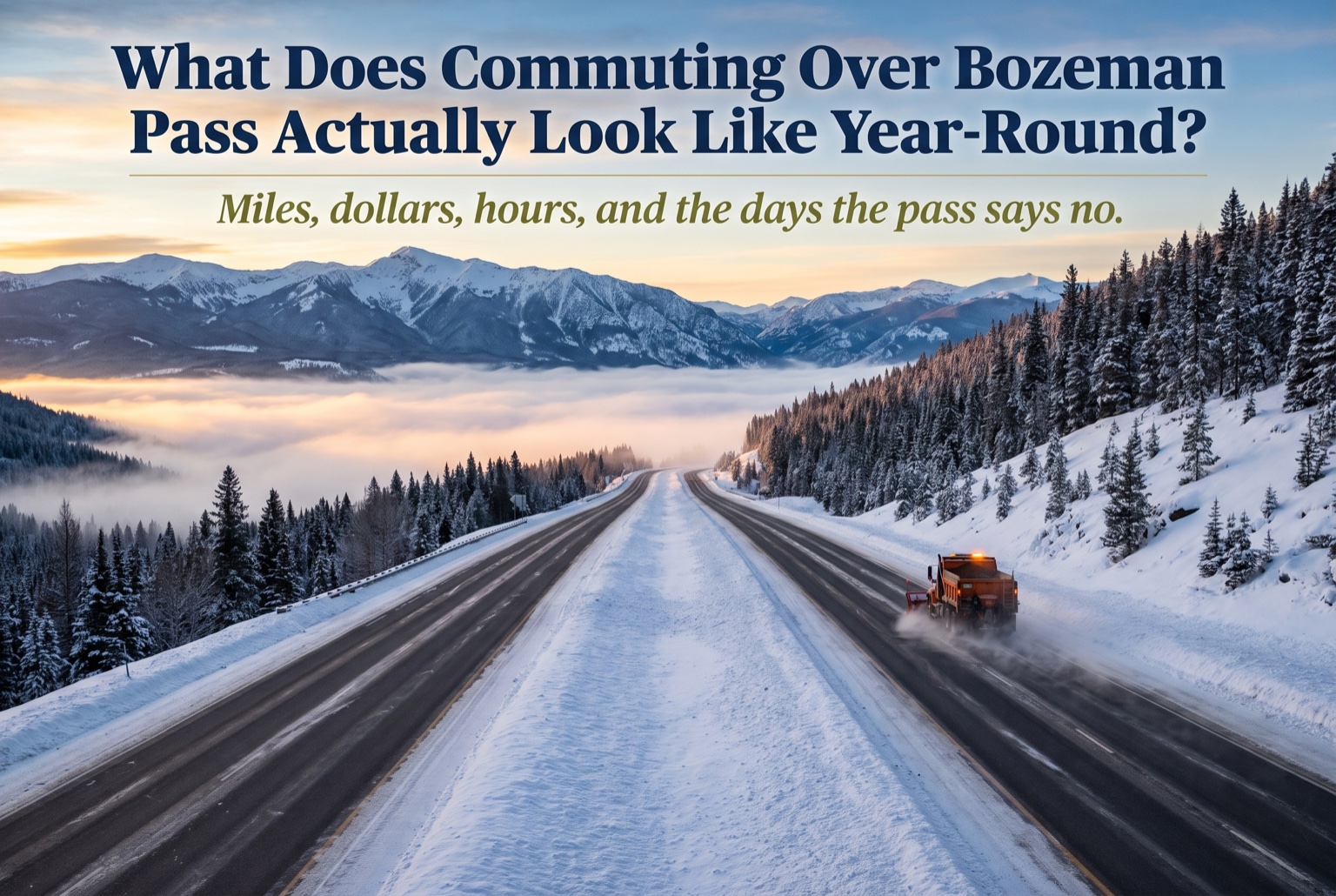
What Does Commuting Over Bozeman Pass Actually Look Like Year-Round?
Twenty-five miles of interstate, one 5,700-foot mountain gap, and a commute that is honest in July and demanding in January.
The short answer: The Bozeman-to-Livingston commute runs about 25 miles over Bozeman Pass, roughly half an hour in good conditions, and it works year-round for many households. It also crosses a genuine mountain pass that ices, drifts, and occasionally closes, past a wind zone MDT manages with its own detour plan. Decide with the winter version in mind, not the summer one.
Nancy Clark here, Broker and Owner at AmeriMont Broker Group in Manhattan, Montana. Every year, buyers priced out of Bozeman ask the same practical question: could we live on the other side of the pass and drive in? The answer is a real yes for some households and a quiet no for others, and the difference is almost never about the miles. Here is the commute itself, examined like the piece of infrastructure it is.
What Is Bozeman Pass, Exactly?
Bozeman Pass is the I-90 crossing between the Gallatin Valley and the Yellowstone River valley, topping out around 5,700 feet in the gap between the Bridger and Gallatin ranges, roughly midway between the two towns. The full city-to-city drive runs about 25 miles, and in dry conditions it takes around half an hour.
Two features make it more than an ordinary stretch of interstate. First, elevation: the summit sits well above both valley floors, which means the pass gets winter earlier, keeps it later, and catches snow that never falls on Main Street in either town. The Montana Department of Transportation operates a road weather information station at the summit itself, which tells you how seriously the state takes this specific piece of road. Second, the wind zone: the corridor near Livingston is, in MDT's own words, "prone to strong crosswinds and adverse conditions," strong enough that the state maintains a formal detour plan for it.
None of this makes the commute unusual by Montana standards. It makes it a mountain commute, and mountain commutes reward people who plan for them.
What Does the Commute Cost in Time and Money?
More than the gas gauge suggests, and the honest math is worth doing before you buy on the far side. Twenty-five miles each way is roughly 50 miles per commuting day. The IRS currently prices the all-in cost of operating a vehicle, fuel, wear, tires, depreciation, at 76 cents per mile for the second half of 2026, up from 72.5 cents at the start of the year. Use that as a cost proxy rather than a tax figure and the arithmetic is quick: about $38 per commuting day, all-in.
Here is what that compounds to, derived from the IRS per-mile figure and a 48-week year:
| Commute pattern | Miles per year (approx.) | All-in vehicle cost per year (approx.) | Hours on the road per year (approx.) |
|---|---|---|---|
| 5 days a week | 12,000 | $9,100 | 240 |
| 3 days a week | 7,200 | $5,500 | 145 |
| 2 days a week | 4,800 | $3,600 | 95 |
Round numbers, honestly labeled: your vehicle, fuel prices, and schedule will move them, and winter days run longer than the table assumes. The point of the table is the shape, not the pennies. A five-day pass commute costs on the order of a used car every few years and six full work-weeks of seat time annually. A two-or-three-day hybrid pattern changes the entire equation, which is why the rise of partial-remote work has quietly redrawn who this commute fits, a shift we covered from the other direction in how far is too far across the Gallatin Valley.
What Does Winter Actually Do to the Pass?
It turns a routine drive into a conditions-dependent one for roughly five months. From late fall through early spring, the pass ices, catches drifting snow, and sees the crash-and-closure cycle every Montana mountain corridor sees. Some winters are gentle. None are free. When conditions deteriorate, MDT's tools come out in sequence: reduced speeds and warnings on the dynamic message signs, restrictions on certain vehicles, and in the harder events, closures of the interstate itself while crews clear crashes or wait out wind and whiteout.
The Livingston end adds its own system. Because the corridor near Livingston is prone to strong crosswinds, MDT maintains a formal detour that reroutes traffic through Livingston for approximately six miles and back onto I-90, and the department "may determine at any time that certain vehicles, or all traffic must use the detour." In practice the wind protocols reach high-profile vehicles and towing units before general traffic, so anyone towing should assume they are restricted first in a wind event. MDT staff monitor conditions through road weather information system sites and push decisions to the signs and to the 511 traveler information system in real time.
For a commuter, the practical translation: most winter days the pass is simply a slower, more attentive version of the summer drive. Several times in a typical winter it becomes a wait, a detour, or a no-go, usually with warning, occasionally without much. The households that do this well are the ones whose Tuesday can absorb that without crisis.
How Do Pass Commuters Actually Manage It?
With habits, margins, and the state's own tools. The commuters who make this work for decades tend to run the same playbook. They check 511 and the MDT traveler information map before leaving, both directions, every winter day, and they treat the summit RWIS readings as the truth about conditions neither town can see. They run real winter tires, carry the emergency basics, and keep the tank above half from November through March. They build schedule margin on both ends, and they know in advance what happens at work and at home on the mornings the pass says no.
Just as important, they negotiate the commute before they buy the house. That means an honest conversation with the employer about late arrivals on closure mornings and remote work on warning days, and an honest household plan for school pickups and appointments that cannot wait an hour. The pass does not ask often. It asks eventually, and the households that answered the question in July handle January easily.
Who Does This Commute Fit, and Who Does It Break?
Fit and break follow schedule flexibility more than toughness. The commute fits schedules that can flex: partial-remote arrangements, employers with weather-sane cultures, work where a late start costs an apology rather than a shift. It fits households with a second driver or a fallback for the days one direction closes. And it fits people who genuinely do not mind driving, because 240 hours a year is a real number even when every one of them goes smoothly.
It grinds on fixed-shift schedules where a closed pass means a missed shift, on households where fixed morning obligations are precision-timed, and on anyone whose stress compounds with conditions they cannot control. None of that is a judgment about the people or the towns on either side. It is a compatibility question between a specific piece of geography and a specific weekly life, and it deserves the same honest audit as the mortgage math.
For buyers running that audit right now, two companion reads: our Livingston-versus-Bozeman comparison for the full two-town picture, and acreage near Bozeman without Bozeman pricing for the Gallatin-side alternatives that skip the pass entirely, since several of them solve the same affordability problem with a flatter drive.
The Bottom Line
Bozeman Pass is a real mountain commute wearing an interstate's clothing. In dollars, a five-day pattern runs on the order of $9,000 a year all-in. In time, about six work-weeks annually. In winter, it demands margins, tools, and a household plan for the mornings it says no. Plenty of households find that trade worth making, and the ones who stay happy with it decided with January numbers, not July ones.
Next Steps
- This week, drive the pass at your actual commute hour, both directions, and time it honestly.
- Run the table math against your real schedule: days per week, your vehicle, your winter fallback plan. Then ask your employer the closure-morning question out loud.
- Talk through both sides of the decision with Nancy. Whether the answer turns out to be east of the pass or a Gallatin-side alternative, the honest audit comes first. Email [email protected].
Frequently Asked Questions
How long is the commute from Livingston to Bozeman?
About 25 miles city to city over Bozeman Pass on I-90, roughly half an hour in good conditions. Winter conditions stretch that unpredictably, and the honest planning number for a year-round commuter is the winter version, with margin built in on both ends of the day.
How high is Bozeman Pass?
The summit sits at roughly 5,700 feet in the gap between the Bridger and Gallatin ranges, roughly midway along the 25-mile drive. Both valley floors sit well lower, which is why the pass gets winter earlier and keeps it later than either town.
Does Bozeman Pass close in winter?
It can and does, typically for crashes, drifting snow, or wind events, usually briefly and with warning through MDT's signs and the 511 system. Most winter days it is simply slower. A year-round commuter should plan for several disrupted mornings in a typical winter rather than zero.
What is the Livingston wind detour?
MDT's formal plan for the wind-prone corridor near Livingston: traffic is rerouted through town for approximately six miles and back onto I-90, and MDT may require certain vehicles or all traffic to use it at any time. High-profile vehicles and anyone towing should expect to be restricted first in wind events.
What does the pass commute cost per year?
Using the IRS's 76-cents-per-mile all-in vehicle cost as a proxy, a five-day pattern of about 50 miles per day runs on the order of $9,100 and 240 road-hours per year, a three-day pattern about $5,500, and a two-day pattern about $3,600. Your vehicle and schedule move the numbers; the shape holds.
How do I check pass conditions before driving?
Use Montana's 511 traveler information system and MDT's traveler map, which carry camera views, warnings, and restrictions, including the road weather station at the pass summit. Experienced commuters check both directions before leaving every winter day and trust the summit readings over either town's weather.
Is living east of the pass worth it to save money?
It can be, when the household's schedule can genuinely absorb a mountain commute and the all-in cost math still favors the move after vehicle expenses. Some households find Gallatin-side alternatives like Three Forks or Manhattan solve the same budget problem with a flatter drive, so run both versions before deciding.
Who handles the pass commute best?
Households with schedule flexibility: partial-remote workers, employers sane about weather mornings, a second driver or fallback plan, and a genuine tolerance for seat time. Fixed shifts, precision-timed mornings, and weather stress compound hardest, and that compatibility audit deserves the same rigor as the mortgage.
This article is general information, not legal, tax, or accounting advice. Nancy Clark and AmeriMont Broker Group are not a law firm or an accounting firm, and nothing here should be treated as advice from one. Laws, tax rules, and programs change, and they vary by state and by situation. Before acting on anything covered here, consult a licensed attorney and/or a certified public accountant in your state for current guidance on your specific circumstances.
Nancy Clark is the Broker and Owner of AmeriMont Broker Group, serving Manhattan, Amsterdam, Churchill, and communities across southwest Montana. With more than $135 million in closed sales and over a decade of experience in Montana real estate, Nancy brings the care of a neighbor and the skill of a seasoned professional to every transaction. Reach her at [email protected] or visit nancyclarkbroker.com.
Nancy Clark
Broker/Owner, AmeriMont Broker Group
Manhattan, Montana
[email protected]
nancyclarkbroker.com


