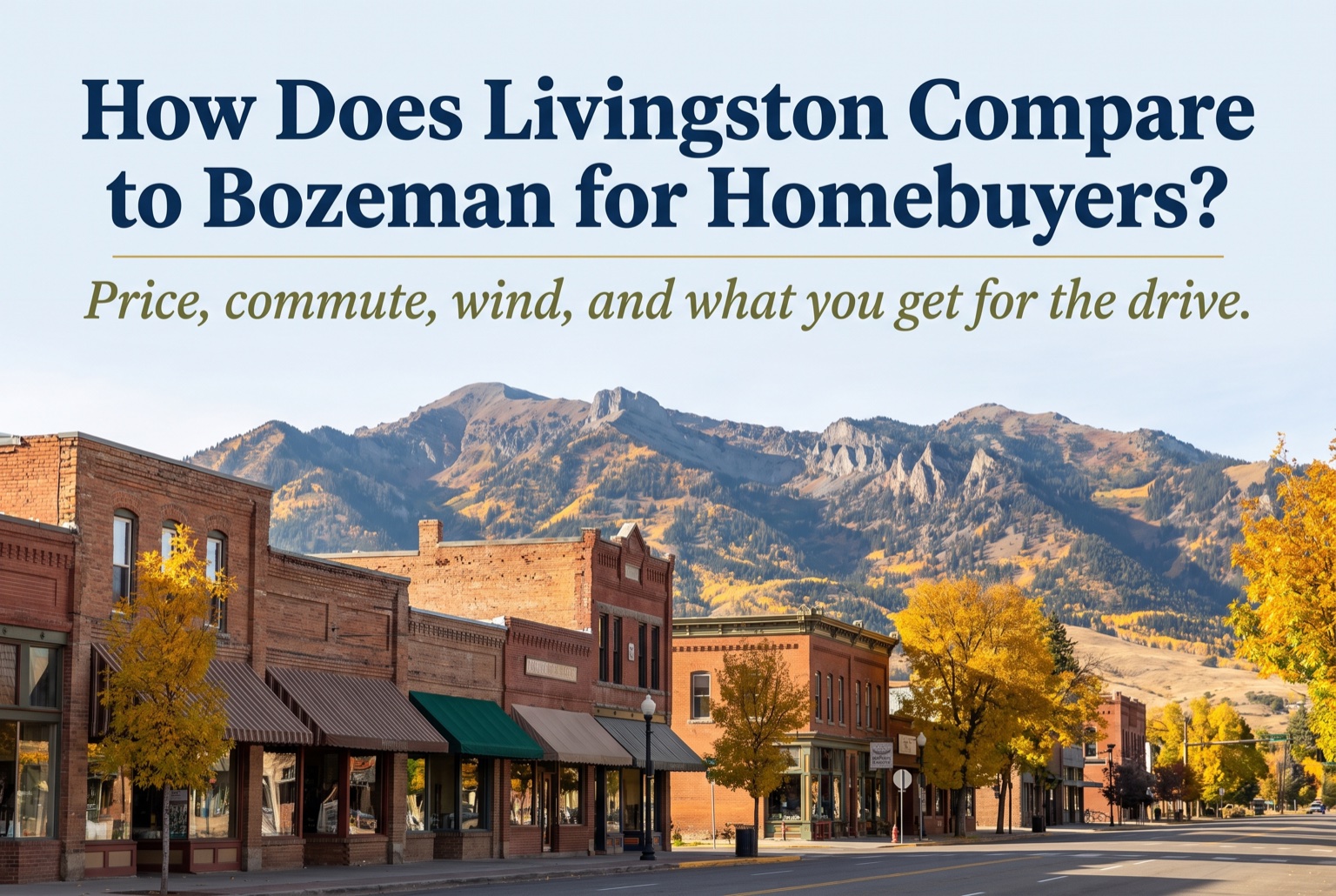
How Does Livingston Compare to Bozeman for Homebuyers?
Twenty-five miles, one mountain pass, and a price gap worth an honest conversation.
The short answer: Livingston costs meaningfully less than Bozeman, trades a college-town economy for a historic railroad-town character, and asks you to accept a mountain-pass commute and serious wind in exchange. Redfin's reported Livingston median was $438,737 in May 2026 against Bozeman's roughly $715,000 single-family median from early 2026, a gap large enough to change what kind of home you buy.
Buyers priced out of Bozeman ask Nancy Clark about Livingston almost weekly, and the question deserves more than "it's cheaper." The two towns sit 25 miles apart and live in different worlds: different county, different economy, different weather, different feel. Here is the side-by-side, followed by the honest verdicts.
| Livingston | Bozeman | |
|---|---|---|
| Median sale price | $438,737 in May 2026, all home types, per Redfin (small market, figures swing month to month) | Roughly $715,000 single-family and $480,000 condo in early 2026, per Montana Free Press |
| County | Park County (Livingston is the county seat) | Gallatin County |
| Commute between the two | About 25 miles on I-90 over Bozeman Pass, roughly half an hour in good conditions | Same drive, reversed |
| Wind | Frequent strong wind events in the colder months; gusts can top 45 mph | Comparatively calm |
| Hospital | Livingston HealthCare, a critical access hospital affiliated with Billings Clinic | Bozeman Health Deaconess, a regional medical center |
| Schools | Livingston Public Schools, including Park High School | Bozeman School District 7, two large high schools |
| Character | Historic railroad town, 1902 depot, arts and gallery downtown, gateway to Paradise Valley | Growing college town, MSU, larger retail and dining base |
What Does the Price Gap Actually Look Like in 2026?
Large, and larger than it used to be. Livingston homes sold at a median of $438,737 in May 2026, down 16.4 percent year over year, per Redfin's Livingston market data. Bozeman's single-family median ran about $715,000 in early 2026, with condos near $480,000, per Montana Free Press's housing report.
Two cautions before you treat that gap as a simple discount.
First, Livingston is a small market, and small markets produce jumpy statistics. A handful of high or low sales moves the monthly median dramatically, which is part of why the same year shows both a $438,737 month and higher quarters. Use the gap as a direction, not a precise number, and price the specific homes you are actually comparing.
Second, the gap buys different housing stock, not just more house. Much of Livingston's inventory is older: Victorian-era and early-1900s homes near the historic core, mid-century blocks, and a smaller ring of newer construction. Bozeman's inventory skews newer. An older home's charm arrives with an older home's furnace, wiring, and windows, so budget the inspection seriously. What the same dollars buy across the wider valley is mapped in what $400,000 to $600,000 actually buys across the Gallatin Valley.
What Is the Commute Between Livingston and Bozeman Really Like?
About 25 miles on I-90 over Bozeman Pass, roughly half an hour when conditions are good, and the conditions clause is doing real work in that sentence. This is a mountain-pass interstate commute in a place famous for wind, and anyone planning to live in Livingston and work in Bozeman should price the drive honestly.
The wind is not a local exaggeration. Livingston's wind is frequent and strong enough in late fall, winter, and early spring, with gusts that can top 45 mph, that the Montana Department of Transportation maintains a dedicated Livingston wind information page and at times restricts or detours high-profile vehicles on I-90. Winter adds snow and ice on the pass itself. Plenty of people make this commute for years without drama. They also check the forecast in a way a Belgrade commuter never has to.
The practical math: on a clear June morning, Livingston to downtown Bozeman is a pleasant 30-some minutes. On a January morning with a wind advisory, it can be slower, tense, or occasionally not worth attempting. Remote and hybrid workers feel this far less than daily commuters. How this drive compares with the other towns around the valley is laid out in the Gallatin Valley commute guide.
How Do Daily Services Compare?
Livingston covers the essentials on its own and leans on Bozeman for the rest. As Park County's seat, Livingston has its own hospital, schools, groceries, and a working downtown, which puts it well ahead of the valley's smaller towns for self-sufficiency.
Healthcare is the headline. Livingston HealthCare is a critical access hospital and trauma facility affiliated with Billings Clinic, with emergency care and a broad clinic practice in town. Specialist care often still means a drive to Bozeman or Billings, which is worth knowing for anyone managing an ongoing condition.
Schools are local. Livingston Public Schools runs the town's elementary and middle schools and Park High School, the largest high school in Park County. As always, research the schools directly through the district rather than through anyone's opinion, this post's included.
County logistics differ more than people expect. Livingston addresses deal with Park County for property taxes, permits, and services, not Gallatin County, and the two counties run different offices, rates, and processes. Verify anything tax- or permit-related with Park County directly rather than assuming the Bozeman answer travels east.
How Different Is the Character, Really?
Genuinely different, and that difference is the honest reason to pick one over the other. Livingston is a railroad town that became an arts town: the Northern Pacific built the 1902 depot that anchors downtown (designed by Reed and Stem, the architects behind New York's Grand Central Terminal), and the surrounding blocks of brick storefronts now hold galleries, bars, and restaurants with the Absaroka Range standing at the end of the street. It is the gateway to Paradise Valley and the Yellowstone River, and it feels like a town that finished its bones a century ago.
Bozeman is a college town in a growth spurt: Montana State University, a far larger retail and dining base, more employers, more services, and more construction. The energy is real and so is the pace of change.
Neither is the better town. They are different answers to the question of what you want outside your front door. Buyers who light up walking Livingston's Main Street tend to know it within an hour. So do the ones who miss Bozeman's options by the second day. The same character question, compared across the valley's other towns, is covered in how Manhattan, Belgrade, and Bozeman compare.
Livingston buyers self-select. Almost nobody ends up there by accident. The ones who choose it choose it hard, and the wind is the price of admission they stopped noticing years ago.
Which Buyers Fit Which Town?
Pick Livingston when the budget math or the character pulls you there and the commute math does not push you back. Pick Bozeman when daily proximity to work, MSU, or the valley's larger service base matters more than price.
Livingston makes sense when: your work is remote, hybrid, in Livingston itself, or flexible about the occasional bad-weather day; the price gap moves you from a compromise home to the right one; you want a historic home and a walkable, finished downtown; or Paradise Valley and the Yellowstone River are the landscape you actually came for.
Bozeman makes sense when: you commute daily to a Bozeman workplace and cannot absorb pass closures; you want newer construction and more housing inventory to choose from; you need the larger hospital and specialist base close by; or your daily life runs through MSU, the airport, or Bozeman's retail and dining.
The tiebreaker most buyers miss: spend a windy day in Livingston before you decide. Not a postcard summer Saturday. A February Tuesday. The town's charm is durable, and so is the weather, and both belong in the decision.
When Should You Pick Neither?
When the real driver is price and the commute still matters, look at Belgrade, Manhattan, or Three Forks before leaving the Gallatin Valley. All three sit closer to Bozeman than Livingston does, without a mountain pass, and all three price below Bozeman. Belgrade keeps freeway access and the airport at hand, Manhattan trades size for a tight small-town center, and Three Forks stretches the dollar furthest. For buyers chasing land specifically, the per-acre comparison across these towns lives in where to find acreage near Bozeman without Bozeman pricing.
Livingston earns the drive when Livingston itself is the point. If it is only a discount, the valley towns west of Bozeman usually serve the same budget with an easier daily life.
The Bottom Line
Livingston offers a real price advantage, a hospital and schools of its own, and a historic character Bozeman cannot manufacture, in exchange for a 25-mile mountain-pass commute and some of the most persistent wind in Montana. Bozeman offers proximity, inventory, and services at Bozeman prices. The gap is roughly $275,000 at the 2026 medians cited above, and what that buys you is not just square footage, it is a different town. Decide which town you are actually choosing, visit both in bad weather, and let the honest version of your weekly routine make the call.
Next Steps
If Livingston is on your list, do the two-day test: one day walking downtown, the depot, and the neighborhoods, and one day making the Bozeman drive at your real commute hour. Then price three actual homes in each town, not the medians.
Nancy can set up both sides of that comparison, including the older-home inspection questions Livingston properties deserve. Reach her at [email protected] and tell her what your weekly routine actually looks like. The right town falls out of that conversation faster than out of any listing search.
Frequently Asked Questions
How much cheaper is Livingston than Bozeman?
Livingston's median sale price was $438,737 in May 2026, per Redfin, against Bozeman's roughly $715,000 single-family median in early 2026, per Montana Free Press. That is a gap in the $250,000 to $280,000 range, though Livingston's small market makes monthly medians swing, so compare specific homes rather than headline numbers.
How long is the drive from Livingston to Bozeman?
About 25 miles on I-90 over Bozeman Pass, roughly half an hour in good conditions. Wind and winter weather can slow the drive, and the Montana Department of Transportation at times restricts or detours high-profile vehicles near Livingston during high-wind events. Daily commuters should plan around the forecast in the colder months.
Is the wind in Livingston really that bad?
It is real. Strong wind events are frequent in late fall, winter, and early spring, with gusts that can top 45 mph, and MDT maintains a dedicated wind information page for the Livingston stretch of I-90. Many residents adjust and stop noticing. Visit on a windy day before buying, because the weather is part of the purchase.
Does Livingston have its own hospital?
Yes. Livingston HealthCare is a critical access hospital and trauma facility affiliated with Billings Clinic, with emergency care and clinic services in town. Specialist care often means a trip to Bozeman or Billings, which buyers managing ongoing medical needs should factor into the decision.
What schools serve Livingston?
Livingston Public Schools operates the town's elementary and middle schools and Park High School, the largest high school in Park County. Research the schools directly through the district's own site and visits, and confirm enrollment details with the district office before making an address decision around them.
Is Livingston in the Gallatin Valley?
No. Livingston sits east of Bozeman Pass in Park County, along the Yellowstone River at the mouth of Paradise Valley. That means a different county government, different property tax bills, and different offices for permits and services than Gallatin Valley towns. Verify county-specific questions with Park County directly.
Is Livingston a good investment compared to Bozeman?
They behave differently: Livingston is a smaller, more volatile market with older housing stock, while Bozeman is larger and steadier with more inventory. Neither is automatically the better hold. Buy the town that fits your life and budget, get a thorough inspection on older homes, and treat appreciation as a bonus rather than the plan.
This article is general information, not legal, tax, or accounting advice. Nancy Clark and AmeriMont Broker Group are not a law firm or an accounting firm, and nothing here should be treated as advice from one. Laws, tax rules, and programs change, and they vary by state and by situation. Before acting on anything covered here, consult a licensed attorney and/or a certified public accountant in your state for current guidance on your specific circumstances.
Nancy Clark is the Broker and Owner of AmeriMont Broker Group, serving Manhattan, Amsterdam, Churchill, and communities across southwest Montana. With more than $135 million in closed sales and over a decade of experience in Montana real estate, Nancy brings the care of a neighbor and the skill of a seasoned professional to every transaction. Reach her at [email protected] or visit nancyclarkbroker.com.
Nancy Clark
Broker/Owner, AmeriMont Broker Group
Manhattan, Montana
[email protected]
nancyclarkbroker.com


