What Should Buyers Know About Gallatin River Ranch in 2026?
A 5,900-acre ranch community north of Manhattan, parcels of 20 acres and up, wells that run hundreds of feet, and an association that plows the roads. Here is the place as it reads on paper, before you drive out to see it.
Gallatin River Ranch comes up in almost every conversation with a buyer who wants acreage near Manhattan, Montana, and most of what they have heard is a sentence or two. This guide is for anyone weighing a parcel or a home there: what the ranch is, what the association does and charges, how water and septic work, who answers the fire call, and what sellers are asking this month.
The short answer: Gallatin River Ranch is a private residential ranch community in the Horseshoe Hills north of Manhattan, roughly 5,900 acres divided into parcels of 20 to 60 acres, with about 2,000 acres of common land and 2.5 miles of Gallatin River frontage. The association describes every parcel as served by its own well and septic system, the roads are gravel and stay that way, and a homeowners association established in 1995 maintains and plows those roads. A volunteer rural fire district covers the ranch. As of late September 2026, the community's own listing page shows nine roughly 20-acre parcels asking $245,000 to $635,000 and three homes asking $1,325,000 to $4,290,000. What follows is the detail behind each of those sentences, with the document it came from.
What Is Gallatin River Ranch?
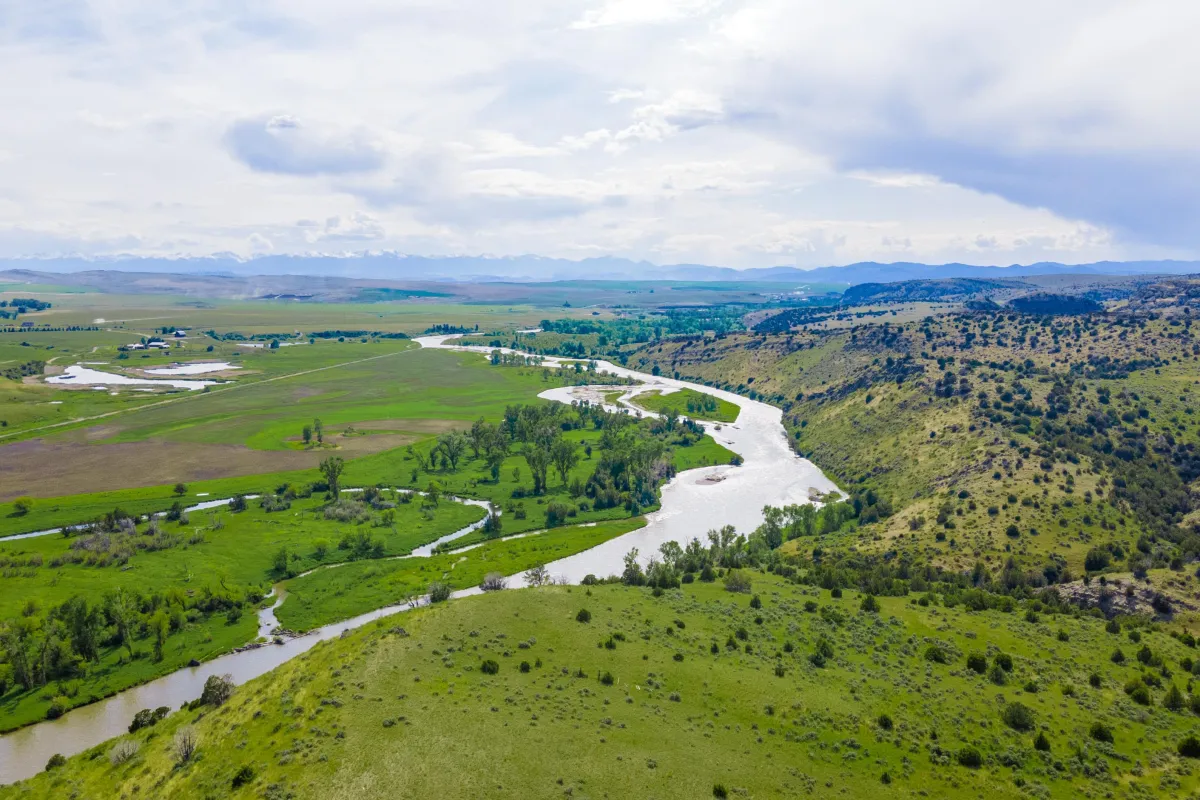
Gallatin River Ranch is a residential ranch community of about 5,900 acres in the Horseshoe Hills north of Manhattan, bordered on the south by the Gallatin River. Parcels run 20 to 60 acres, more than 2,000 acres are dedicated common area, and the ranch holds about 2.5 miles of river frontage. It is a census-designated place, with a homeowners association dating to 1995.
The community's own site describes it as a 5,900(+/-) acre residential ranch community of individual 20 to 60 acre parcels of varying topography, at 3200 Nixon Gulch Road. The homeowners association's site adds that over 2,000 acres of the ranch is dedicated common area that will never be developed, and that owners have private access to 2.5 miles of the Gallatin River. Nearly every parcel I have walked out there sits at 20 acres and change, which matches the listing page.
The Census Bureau also draws a Gallatin River Ranch census-designated place, a statistical boundary that need not match the association's. Census Reporter's profile of it shows about 7.1 square miles of land and an estimated 127 residents in the 2024 five-year American Community Survey estimate. That is a small full-time population on a lot of ground, which is the point of the place.
Manhattan is my home base, and the ranch is where a buyer with a horse trailer, a drift boat, or a wish for distance between houses ends up looking. It is not a subdivision with a paved loop and a clubhouse, and the rest of this guide is the practical side of that difference.
| Item | What the documents say | Source |
|---|---|---|
| Size | About 5,900 acres; parcels 20 to 60 acres; over 2,000 acres common area | Community site; HOA site |
| River | About 2.5 miles of Gallatin River frontage, private access for owners | HOA site; community site |
| Population | Estimated 127 residents on 7.1 square miles in the census-designated place (2024 ACS five-year estimate) | Census Reporter |
| Association | Established 1995; enforces covenants, maintains and plows roads, weed and litter control | HOA welcome packet (Dec. 2018) |
| Assessment | $1,200 per year in the 2018 welcome packet; confirm the current figure | HOA welcome packet (Dec. 2018) |
| Roads | Private, gravel, and per the HOA "will remain so"; 25 mph | HOA building page; welcome packet |
| Water | Private wells only; 350 to 1,000 feet per the HOA building page, to 1,500 in the packet; hard water | HOA building page; welcome packet |
| Sewer | Individual septic systems; county wastewater permit required before installation | HOA building page; Gallatin City-County Health Dept. |
| Utilities | Propane; no municipal water, sewer, gas, or cable; wireless or satellite internet | HOA welcome packet; building page |
| Fire | Gallatin River Ranch Rural Fire District, formed Dec. 14, 1999; all-volunteer; Station 1 at 480 Equestrian Center Loop Road | GRRRFD site |
| Schools | Manhattan School District #3; district buses stop at the ranch entry | District site; welcome packet |
Where Is Gallatin River Ranch, and How Long Is the Drive?
The ranch sits on Nixon Gulch Road, north of Manhattan and Interstate 90, in the Horseshoe Hills. The community's own page puts the Bozeman airport at about 20 minutes and Bozeman at about half an hour on I-90. Those are the developer's figures, so check them in a mapping app at the hour you would drive them, in winter.
The entry is at 3200 Nixon Gulch Road, Manhattan, Montana 59741. The Life on the Ranch page states that Manhattan is only minutes away, that Bozeman is within an easy half-hour's drive on I-90 East, and that the Bozeman/Yellowstone International Airport is 20 minutes away. Treat these as a seller's estimate. The commute post on this site, how far is too far across the Gallatin Valley, explains why a summer drive time and a January drive time on the same road are two different numbers.
One landmark on the same road matters to a buyer. Montana Fish, Wildlife and Parks' Gallatin Forks Fishing Access Site is reached from I-90 at Manhattan, milepost 288, then 2 miles north on Nixon Gulch Road: 270.48 acres, a gravel boat ramp, day use only, and a 10-foot trailer limit at the Nixon Bridge access. It is the public fishing access site on the ranch's road and the launch point for anyone floating past the ranch. Garbage service on the ranch is by private hauler, per the HOA packet, with the county's Logan Landfill at 10585 Two Dog Road, Manhattan.
The grocery store, the schools, and the post office are in Manhattan, a gravel road and a bridge away; town itself is covered in my guide to what makes Manhattan different from the other small towns in the valley.
What Does the Homeowners Association Do, and What Does It Charge?
The Gallatin River Ranch Homeowners Association, a nonprofit established in 1995, enforces the covenants, maintains the private roads, plows them, controls roadside weeds, and picks up litter. Its December 2018 welcome packet listed an annual assessment of $1,200, payable yearly or quarterly. Exterior changes go through an Architectural Review Committee, with review fees of $25 to $250 in that packet.
Ownership carries membership, per the packet. The association's welcome packet, dated December 24, 2018, states that the HOA was established in 1995, that it is a nonprofit organized under Section 501(c)(4), and that it is responsible for enforcement of covenants, road maintenance, road snow removal, roadside weed abatement, and litter control. Law enforcement is the Gallatin County Sheriff; the ranch offers no security services.
The money, as of that packet: an annual assessment of $1,200, paid yearly by January 1 or quarterly before the first of January, April, July, and October. Members behind on the assessment lose their vote. The packet is eight years old, so ask the management company for the current assessment, the current budget, and any special assessment history before your contingency period ends. The HOA post on this site lists the documents to request from any association in the valley; most of them apply here, and the management company can add whatever this association requires.
Rules a buyer should know before falling for a parcel, all from the same packet:
- Exterior improvements go to the Architectural Review Committee before the project starts, with fees of $25 to $250 in the packet. Per the HOA's building page, construction cannot begin until the ARC approves the plans, and a project must be complete within 18 months after it begins.
- Roads carry a 25 mph limit, and vehicles, trailers, and campers must be screened from view of neighbors, roads, and common areas.
- No hunting, trapping, or discharge of firearms unless authorized by the board. ATVs stay on roads; mountain biking is on ranch roads only and limited to owners.
- Renting a property, running a bed and breakfast, or housing a caretaker requires a written request and written board approval.
- Owners handle noxious weeds on their own land. The HOA plows the road; the driveway is yours, or the ranch crew will plow, spray, mow, or grade it for a charge on your HOA bill.
Each parcel carries one vote, the board meets quarterly, and the annual meeting is the second weekend in August. Read the recorded covenants, not this summary, before you rely on any of it.
How Do Water, Septic, and Utilities Work on a 20-Acre Parcel?
The association describes every home on Gallatin River Ranch as served by its own well and its own septic system, and the listings I have walked match that; confirm the arrangement for your parcel in the recorded documents. The HOA's building page puts wells at 350 to 1,000 feet deep, its welcome packet stretches the top of that range to 1,500 feet, and both documents call the water hard. There is no municipal water, sewer, gas, or cable; heat is propane, and internet is wireless or satellite.
The HOA's building page is direct: you will need a well, GRR wells range from 350 to 1,000 feet in depth, well water has a high mineral content, and most residents install a central reverse osmosis system. The welcome packet gives the depth range as 350 to 1,500 feet and adds that wells may require shocking from time to time to eliminate bacteria. The same page says you cannot hook up to municipal water, sewer, cable TV, DSL, or gas, that the roads are unpaved and will remain so, and that power outages are frequent enough that the HOA recommends battery backup for a computer. Read that as the association's own description of daily life, not a criticism.
Depth has nothing to do with whether a well needs a water right; rate and volume do. Under Montana Code 85-2-306, a well outside a stream depletion zone that pumps 35 gallons a minute or less and no more than 10 acre-feet a year is exempt from the permit requirement, subject to the statute's other conditions, and the owner files a notice of completion within 60 days of putting the water to use. Inside a legally designated stream depletion zone the same statute sets the limits at 20 gallons a minute and 2 acre-feet a year; proximity to the river does not put a parcel in one, so ask DNRC whether the parcel is. Depth is the cost question: drilling scales with feet, two parcels on the same road can differ by tens of thousands of dollars, and a quote from a driller who has worked the ranch belongs in the price of any vacant lot. For an existing home, pull the well log from the state's Ground Water Information Center, which holds logs for most wells in Montana, and have the water tested. The Gallatin City-County Health Department's private well guidance recommends testing once each year for total coliform bacteria and nitrates, with kits available through the Gallatin Local Water Quality District. The district's Well Educated program offers subsidized testing, but its page says it cannot be used for testing associated with a real estate transaction, so budget for a lab test of your own during due diligence.
Septic follows the county's rules regardless of covenants. The health department states that a local wastewater treatment system permit is always required before a system is installed, that site evaluations must be performed by a Gallatin County registered site evaluator or a Montana-licensed professional engineer, and that a registered installer must be on site during installation. The HOA's building page reports that soil around the ranch generally perks well. For a resale, look up the existing permit through the county's septic permit records search, which covers permits issued since 1966, and compare the permitted bedroom count to the house you are buying. My post on well and septic systems for valley buyers walks through both inspections.
One more detail from the packet: mail is not delivered to the door. Residents use USPS boxes at the ranch entry, and package carriers deliver to the house.
What About Horses, Riding, and the River?
Horses are the community's organizing idea. A privately run equestrian center inside the ranch offers boarding in a 40-stall barn with a 100 by 200 foot indoor arena and a 120 by 250 foot outdoor arena, and boarders may ride the ranch roads and trails. Owners keep horses on their own parcels under the recorded covenants. The association describes its river access points as private, though the water itself is public below the high-water mark.
The equestrian center's page describes a facility run as a private business: a 40-stall barn, a 100' x 200' indoor arena, a 120' x 250' outdoor arena, two 60' round pens, a heated wash room, a farrier's stall, and a heated vetting area with stocks, with instruction offered across disciplines. The HOA packet confirms that equestrian center boarders are permitted to ride on ranch roads and trails under the riding guidelines, and it adds a point worth reading twice: there are no official ranch trails. The obvious trails exist from past use, cross private parcels, and are not marked, maintained, or inspected.
Keeping horses at home is governed by the recorded covenants, including the number of animals a parcel may carry and how they are fenced, so read the recorded CC&Rs rather than a marketing summary. Stocking math on dry ground north of Manhattan is its own subject, covered in my post on what to look for in a horse property in the Gallatin Valley; the short version is that 20 acres of unirrigated hills is a dry lot with hay, not a season of pasture.
On the river: the association's private access means the entry points are private. Under Montana's Stream Access Law, surface waters capable of recreational use may be used by the public up to the ordinary high-water mark without regard to who owns the bed, subject to the statute's conditions, and the public may not cross private land to reach them. On the ranch's 2.5 miles, that means anglers who launched at Gallatin Forks may float and wade past the common area, and may not walk up through it. A buyer who wants the water to themselves should understand that distinction before paying for frontage.
Who Answers a Fire or Medical Call on the Ranch?
The Gallatin River Ranch Rural Fire District, formed by the Gallatin County Commission on December 14, 1999, covers about 9 square miles, 90 structures, and a full-time population of about 150. It has been all-volunteer since spring 2017, runs from Station 1 at 480 Equestrian Center Loop Road, and has an automatic aid agreement with the Manhattan Volunteer Fire Department.
The district's own site states that it was established in December 1999 by the county commission, that it covers about 9 square miles, 90 structures, and a full-time population of about 150, and that the department members are all unpaid volunteers. Its history page records the founding resolution, Resolution 1999-82 of December 14, 1999, and the shift to an all-volunteer model in the spring of 2017. Manhattan's volunteer department automatically responds to all fires on the ranch under the aid agreement, and the district runs a wildland fire preparedness program for owners.
Why this is in a buyer's guide: an insurer asks the distance to the responding station and the department's protection class before quoting a home on 20 acres of grass and juniper, and the answer shapes the premium. Ask the district for its current response and rating information, get the quote before your contingency ends, and ask what the current owner has done for defensible space.
What Do Parcels and Homes Cost at Gallatin River Ranch Right Now?
As of September 28, 2026, the community's listing page shows nine vacant parcels of 19.67 to 20.53 acres asking $245,000 to $635,000, three homes on 20 to 22 acres asking $1,325,000 to $4,290,000, and one 1,583.5-acre ranch tract at $15,500,000, which the page shows twice, once as farm and once as land. These are asking prices from one source on one day, not sales, and a buyer prices an offer from closed comparables.
The figures come from the properties-for-sale page on the community's site, which lists an MLS number for each. Five of the nine vacant parcels ask between $245,000 and $325,000; the higher asks are $365,000, $525,000, and $635,000. The three homes, with the square footage the page gives, work out to roughly $444, $384, and $656 per square foot at their asking prices, as the table shows. Asking price per square foot is not a comparable-sales metric, and a snapshot from the seller's own page needs each listing's status confirmed in the MLS. Asks at this price point often sit for months and close below list; my post on what $1 million buys across the Gallatin Valley has the county's sales figures for context.
| Listing (community listing page, Sept. 28, 2026) | Acreage | Finished sq ft | Asking price | Ask per sq ft |
|---|---|---|---|---|
| Nine vacant parcels | 19.67 to 20.53 acres | n/a | $245,000 to $635,000 | n/a |
| 90 Fawn Meadow | 22.31 acres | 2,986 | $1,325,000 | about $444 |
| 6076 Nixon Gulch Road | 20.41 acres | 3,776 | $1,450,000 | about $384 |
| 1240 Twin River Cutoff | 20.53 acres | 6,537 | $4,290,000 | about $656 |
| Ranch tract, Nixon Gulch Road | 1,583.5 acres | n/a | $15,500,000 | n/a |
Two cost lines sit outside the price. A vacant parcel typically needs a well of several hundred feet, a permitted septic system, a driveway, power to the building site, and ARC approval before the exterior work starts; each is quoted per parcel, and the spread between two lots can be tens of thousands of dollars. And a home that is not the owner's principal residence does not qualify for Montana's reduced homestead rate, which the homestead tax post explains with the Department of Revenue's tiers.
What Should You Check Before Writing an Offer?
Read the recorded covenants, get the current assessment and minutes from the association, pull the well log and septic permit, confirm zoning with the county, and price fire insurance. Start all of it this week, because agencies, labs, and insurers set their own clocks, and none of it should wait for the inspection period.
- Request the recorded CC&Rs, the ARC guidelines, the current assessment, the budget, and the last year of board minutes through the property management company named on the association's site. Read the animal, rental, and screening rules against how you plan to live.
- Pull the well log from the state's Ground Water Information Center by owner name or location, note the depth and the yield, and schedule a bacteria and nitrate test with a lab during your contingency.
- Look up the septic permit in the county's records search and match the permitted design to the house. For a vacant parcel, hire a registered site evaluator before you close.
- Confirm zoning and permits with the county, not with the covenants. The county planning department handles zoning outside city limits, and its planning FAQ states that land use permits are required in all of its zoning districts, before construction of most structures. The county's zoning regulations page lists its districts by name, and a community name is not itself a zoning district, so ask the planning office for the parcel's designation rather than assuming there is none. The recorded covenants sit on top of whatever public rules apply. On building permits, the same FAQ is direct: Gallatin County does not issue building permits, and it sends projects outside Belgrade and Bozeman to the state building department in Helena. Montana's list of certified local code programs names six counties, none of them Gallatin, plus the cities and towns that enforce codes inside their own limits. So the questions for a house on the ranch are which state permits and inspections apply, answered by the state Building Codes Program; which county approvals apply, such as land use, septic, floodplain, and driveway access, answered by the county; and what your own inspector and lender require beyond both.
- Get a homeowners insurance quote in writing with the fire district's station distance disclosed, before the contingency deadline, not after.
- Drive the road in the conditions you will live in. Gravel, 25 mph, plowed by the association, with your driveway plowed by you or by the ranch crew for a fee.
- Walk the parcel with the bus stop, the mailboxes, and the equestrian center in mind, since each is at or near the entry, and a parcel at the far end of the ranch is a different daily routine. Manhattan School District #3 runs K-5, 6-8, and 9-12 schools, and the 2018 HOA packet says district buses stop at the ranch entry; confirm current transportation with the district.
The Bottom Line
Gallatin River Ranch is a large-parcel community that runs on its own well, its own septic, propane, a gravel road plowed by the association, and a volunteer fire district. The agency records are searchable, the association's documents come on request, and the current asks range from a quarter million for 20 acres of hills to several million for a finished home. A buyer who reads the covenants, the well log, and the septic permit before the offer, and who prices the well and the insurance for that specific parcel, will know what the place costs to own and not just what it costs to buy. That is the conversation I would rather have on the front end, over a map of the ranch, than on the back end.
Frequently Asked Questions
How big are the lots at Gallatin River Ranch?
The community's site and its homeowners association both describe parcels of 20 to 60 acres on a ranch of about 5,900 acres, with over 2,000 acres of common area. The listing page on September 28, 2026 showed nine vacant parcels between 19.67 and 20.53 acres, so most available lots sit right at 20 acres.
What are the HOA dues at Gallatin River Ranch?
The association's December 2018 welcome packet listed an annual assessment of $1,200, payable yearly by January 1 or quarterly. That figure is eight years old, so ask the management company for the current assessment, the budget, and any special assessment history before your contingency period ends.
Does Gallatin River Ranch have city water and sewer?
No. The association describes every home as served by a private well and an individual septic system. The HOA's building page puts wells at 350 to 1,000 feet, its welcome packet says up to 1,500, and both call the water hard. The Gallatin City-County Health Department requires a wastewater treatment system permit before a septic system is installed.
How far is Gallatin River Ranch from Bozeman and the airport?
The community's own page puts the Bozeman airport about 20 minutes away and Bozeman about half an hour on I-90 East. Those are the developer's estimates; check them in a mapping app at the hour and season you would drive, since Nixon Gulch Road is gravel inside the ranch and winter adds time.
Can you keep horses at Gallatin River Ranch?
Yes. Owners keep horses on their parcels under the recorded covenants, which set the animal and fencing rules, and a privately run equestrian center on the ranch boards horses in a 40-stall barn with indoor and outdoor arenas. Read the recorded CC&Rs for the number of animals a parcel may carry.
Is the river at Gallatin River Ranch private?
The access is private; the water is not. Owners have private access to about 2.5 miles of the Gallatin River, but under Montana's Stream Access Law the public may use a river capable of recreational use up to the ordinary high-water mark, subject to the statute's conditions, and may not cross private land to reach it.
Who provides fire protection at Gallatin River Ranch?
The Gallatin River Ranch Rural Fire District, formed by the county commission on December 14, 1999, covers about 9 square miles and 90 structures with an all-volunteer department based at 480 Equestrian Center Loop Road. It has an automatic aid agreement with the Manhattan Volunteer Fire Department. Ask your insurer how the station distance affects your premium.
Does Gallatin County issue building permits for homes at Gallatin River Ranch?
No. The county's planning FAQ says Gallatin County does not issue building permits and directs projects outside Belgrade and Bozeman to the state building department in Helena, which is where to ask which state permits and inspections apply to a house on the ranch. The county health department requires a septic permit, and the association requires Architectural Review Committee approval before construction begins.
This article is general information, not legal, tax, or accounting advice. AmeriMont Broker Group is not a law firm or an accounting firm, and nothing here should be treated as advice from one. Laws, tax rules, and programs change, and they vary by state and by situation. Before acting on anything covered here, consult a licensed attorney and/or a certified public accountant in your state for current guidance on your specific circumstances.
Nancy Clark is the Broker and Owner of AmeriMont Broker Group, serving Manhattan, Amsterdam, Churchill, and communities across southwest Montana. With more than $135 million in closed sales and over a decade of experience in Montana real estate, Nancy brings the care of a neighbor and the skill of a seasoned professional to every transaction. Reach her at [email protected] or visit nancyclarkbroker.com.
Nancy Clark
Broker/Owner, AmeriMont Broker Group
Manhattan, Montana
[email protected]
nancyclarkbroker.com


