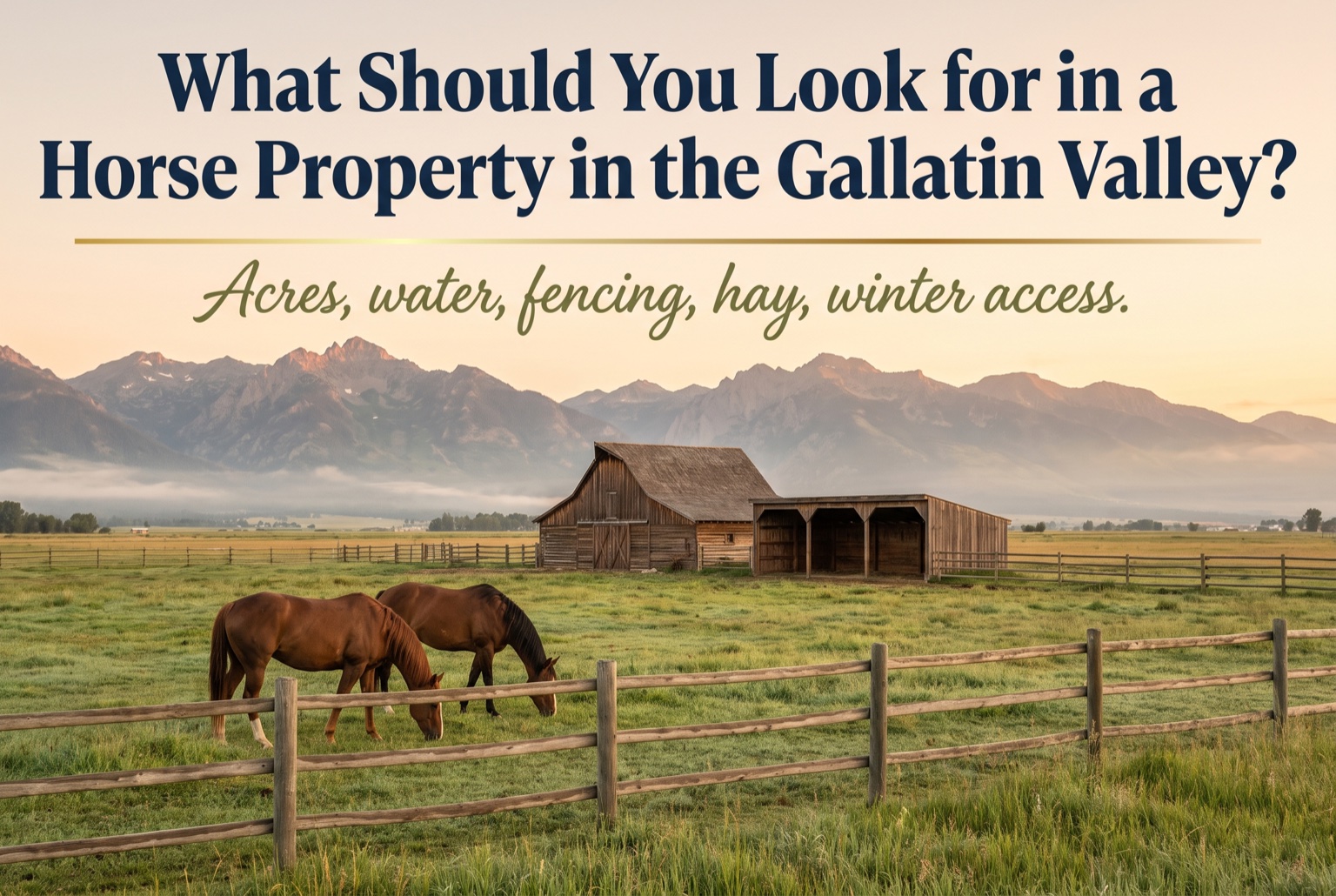
What Should You Look for in a Horse Property in the Gallatin Valley?
Acreage is the headline. Water, fencing, hay, and winter access are the property.
The short answer: A workable Gallatin Valley horse property needs five things checked in order: enough usable land for how you will actually keep horses, a well and water setup that can carry stock through August, horse-safe fencing, honest outbuildings, and winter access for you and the hay truck. The internet's two-acres-per-horse rule was not written for Montana.
Nancy Clark here, Broker and Owner at AmeriMont Broker Group in Manhattan, Montana. Horse properties are some of the most satisfying sales in this valley and some of the easiest to buy wrong, because the pretty parts show in photos and the important parts live in well logs, covenants, and stocking math. Here is the walkthrough, in the order that saves buyers money.
How Many Acres Do You Actually Need Per Horse?
More than the internet says, if you expect the land to feed the horse. Montana State University's range program suggests initial stocking rates for seeded pasture of 1.0 acre per animal unit month in the 15 to 19 inch precipitation zone and 1.5 to 2.0 acres per AUM in the 10 to 14 inch zone, with native rangeland needing roughly twice that, per MSU Extension's grazing management guidance. An animal unit is a 1,000-pound animal, and most horses weigh more, so treat what follows as minimums.
Run that math honestly, using MSU's spring-pasture stocking rates as a yardstick, and the popular "two acres per horse" rule collapses for our climate. At 1.5 to 2.0 acres per animal unit month on dryland seeded pasture in the drier parts of the valley, supporting one horse on grazing alone for even six months is on the order of 9 to 12 acres, and native range needs more. Irrigated pasture, which many valley parcels have, supports far higher stocking and changes the math entirely, which is one more reason the site-specific answer beats the rule of thumb. Either way, the pattern holds: many working horse setups here are not grazing operations at all. They are a dry lot or small pasture plus purchased hay for much of the year, and the land question becomes "enough room to keep horses well" rather than "enough grass to feed them."
Both models work. What fails is buying five acres expecting it to feed three horses year-round. If self-sufficient grazing is the dream, size the land for it with help from the local MSU Extension office or NRCS, who run site-specific numbers for free. If the dry-lot-plus-hay model fits your life, five usable acres can be a fine horse property, and the checklist below matters more than the acre count.
Will the Water Actually Carry Horses?
Budget roughly 5 to 10 gallons per horse per day before you believe any listing that says "great well." MSU Extension's winter horse care guidance puts normal adult consumption at 5 to 8 gallons a day, rising to 9 to 10 gallons when horses are on full hay rations in cold weather, which in this valley is most of the winter. Three horses can mean 30 gallons a day of stock water on top of the house.
Then check the legal side, because volume and rights are different questions. Many rural wells operate under Montana's permit exception, which caps use at 35 gallons a minute and 10 acre-feet a year outside stream depletion zones, with combined appropriations from the same source counted together, under MCA 85-2-306. A house, a horse barn, stock tanks, and lawn irrigation all pull from the same math. For most small horse setups the numbers work, but verify rather than assume, and if the property advertises irrigation or a ditch, that is a water rights question deserving its own diligence. Our guides to well and septic systems and how water rights work when you buy land in Montana cover both halves.
Practical checks while touring: where the frost-free hydrants are, whether stock tanks have power for winter heaters, and what the well log says about flow. Water that requires hauling buckets through a Montana January is a lifestyle few buyers keep.
What Fencing Is Actually Safe for Horses?
Look past whether fencing exists to what it is made of, because horses and cattle fencing are not interchangeable. Extension guidance is blunt about the biggest issue: barbed wire should never be used for horse fencing, because its poor visibility and sharp edges make serious injury highly likely, per university extension fencing guidance. Horses also carry thinner skin than cattle and tend to panic when a leg gets trapped, which is how entanglements end careers. A great deal of Gallatin Valley acreage is fenced for cattle, which means a "fenced" horse property may need refencing.
The safe categories: woven or V-mesh wire, board or rail, pipe, and coated high-tensile systems. The guidance runs 5 feet minimum for perimeter fencing, taller for breeds that jump, with interior cross-fencing as low as 4.5 feet. Each has its price point and maintenance profile, and refencing a perimeter is a real number worth bidding before you offer, not after. While walking the fence line, note the gates (wide enough for a trailer and a tractor), the corners (safe or acute), and anything the previous owner improvised with T-posts and hope.
What Are the Outbuildings Really Worth?
Price the barn by what it would cost you to solve the same problems, not by what the listing implies it adds. Horse buyers pay for solved problems: dry hay storage, safe stalls or loafing sheds, a tack room that locks, power and water to the barn, and workable footing between buildings in mud season. A tight, boring pole barn that keeps twenty tons of hay dry is worth more to your horses than a beautiful show barn with no ventilation.
On hay specifically, the storage question is the money question. A 1,000-pound horse eats 15 to 20 pounds of hay a day per MSU Extension, which over a six-month feeding season is a ton and a half to nearly two tons per horse, and hay stored outside loses quantity and quality to weather, which is why MSU's forage program recommends inside storage in a well-ventilated barn or shed. Enough dry storage to buy a year's hay in one summer purchase, at summer prices, pays for itself quietly every single year.
One honest caveat about value: outbuildings often appraise for less than they cost to build, so a property loaded with improvements may be priced above what a lender's appraisal will support. That gap is negotiable when you see it coming and painful when you do not.
Do Zoning and Covenants Allow Your Horses?
In much of Gallatin County the binding answer lives in the covenants, not the zoning. Large parts of the county are unzoned or lightly zoned (the county planning department publishes the zoning map), but subdivisions carry recorded covenants that can limit animal numbers per acre, restrict barns and fencing styles, or prohibit livestock outright, and those private restrictions are generally enforceable as private contracts. The prettiest five acres in the valley is not a horse property if the CC&Rs cap you at one animal or ban them entirely.
Before you offer: read the full CC&Rs, not the summary; ask the HOA, where one exists, how the animal rules are actually enforced; and confirm with the county planning office whether any zoning district applies to the parcel. Our guide to HOAs across the valley explains the document stack and the five things worth reading before closing. Horse people should read them with one extra question in mind: can I do this with three horses, a trailer, and a manure pile, for the next twenty years, without a variance?
Can You and the Hay Truck Get In All Winter?
Winter access is the most underrated line on the horse property checklist. Horses do fine in Montana winters when they can stay dry and out of the wind; a lean-to or windbreak covers the shelter side, per MSU's winter care guidance. What actually breaks winter horse keeping is access: a north-facing driveway that ices until March, a subdivision road nobody plows, or a hay supplier who cannot get a truck to your barn in January.
Gallatin County generally does not maintain subdivision or private roads unless a road has been formally accepted into the county system, so plowing usually falls to the HOA, a road district, or you, which is exactly the arrangement to verify in writing before buying. Ask who plows, what it costs, and how the road looked last February. Then stand in the driveway and picture a three-quarter-ton truck with a loaded stock trailer making the turn in a foot of snow, because someday, likely at 11 pm with a colicking horse, that will be the exact scenario.
Where Do Horse Properties Actually Cluster in the Valley?
The honest market answer: where land stayed in larger parcels with water. Manhattan, Amsterdam, and Churchill hold a deep bench of horse-friendly acreage, Three Forks adds some of the valley's most affordable usable ground, and the benches out toward Gallatin Gateway carry horse parcels with canyon proximity. Closer to Bozeman, horse setups exist but the land under them is priced by development pressure, which is a hard bid to win with a hay budget, a point our post on acreage near Bozeman without Bozeman pricing makes with numbers.
Every one of those areas trades differently on water, covenants, and commute. The filter that matters is not the town name; it is the checklist above, run parcel by parcel.
| Check | The number or document | Rule of thumb (verify per parcel) |
|---|---|---|
| 1. Land for your model | MSU/NRCS stocking rates | Grazing support: roughly 9-12 seeded-pasture acres per horse per 6-month season in drier zones; dry lot + hay changes everything |
| 2. Water | Well log + water rights records | 5-8 gal/horse/day, 9-10 in winter; exempt wells capped at 35 gpm / 10 acre-feet combined |
| 3. Fencing | Walk the perimeter | No barbed wire for horses; mesh, board, pipe, or coated systems, 5 ft minimum perimeter; bid refencing before offering |
| 4. Hay and outbuildings | Storage capacity, dry and ventilated | 15-20 lbs hay/horse/day; 1.5-2 tons per horse per winter; room to buy a year at summer prices |
| 5. Covenants and zoning | Full CC&Rs + county planning check | Covenants restrict animals more than zoning in much of the county; read before offering |
| 6. Winter access | Who plows, in writing | County generally does not maintain subdivision/private roads (unless formally accepted); picture the hay truck in February |
The Bottom Line
Buy the boring parts. The view sells itself and the barn photographs beautifully, but the horse property that works for a decade is the one with honest water, safe fencing, dry hay storage, covenants that welcome your animals, and a driveway that works in February. Price those five things first and the pretty parts come along for free.
Next Steps
- This week, write down your real model: how many horses, dry lot or grazing, and how much hay you would buy versus grow. That single page turns "horse property" from a vibe into a spec.
- For any listing you like: pull the covenants, the well log, and the fence materials before touring a second time.
- Send the spec to Nancy at [email protected]. Plenty of valley fence lines have been walked from this desk, and you will get a plain answer on which listings fit your horses and which just photograph well.
Frequently Asked Questions
How many acres do you need per horse in Montana?
If the land must feed the horse, far more than the common two-acre rule: MSU Extension stocking rates imply roughly 9 to 12 acres of seeded pasture per horse for even a six-month grazing season in the valley's drier zones. Most local horse properties instead run a dry lot plus purchased hay, where five usable acres can work.
How much water do horses need from a well?
Plan on 5 to 8 gallons per horse per day normally, rising to 9 to 10 gallons in winter when horses are on full hay, per MSU Extension. Check the well log's flow, the stock tank setup, and the legal side: many rural wells operate under Montana's 35 gallon-per-minute, 10 acre-foot exempt well limits.
Is barbed wire OK for horses?
Extension guidance says no. Horses have thinner skin than cattle and panic forward, and barbed wire causes severe injuries. Safe options include woven or V-mesh wire, board, pipe, and coated systems, at 5 feet minimum for perimeter fencing. Cattle-fenced acreage often needs refencing before horses move in, so bid it before offering.
How much hay does a horse eat over a Montana winter?
A 1,000-pound horse eats 15 to 20 pounds of hay daily, per MSU Extension, which works out to a ton and a half to nearly two tons per horse over a six-month feeding season. Dry, ventilated storage protects both quantity and quality, and storage big enough for a full year's purchase saves real money.
Can covenants stop me from keeping horses?
Yes. In much of Gallatin County, recorded covenants restrict animals more than zoning does, capping numbers per acre or banning livestock entirely, and they are generally enforceable. Read the full CC&Rs and ask about enforcement before you offer on any property you intend to keep horses on.
Do horses need a barn in Montana winters?
Not necessarily. MSU Extension notes horses withstand cold well when they can stay dry and get out of the wind, so a lean-to, shed, or windbreak is often enough. What winter horse keeping really requires is reliable water at drinkable temperatures, extra hay, and access for you and deliveries.
Where are horse properties in the Gallatin Valley?
They cluster where land stayed in larger parcels with water: Manhattan, Amsterdam, and Churchill, the Three Forks area at the affordable end, and the benches toward Gallatin Gateway. Near Bozeman, land under horse setups is priced by development pressure, which changes the math for a hay-budget buyer.
What should I check first on a horse property?
Run five checks in order: usable land for your keeping model, water volume and rights, fence materials and condition, dry hay storage and honest outbuildings, and winter access including who plows the road. Covenants ride alongside all five. The view is the one thing you never need to inspect.
This article is general information, not legal, tax, or accounting advice. Nancy Clark and AmeriMont Broker Group are not a law firm or an accounting firm, and nothing here should be treated as advice from one. Laws, tax rules, and programs change, and they vary by state and by situation. Before acting on anything covered here, consult a licensed attorney and/or a certified public accountant in your state for current guidance on your specific circumstances.
Nancy Clark is the Broker and Owner of AmeriMont Broker Group, serving Manhattan, Amsterdam, Churchill, and communities across southwest Montana. With more than $135 million in closed sales and over a decade of experience in Montana real estate, Nancy brings the care of a neighbor and the skill of a seasoned professional to every transaction. Reach her at [email protected] or visit nancyclarkbroker.com.
Nancy Clark
Broker/Owner, AmeriMont Broker Group
Manhattan, Montana
[email protected]
nancyclarkbroker.com


