When Are Gallatin County Property Taxes Due, and What Is the Penalty?
Two dates, one bill, and a penalty that starts the morning after. The calendar for the tax year 2026 bill, taken from the statute and the county's own pages.
Wondering when Gallatin County property taxes are due, and what it costs to pay late? If you own a home in Manhattan, Belgrade, Bozeman, or anywhere else in the Gallatin Valley, or you are closing on one this fall, this guide gives the two due dates for the tax year 2026 bill, the penalty and interest by statute, every way to pay, and what changes when a home sells mid-year.
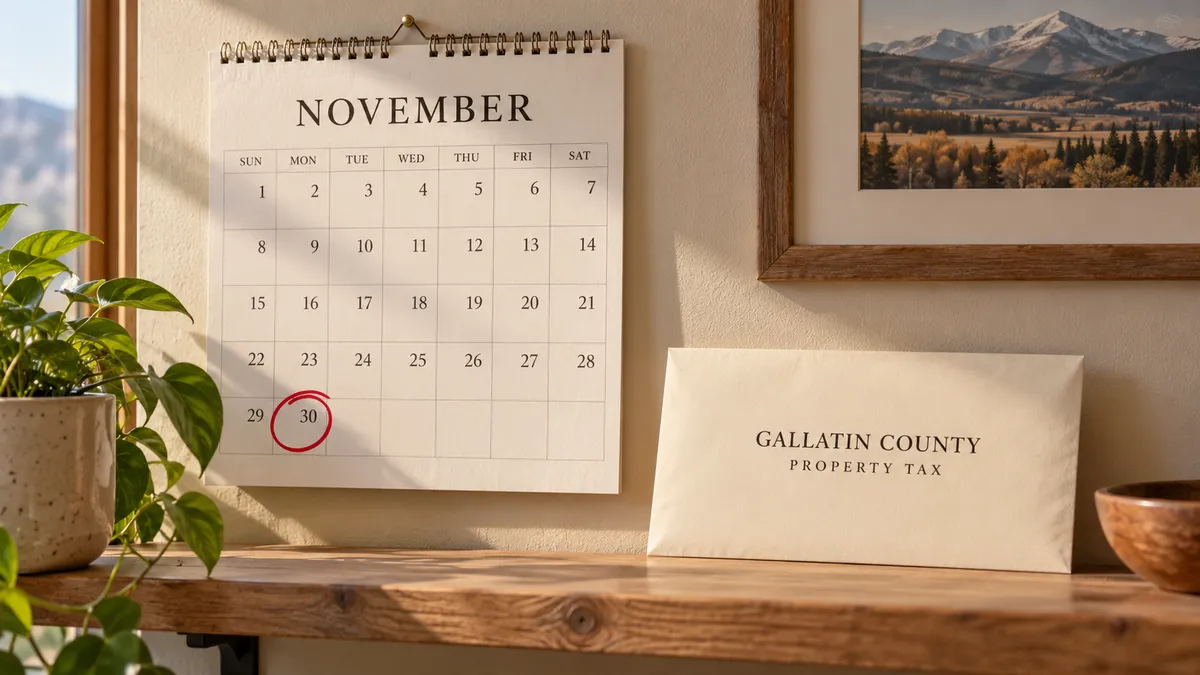
The short version: the first half of a Gallatin County real property tax bill is due by 5 p.m. on November 30, or 30 days after the bill is postmarked if that is later. The second half is due by 5 p.m. on May 31, or the next business day when May 31 is a holiday, which for the tax year 2026 bill makes the deadline June 1, 2027. The county itself lists May 31, 2027, and a payment by then is on time under either date. A payment made after the due date, or after the next business day when the due date is a holiday, is delinquent, and Montana law adds a 2 percent penalty plus interest at 5/6 of 1 percent a month until it is paid. The county mails one bill a year and sends no second-half notice. Everything below was read at the source between October 12 and October 29, 2026.
When Are Gallatin County Property Taxes Due for Tax Year 2026?
For the tax year 2026 real property bill, the first half is due by 5 p.m. on Monday, November 30, 2026, or 30 days after the bill is postmarked, whichever is later. The second half is due by 5 p.m. on May 31, 2027 by statute. That date is Memorial Day, so under Montana law the payment deadline is Tuesday, June 1, 2027.
Gallatin County's notice lists the statutory date itself. As of October 29, 2026, the Treasurer's Property Tax Division page lists the second due date for the 2026 bills as Monday, May 31, 2027. Paying online by May 31, or by mail or in person by Friday, May 28, is on time under either date.
The dates come from Montana Code Annotated 15-16-102, which sets one-half of the taxes payable on or before 5 p.m. on November 30 or within 30 days after the tax notice is postmarked, whichever is later, and one-half on or before 5 p.m. on May 31. The same section says that when a due date falls on a holiday or a Saturday, the taxes may be paid without penalty or interest by 5 p.m. on the next business day. Montana Code Annotated 1-1-216 lists Memorial Day, the last Monday in May, among the state's legal holidays, and every Sunday with it. The last Monday of May 2027 is May 31.
The postmark rule matters more than it looks. The county does not control the day the bills leave the post office, and when the mailing runs late the 30-day rule puts the first-half date after November 30. The date printed on the stub is the one the Treasurer collects on, and it is the statutory date or a later one, never an earlier one, and a stub date that falls on a holiday carries over to the next business day. As of October 12, 2026, the county's online tax site still showed tax year 2025 real property as the current cycle, with its second half having been due June 1, 2026, and the Treasurer's Property Tax Division page listed the same date under upcoming tax dates. The 2026 real property bills had not been posted yet.
| Bill | Due date | If it is missed |
|---|---|---|
| Tax year 2026 real property, first half | 5 p.m. Monday, November 30, 2026, or 30 days after the postmark if later. The stub governs. | 2 percent penalty, plus interest at 5/6 of 1 percent a month from the day after |
| Tax year 2026 real property, second half | May 31, 2027 is the statutory date and a legal holiday, so the payment deadline is 5 p.m. Tuesday, June 1, 2027. The county lists Monday, May 31, 2027; paying by then is on time under either date. | Same penalty and interest |
| Tax year 2026 real property, monthly plan (primary residences enrolled by September 30, 2026) | One-seventh by the last day of each month, November 30, 2026 through May 31, 2027, with each date that falls on a Sunday or holiday moving to the next business day (January 31 and February 28, 2027 are Sundays; May 31, 2027 is Memorial Day) | Same penalty and interest on a missed installment |
| Tax year 2026 mobile home | First half June 15, 2026; second half November 30, 2026, per the county tax site | Same penalty and interest |
| Tax year 2026 personal property | June 30, 2026, per the Treasurer's page | Same penalty and interest |
Two of those rows are already past for 2026. They are in the table because the Treasurer's page lists them, and because a buyer of a home with a detached shop full of equipment, or a mobile home on a rented lot, pays on a different calendar than a buyer of a house on its own land.
What Is the Penalty for Paying Gallatin County Property Taxes Late?
A payment made after the due date, or after the next business day when the due date is a holiday, is delinquent. Montana Code Annotated 15-16-102 adds a 2 percent penalty to the delinquent amount and charges interest at 5/6 of 1 percent a month, about 10 percent a year, from the delinquency until the tax is paid. Gallatin County applies the penalty at once and calculates the interest daily.
The county's own Understanding Your Property Taxes insert, in the version posted on the county site and dated October 2024, the one that goes out with the bill, puts it this way: all payments made or postmarked after the due dates on the front of the bill are considered delinquent, a 2 percent penalty is charged immediately, and interest runs at 5/6 of 1 percent per month until paid, calculated daily. The county's delinquent taxes page repeats the same figures and adds that taxes become delinquent the day after the listed due date. For the 2026 bill the listed second-half date is May 31, a holiday, so the county's wording and the statute's next-business-day rule point to different days. Paying online by May 31, or by mail or in person by Friday, May 28, avoids the question.
Here is what that costs on a half-year installment of $3,000. The penalty is $60. Interest is $25 a month. Thirty days late, the bill is about $3,085. Three months late, about $3,135. Six months late, about $3,210. The figures are rounded, because the county computes the interest by the day, and the exact payoff on any date comes from the Treasurer's office at 406-582-3033 or from the online tax site.
Two details in the statute and one in the county's own insert soften the edges, and all three are easy to miss:
- The insert treats a mailed payment postmarked by the due date as on time. Its wording is that payments "made or postmarked" after the due date are delinquent. The county's delinquent taxes page uses "not received by the due date," so mail early enough to arrive, or confirm the postmark practice with the Treasurer at 406-582-3033.
- Owners enrolled in the state's Property Tax Assistance Program get 20 calendar days of grace. Under subsection (4)(b) of the statute, taxes on qualifying property paid within 20 days of the due date carry no penalty or interest. Paid later than that, the penalty applies and interest runs from the original date. The grace period does not apply to an owner who is also on the seven-payment monthly plan. The Department of Revenue's program page describes the income limits and the April 15 application deadline.
- The current year can be paid without paying older delinquent years. Subsection (5)(a) requires the Treasurer to accept a current-year payment on its own, and says a payment toward delinquent years is applied to the oldest year first.
One more point from Montana Code Annotated 15-1-402 for anyone disputing a value: a protest has to be paid before the tax becomes delinquent. An owner with an appeal pending pays the disputed portion under written protest by the due date, using the Treasurer's protest form, or the appeal can continue but no refund can come out of it. The form itself says delinquent taxes cannot be protested.
What Happens After a Gallatin County Tax Bill Goes Delinquent?
Penalty and interest start the day after the due date, and the county's collection calendar runs from there to a tax lien on the first working day in August, an assignment of that lien to a third party from the end of August, and a three-year redemption window before a tax deed can issue. Every step has a statute and a date behind it.
The county's delinquent taxes page lays out the sequence it follows and names the laws. After the first half goes delinquent, Gallatin County may send a courtesy notice. After the second half goes delinquent, the county places an advertisement in the Bozeman Daily Chronicle warning that a lien could be placed, and Montana Code Annotated 15-17-122 requires that notice of the pending attachment be first published or posted on or before the last Monday in June. Two weeks before the first working day in August, the county mails pending lien notices to the owner's last known address, which is the two-week minimum in Montana Code Annotated 15-17-125. That section then requires the Treasurer to attach a tax lien no later than the first working day in August and file the certificate with the Clerk and Recorder. The county's page gives its own example from a recent cycle: August 1, 2024, for tax year 2023.
| When, for the tax year 2026 bill | What happens | Where it is written |
|---|---|---|
| The day after each due date | The installment is delinquent (June 2, 2027 for the second half, after the holiday rule). 2 percent penalty added, interest begins. | MCA 15-16-102; county insert |
| After the first half is delinquent | The county may mail a courtesy notice. | County delinquent taxes page |
| On or before Monday, June 28, 2027 | Notice of pending lien attachment published; the county runs an ad in the Bozeman Daily Chronicle. | MCA 15-17-122; county page |
| About mid-July 2027 | Pending lien notice mailed to the owner of record, at least two weeks before attachment. | MCA 15-17-125(4); county page |
| Monday, August 2, 2027 | Tax lien attached and filed with the Clerk and Recorder. Paying the delinquent taxes, penalty, interest, and costs releases it. | MCA 15-17-125; county page |
| Late August 2027 (August 31 in the county's published timeline for the 2023 bill) | A third party may take an assignment of the lien by paying everything owed plus a $60 county fee per parcel. After that, payoff goes through the Treasurer's office. | County delinquent taxes page |
| First working day in August 2030 | End of the three-year redemption period. A tax deed can follow, through the notice and deed procedures Montana law requires. | MCA 15-18-111 |
The 2027 and 2030 dates are the statute's calendar applied to the tax year 2026 bill, plus the county's published assignment timeline from an earlier cycle, not dates the county has published for this bill. They assume the second half goes delinquent on June 2, 2027 and the lien attaches on August 2, 2027; a different attachment date moves the redemption date with it, and the tax lien certificate the county mails states the controlling dates for a parcel. Montana Code Annotated 15-18-111 sets redemption at the first working day in August three years after the lien attaches, and shortens it to two years for a subdivided lot with no habitable dwelling and delinquent improvement district assessments. The county's page is blunt about the end of that road: delinquent taxes are subject to tax lien, could be assigned to a third party, and may result in the eventual loss of the property.
Two Bozeman-specific notes from the same page. City of Bozeman special assessments are forwarded to the county for collection and can carry a lien of their own, so a parcel with its county taxes paid can still be delinquent on a city special. The Treasurer's page adds that Bozeman city-wide specials now appear on the county bill, and that a Bozeman owner may still receive a separate postcard for other amounts the city collects. And the county does not give legal advice on liens, assignments, or tax deeds. Its page sends those questions to an attorney.
How Can You Pay a Gallatin County Property Tax Bill?
Three ways: online at the county's tax site by card or electronic check, in person at the Treasurer's office in the courthouse in Bozeman, or by mail with the payment stub. Online card payments carry a third-party fee of $1.25 plus 1.995 percent, an electronic check costs $2, and a check in person or by mail carries no fee.
The fees come from the Treasurer's Property Tax Division page and the bill insert, both read on October 12, 2026. A processor fee can change on its own schedule, so the amount shown on the payment screen is the one that applies. On the $3,000 installment above, a card payment costs $61.10 in fees. An electronic check costs $2. A paper check costs a stamp. Multiple parcels can be paid together online, and the county posts a short video on paying online.
For a mailed check, the insert asks for the payment stub, a signed check made payable to Gallatin County Treasurer's Office, and the parcel number and a phone number on the memo line. A self-addressed stamped envelope brings back a receipt. In person, the office takes cash, check, money order, or cashier's check without a fee, and cards with the same processor fee as online. The office is at 311 West Main Street, Room 103, Bozeman, open Monday through Friday, 8 a.m. to 5 p.m., closed on holidays.
The county's Pay My Taxes page stops every visitor with two checks before the payment screen: confirm that a mortgage company, bank, or title company is not already paying on your behalf, and confirm you are paying on the right property. The reason is stated on the same page. The county accepts the first payment made and cannot refund it.
The one habit that prevents most late second halves is the county's tax reminder service. It takes a parcel number and sends an email or a text before the second-half date, which is the installment most owners miss, because no second bill arrives to prompt it.
Can You Pay Gallatin County Property Taxes Monthly?
Yes, for a primary residence. Montana Code Annotated 15-16-122 lets the owner of a home they own and occupy at least seven months of the year pay the current year's taxes in seven monthly installments, November 30 through May 31. Enrollment is by application to the County Treasurer by September 30, and the owner stays enrolled until they cancel in writing.
The county's monthly payment form carries the terms. Application by September 30 covers the current year, so the window for the tax year 2026 bill closed on September 30, 2026, and the next deadline is September 30, 2027, for the 2027 bill. The seven payments must be as nearly equal as possible and are due by the last day of each month from November through May. The November tax notice shows the installment amount. Paying the full year early is still accepted.
Three conditions in Montana Code Annotated 15-16-122 decide who can use it. The home has to be class four residential property, owned and occupied by the taxpayer for at least seven months of the year, and not a mobile or manufactured home off a permanent foundation that the Department of Revenue taxes as personal property. The county may require automatic payments as a condition of enrollment, and Gallatin County's form includes an electronic debit authorization with a voided check attached, alongside a mail or in-person option. And the Treasurer may not accept a plan payment from an escrow service, lender, or mortgage company, which rules out the plan for anyone whose lender pays the taxes.
The plan changes the penalty math too. Under subsection (3)(a)(ii) of 15-16-102, a missed installment makes the amount delinquent with the same 2 percent penalty and monthly interest. Seven smaller dates are easier on a budget and harder on a calendar.
What If a Lender Pays Your Taxes From Escrow?
The county still mails the bill to you, not the lender. The insert states that bills go only to the owner of record, whether the owner pays directly or through an escrow or mortgage company, and makes it the owner's responsibility to forward a copy to the lender as needed. The payment itself comes out of the escrow account the lender holds.
Two things go wrong with escrow in practice. The first is a double payment: the owner sees the bill, pays it, and the lender pays it too. The county keeps the first payment and cannot refund it, so the money has to be sorted out with the lender. The second is a missed payment on a parcel the lender was never set up to pay, which happens after a refinance, a lender change, or a closing where the escrow account was opened on the wrong parcel number. The fix for both is the same: look the parcel up on the county's tax site in early December and again in early June and confirm the installment posted.
Escrow also changes what the monthly plan can do for you. The statute bars plan payments from a lender, so an owner with escrow uses the lender's monthly collection instead, and the lender pays the county on the two statutory dates.
Who Pays the Tax Bill When a Gallatin Valley Home Sells Mid-Year?
Both parties, split at closing. Under Montana Code Annotated 15-16-403, every tax on real property is a lien on the parcel that attaches as of January 1 each year, so the tax follows the land, not the person. The settlement statement prorates the year's taxes between seller and buyer as of the closing date, a term of the buy-sell agreement and closing custom rather than a statute, and the owner of record when the bill mails pays the county.
That proration line is covered in what it costs to close on a home in Montana. The part that trips people up comes after closing. The bill mailed in the fall goes to the owner of record in the Department of Revenue's records, and the county's insert warns that all transfers of ownership may not be reflected on it. A buyer who closes in August can find the November bill addressed to the seller, or sitting in the seller's mailbox in another state.
Four steps keep a mid-year buyer out of the penalty column:
- Get the parcel number at closing and look the bill up on the county's tax site in November. The site searches by parcel number, owner name, address, or geocode.
- Confirm the mailing address with the Department of Revenue's Bozeman office at 406-582-3400 or [email protected]. The Treasurer's page routes address changes there, and the bill insert carries a change-of-address form that goes back to the Treasurer, who passes it along; changes for an LLC or a trust go to the Department directly.
- If a lender escrows, confirm with the lender that the escrow account carries the right parcel number before the first-half date.
- Calendar the homestead enrollment deadline. The reduced rate on a principal residence expires at the end of the calendar year the home sells, and the buyer applies on their own. The rules and the March 1, 2027 deadline for tax year 2027 are in who qualifies for Montana's reduced homestead rate.
A seller who receives a bill for a home already sold has a one-line instruction from the insert: return the bill to the Treasurer with a note saying the property sold and when.
Where Is the Gallatin County Treasurer, and Is It the Same Office as Motor Vehicle?
Same Treasurer, two divisions, two rooms. The Property Tax Division is in Room 103 of the courthouse at 311 West Main Street in Bozeman, 406-582-3033. The Motor Vehicle Department is next door in Room 102, 406-582-3084, with a second office in Belgrade at 312 Main Street, Suite B-8, 406-582-3335.
The two divisions share a Treasurer and do not share a phone line, which is why a property tax question to the vehicle line gets a transfer. Property tax hours are Monday through Friday, 8 a.m. to 5 p.m. The Bozeman vehicle office takes renewals 8 a.m. to 5 p.m. and titles 8 a.m. to 4:30 p.m. The Belgrade office runs 7:30 a.m. to 4:30 p.m. for renewals and 7:30 a.m. to 4 p.m. for titles, and the vehicle page caps visitors at two transactions per person per day. Both offices answer at [email protected], and the property tax office at [email protected].
The county's 2026 closure list on the vehicle page includes Veterans Day on November 11, Thanksgiving on November 26, and Christmas Day. November 30, 2026, is a regular Monday, and June 1, 2027, is a regular Tuesday, so both due dates are days the courthouse is open.
What Is the Bottom Line on Gallatin County Due Dates?
Two dates, printed on two stubs, on the one bill the county mails each year. For tax year 2026, plan on Monday, November 30, 2026, and Monday, May 31, 2027, the date the county lists (Friday, May 28, for a check mailed or brought in person; the statute allows until 5 p.m. Tuesday, June 1, because May 31 is Memorial Day), and let the printed stub override the plan if the postmark rule pushes the first date past November 30. Miss either deadline (June 1 for the second half) and the cost is 2 percent at once plus 10 percent a year, with a lien by the first working day of the following August. The rates behind the bill, and what changed for 2026, are in Gallatin County property taxes in 2026.
After more than a decade of closings from an office in Manhattan, the pattern is familiar: the owners who lose money to penalties are rarely the ones who could not pay. They are the ones who did not know the second bill was never coming, or who assumed a lender was paying on a parcel the lender had never heard of. A parcel number, a reminder sign-up, and two looks at the county's tax site a year handle both. Questions about how a specific Gallatin Valley property's bill works, or how taxes get split at a closing, are always welcome.
Frequently Asked Questions
When are Gallatin County property taxes due for tax year 2026?
The first half is due by 5 p.m. on Monday, November 30, 2026, or 30 days after the bill is postmarked, whichever is later. The statutory second-half date is May 31, 2027, which is Memorial Day, so Montana law moves the payment deadline to 5 p.m. on Tuesday, June 1, 2027. Gallatin County's Treasurer lists Monday, May 31, 2027, the statutory date, and a payment by then is on time under either date. For the first half, the date printed on the stub governs when the postmark rule moves it later.
What is the penalty for paying Gallatin County property taxes late?
Montana Code Annotated 15-16-102 adds a 2 percent penalty to a delinquent installment and charges interest at 5/6 of 1 percent a month, about 10 percent a year, until it is paid. Gallatin County applies the penalty immediately and calculates the interest daily. On a $3,000 installment, that is $60 plus about $25 a month.
Does Gallatin County send a second-half property tax bill?
No. Gallatin County mails one bill a year with two payment stubs and sends no second-half notice. The county's insert says it is the only tax bill you will receive for the year. The county offers a reminder service by email or text message, keyed to the parcel number, for the second-half date.
Can you pay Gallatin County property taxes monthly?
Yes, on a primary residence you own and occupy at least seven months of the year. Montana Code Annotated 15-16-122 provides seven monthly payments, November 30 through May 31, by application to the County Treasurer by September 30. Lenders and escrow companies cannot pay on the plan, and the county may require automatic payments.
Is a mailed property tax payment on time if it is postmarked by the due date?
By the county's bill insert, yes: it treats payments made or postmarked by the due date as on time. The county's delinquent taxes page uses the words not received by the due date, so mail early or confirm with the Treasurer at 406-582-3033. Include the payment stub, make the check payable to Gallatin County Treasurer's Office, and write the parcel number on the memo line.
What happens if Gallatin County property taxes go unpaid for years?
The county attaches a tax lien on the first working day in August after the second half goes delinquent and files it with the Clerk and Recorder. From about the end of August, on the county's published timeline, a third party can take an assignment of the lien by paying the taxes, penalty, interest, and a $60 fee per parcel. Under Montana Code Annotated 15-18-111, the owner generally has until the first working day in August three years after attachment to redeem (two years for certain vacant subdivided lots), after which a tax deed can issue through the procedures Montana law requires.
Who pays the property taxes when a Gallatin Valley home sells mid-year?
Both parties. The year's taxes are prorated between seller and buyer on the settlement statement as of the closing date, under the buy-sell agreement rather than a statute, and the owner of record when the bill mails pays the county. Under Montana Code Annotated 15-16-403, the tax is a lien on the parcel from January 1, so it follows the land. Buyers confirm the mailing address with the Department of Revenue after closing.
Where is the Gallatin County Treasurer's office, and does it handle motor vehicle?
The Property Tax Division is in Room 103 of the Gallatin County Courthouse, 311 West Main Street, Bozeman, 406-582-3033, Monday through Friday, 8 a.m. to 5 p.m. The same Treasurer runs the Motor Vehicle Department in Room 102, 406-582-3084, and a second vehicle office at 312 Main Street, Suite B-8, in Belgrade, 406-582-3335.
This article is general information, not legal, tax, or accounting advice. AmeriMont Broker Group is not a law firm or an accounting firm, and nothing here should be treated as advice from one. Laws, tax rules, and programs change, and they vary by state and by situation. Before acting on anything covered here, consult a licensed attorney and/or a certified public accountant in your state for current guidance on your specific circumstances.
Nancy Clark is the Broker and Owner of AmeriMont Broker Group, serving Manhattan, Amsterdam, Churchill, and communities across southwest Montana. With more than $135 million in closed sales and over a decade of experience in Montana real estate, Nancy brings the care of a neighbor and the skill of a seasoned professional to every transaction. Reach her at [email protected] or visit nancyclarkbroker.com.
Nancy Clark
Broker/Owner, AmeriMont Broker Group
Manhattan, Montana
[email protected]
nancyclarkbroker.com


