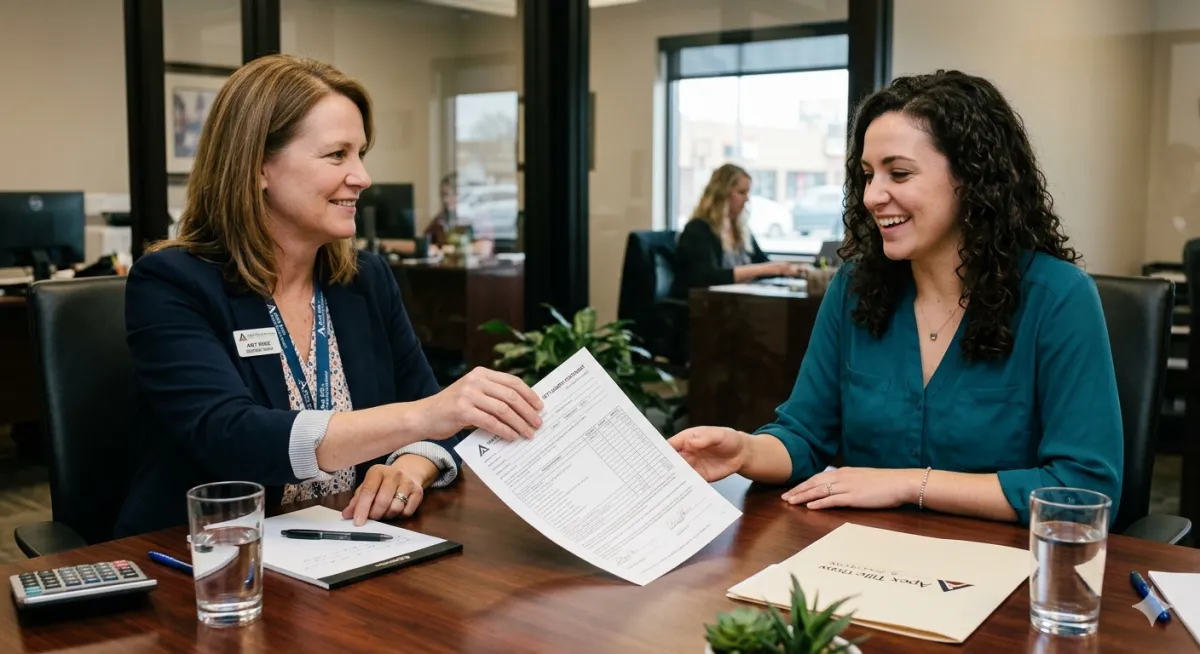
How Much Does It Actually Cost to Close on a Home in Montana?
The line items, the surprises, and the numbers nobody tells you until you are sitting at the closing table.
If you are buying a home in the Gallatin Valley and your lender just sent over a loan estimate, the closing costs section probably looks like a foreign language. Origination fees, title insurance, prepaid taxes, escrow reserves, recording fees. The total at the bottom is real money, and most buyers do not have a clear picture of what they are paying for until it is too late to negotiate. This guide breaks down every major closing cost line by line, with Montana-specific numbers so you know what to expect before you get to the table.
The short answer:Buyer closing costs in Montana typically run 2% to 5% of the purchase price (according to ConsumerAffairs). On a $500,000 home, that is $10,000 to $25,000 on top of your down payment. The exact amount depends on your loan type, your lender's fees, whether you are buying a property on well and septic, and how you negotiate the purchase contract. Montana has no transfer tax, and sellers customarily pay for title insurance, which helps, but there are still plenty of costs that land on the buyer's side.
A note before we go further:I am a real estate broker, not a lender or title officer. The cost ranges below are based on publicly available data as of spring 2026. Exact fees vary by lender, title company, and county. Please contact your lender and title company to confirm current costs specific to your transaction.
Nancy Clark here, Broker and Owner of AmeriMont Broker Group in Manhattan. After walking hundreds of buyers through closings across the Gallatin Valley, the most common reaction at the closing table is still "I did not realize it would be this much." This guide is meant to change that.
What Are the Major Closing Cost Categories for Buyers?
Buyer closing costs in Montana fall into four categories: lender fees, third-party services, prepaid items, and government fees. Each one contains multiple line items. Here is how they break down.
1. Lender Fees (paid to your mortgage company)
Loan origination fee: typically 0.5% to 1% of the loan amount (according toBankrate). On a $400,000 loan, that is $2,000 to $4,000.
Discount points (optional): 1 point equals 1% of the loan amount and typically buys a 0.25% rate reduction (according to Amerisave). Points only make sense if you plan to stay long enough to recoup the upfront cost.
Underwriting and processing fees: $300 to $900 depending on the lender.
Credit report fee: $30 to $75.
2. Third-Party Services (paid to inspectors, appraisers, title companies)
Home inspection: $350 to $600 in Montana, depending on property size and age (according toHouzeo).
Appraisal: $400 to $900 for a standard single-family home; FHA and VA appraisals tend toward the higher end (according to Houzeo).
Well and septic inspections (rural properties): $400 to $650 combined, plus $100 to $350 for lab water quality testing (according to Montana Life Real Estate).
Survey (if needed): $500 to $1,500 depending on parcel size and complexity.
Title search and closing/escrow fee: $500 to $1,000.
3. Prepaid Items (paid upfront, held in escrow)
Homeowners insurance (first year): $2,000 to $2,400 on average in Montana (according to Insurify), with higher premiums for properties in wildfire-risk areas.
Prepaid property taxes: prorated from your closing date through the next billing cycle. Montana property taxes are billed in two installments (November 30 and May 31 per Montana Code 15-16-102).
Prepaid interest: per-diem interest from your closing date to the end of that month.
Escrow reserves: typically 2 to 3 months of taxes and insurance held by your lender as a cushion (according to Montana's Credit Union).
4. Government Fees
Recording fees: $20 for the first page, $10 for each additional page (effective October 1, 2025 per Gallatin County). Total recording costs at closing are typically $50 to $150.
No transfer tax. Montana does not charge a real estate transfer tax, which saves buyers and sellers compared to many other states.
How Much Should You Budget at Different Price Points?
The percentage range (2% to 5%) is useful as a rule of thumb, but concrete numbers matter more when you are planning your cash needs. Here is what closing costs look like at common Gallatin Valley price points, assuming a conventional loan with no discount points:
Purchase PriceEstimated Closing Costs (2.5%-4%)Down Payment (5%)Total Cash Needed$400,000$10,000-$16,000$20,000$30,000-$36,000$500,000$12,500-$20,000$25,000$37,500-$45,000$600,000$15,000-$24,000$30,000$45,000-$54,000$700,000$17,500-$28,000$35,000$52,500-$63,000
These estimates include lender fees, third-party services, prepaids, and government fees. They do not include discount points, HOA transfer fees (if applicable), or optional add-on inspections. Your lender's loan estimate will provide exact numbers within three business days of your application.
If you are using an FHA loan, add the upfront mortgage insurance premium (1.75% of the loan amount) to these figures. On a $400,000 loan, that is an additional $7,000 (which can usually be rolled into the loan balance rather than paid in cash).
Who Pays for What in a Montana Closing?
Montana has customary splits between buyer and seller, but nothing is set by law. Everything is negotiable in the purchase contract. Here is what is customary in most Gallatin Valley transactions.
Seller typically pays:
Owner's title insurance policy
Lender's title insurance policy (Montana is one of the few states where sellers customarily cover this, according to iBuyer)
Real estate commissions
Their share of prorated property taxes
Any agreed-upon repair credits
Buyer typically pays:
Loan origination and lender fees
Appraisal
Home inspection
Well and septic inspections (if applicable)
Prepaid taxes, insurance, and escrow reserves
Recording fees
Survey (if needed)
Negotiable (depends on contract):
Closing/escrow fee (sometimes split 50/50)
Home warranty
Seller concessions toward buyer's closing costs
The fact that Montana sellers customarily pay for both owner's and lender's title insurance is a meaningful benefit for buyers. In many states, buyers pay for lender's title insurance, which can add $500 to $1,500 to the buyer's side of the closing statement.
What Are Seller Concessions, and Can You Get Them?
Seller concessions are when the seller agrees to pay a portion of the buyer's closing costs, reducing the cash the buyer needs at closing. In the current Gallatin Valley market (spring 2026), concessions are more available than they were during the peak-competition years of 2021 to 2023.
Each loan type caps how much the seller can contribute (according to iBuyer's Montana guide):
Loan TypeMaximum Seller ConcessionConventional (less than 10% down)3% of sale priceConventional (10-25% down) 6% of sale priceConventional (25%+ down)9% of sale priceFHA6% of sale priceVA4% of sale priceUSDA6% of sale price
On a $500,000 home with a conventional loan and 5% down, the seller could contribute up to $15,000 toward your closing costs. That does not mean every seller will agree, but in a balanced or buyer-friendly market, it is a legitimate negotiation tool.
How to ask effectively: Seller concessions work best when built into the offer price rather than presented as a separate ask. Instead of offering $490,000 and requesting $10,000 in concessions, many buyers offer $500,000 with $10,000 in seller-paid closing costs. The net to the seller is similar, but the higher sale price must appraise.
How Do Montana Property Taxes Work at Closing?
Property tax proration confuses more buyers at closing than any other line item. Here is how it works in Montana.
Montana property taxes are billed in arrears, meaning you pay for the period that has already passed. Taxes for the current year are due in two installments: the first half by November 30, and the second half by May 31 of the following year (according to Montana Code Annotated 15-16-102).
At closing, the title company prorates taxes so each party pays their fair share:
The seller owes taxes for every day they owned the property from January 1 through the closing date.
The buyer owes taxes from the closing date forward.
If taxes for the current year have not yet been billed (which is common for closings earlier in the year), the proration is estimated based on the prior year's tax amount. Your closing disclosure will show either a credit to you (if the seller's share exceeds what has been paid) or a charge (if you need to deposit into escrow for upcoming tax bills).
The practical effect: you will not write a separate check for property taxes at closing. The proration appears as a line item on your settlement statement, and your lender's escrow account handles ongoing payments after that.
For Gallatin County-specific tax information, the Gallatin County Treasurer's office provides property tax lookup tools and payment schedules.
What Closing Costs Are Specific to Rural Properties?
If you are buying outside Bozeman or Belgrade city limits, on well and septic rather than municipal water and sewer, your closing costs will be higher than an in-town purchase. Here is what to budget for.
Well inspection and water quality testing:$200 to $400 for the well inspection (flow rate, pump condition, pressure tank), plus $100 to $350 for lab testing (bacteria, nitrates, arsenic, and other contaminants). Total: $300 to $750. In rural Gallatin County, well inspectors are in high demand, so book early in your due diligence period (according to Montana Life Real Estate).
Septic inspection:$250 to $650 depending on system type and accessibility. A standard gravity system is simpler (and cheaper) to inspect than an advanced treatment system or mound system. The Montana DEQ septic guide covers system types and maintenance requirements.
Survey:$500 to $1,500. Rural parcels often lack recent surveys, and your lender or title company may require one. Larger or irregularly shaped parcels cost more. If the property has a survey from the past 5 to 10 years and no boundary disputes, you may be able to use the existing survey.
Radon testing:$150 to $300. Montana has elevated radon levels in many areas, and testing is recommended by the EPA for any home purchase. Mitigation (if needed) typically runs $800 to $1,500 and is often negotiated as a seller repair.
These costs add $1,200 to $3,200 to a rural closing compared to an in-town purchase. Plan for them in your budget from the start, not as surprises during due diligence.
What Can You Do to Reduce Your Closing Costs?
Closing costs are not entirely fixed. Some are negotiable, some are avoidable, and some can be shifted. Here are the legitimate strategies.
Negotiate seller concessions.As covered above, the seller can contribute up to 3% to 9% of the sale price depending on your loan type and down payment. In the current market, this is the single biggest lever for reducing out-of-pocket closing costs.
Shop your lender.Loan origination fees and discount points vary significantly between lenders. Get loan estimates from at least three lenders and compare the "Loan Costs" section line by line. The origination fee is a zero-tolerance fee under federal law, meaning it cannot increase between your loan estimate and closing disclosure (according toAmerisave). Negotiate it upfront.
Ask about lender credits.Some lenders offer credits that offset closing costs in exchange for a slightly higher interest rate. This trades upfront cost for long-term cost. It makes sense if you plan to refinance or move within 5 to 7 years.
Close late in the month.Prepaid interest is charged from your closing date through the end of that month. Closing on the 28th means 2 to 3 days of prepaid interest. Closing on the 5th means 25 to 26 days. The difference on a $500,000 loan at 6.5% is roughly $50 per day, so closing later in the month can save $1,000 or more in prepaid interest.
Use Montana Housing down payment assistance.The Bond Advantage DPA and MBOH Plus DPA (covered in detail in the financing guide:What Financing Options Exist for First-Time Buyers in Montana?) can cover closing costs in addition to your down payment, up to 5% of the purchase price or $15,000.
Skip optional add-ons carefully.Discount points, home warranties, and enhanced title policies are optional. Evaluate each one on its own merits rather than accepting everything your lender or title company suggests.
Next Steps
Before you get to the closing table, here is how to prepare:
Request a loan estimate from your lenderas early as possible. Federal law requires lenders to provide one within three business days of your application. This document breaks down every closing cost line item with actual numbers.
Compare the loan estimate to this guide.If a line item seems high, ask your lender to explain it. Some fees are fixed by law. Others are negotiable.
Budget for total cash needed, not just the down payment.Down payment plus closing costs plus reserves is your real number. Use the table above as a starting point and refine with your lender's estimate.
Ask about seller concessions early in the offer process.Your broker can advise on what is realistic given the property, the seller's situation, and the current market.
Get your closing disclosure at least three business days before closingand compare it to your original loan estimate. Federal law requires this timeline so you have time to catch errors.
If any of these numbers raised questions about your specific situation, reach out. Walking buyers through the closing cost math is part of what we do, and it is always easier to plan for these costs than to scramble at the last minute.
Related reading
- How long it takes to close on a home here
- Financing options for first-time buyers in Montana
- Gallatin County property taxes for 2026
Frequently Asked Questions
Does Montana have a real estate transfer tax?
No. Montana does not charge a real estate transfer tax at the state or county level. This saves both buyers and sellers compared to states that charge 0.5% to 2% of the sale price as a transfer fee. It is one of the genuine cost advantages of buying in Montana.
How much cash do I need to bring to closing?
Your total cash needed equals your down payment plus closing costs minus any seller concessions or lender credits. On a $500,000 home with 5% down and no concessions, plan for $37,500 to $45,000. With seller concessions covering closing costs, that number could drop to $25,000 (your down payment only). Your lender's closing disclosure will show the exact amount, typically wired to the title company one to two business days before closing.
Can I roll closing costs into my mortgage?
Some costs can be financed. FHA's upfront mortgage insurance premium (1.75%) is routinely added to the loan balance. VA loans allow the VA funding fee to be financed. However, most standard closing costs (lender fees, prepaids, third-party services) must be paid in cash at closing unless covered by seller concessions or down payment assistance programs.
Why are rural property closing costs higher?
Rural properties on well and septic require additional inspections (well yield, water quality, septic evaluation) that in-town properties on municipal systems do not need. Surveys are also more common on larger rural parcels. These add $1,200 to $3,200 to the buyer's closing costs compared to a comparable in-town purchase.
When do I pay for the home inspection?
The home inspection is typically paid at the time of the inspection, not at closing. Most inspectors require payment on the day of service. Budget $350 to $600 for a standard home inspection in Montana, with additional costs for well, septic, radon, or other specialty inspections.
What is the difference between prepaids and closing costs?
Closing costs are fees for services needed to complete the transaction (lender fees, title search, appraisal, recording). Prepaids are advance payments for ongoing expenses (first year of homeowners insurance, prorated property taxes, escrow reserves). Both appear on your closing disclosure, but prepaids are money you would owe regardless of the transaction. They are just collected upfront rather than monthly.
Can I negotiate closing costs with my lender?
Yes, some fees are negotiable. The loan origination fee, application fee, and rate lock fee are all worth discussing. Federal law classifies origination fees as zero-tolerance, meaning they cannot increase after your loan estimate is issued. That makes the initial estimate the time to negotiate. Get estimates from multiple lenders and use them as leverage.
How long does it take to get my earnest money back if the deal falls through?
In Montana, earnest money is held by the title or escrow company. If the deal falls through during the contingency period (inspection, financing, appraisal), the buyer typically receives a full refund. The timeline for return varies but is usually 5 to 15 business days after both parties sign a release. If there is a dispute over the earnest money, the process takes longer and may require mediation.
Disclaimer: Nancy Clark is a licensed real estate broker, not a mortgage lender, title officer, or financial advisor. The cost ranges and program details described in this article are based on publicly available information as of spring 2026 and are subject to change. This article is for informational purposes only. Please contact your lender and title company to confirm current costs specific to your transaction.
Nancy Clark
Broker/Owner, AmeriMont Broker Group
Manhattan, Montana[email protected]
nancyclarkbroker.com
Nancy Clark is the Broker and Owner of AmeriMont Broker Group, serving Manhattan, Amsterdam, Churchill, and communities across southwest Montana. With more than $135 million in closed sales and over a decade of experience in Montana real estate, Nancy brings the care of a neighbor and the skill of a seasoned professional to every transaction. Reach her at[email protected]or visit nancyclarkbroker.com.
Note: All cost ranges in this article are estimates based on publicly available data. Actual costs vary by lender, title company, property type, and transaction specifics. Verify all figures with your service providers before making financial decisions.


