How Do You Read a Gallatin County Property Tax Bill?
The bill is one page with dozens of numbers on it. Three of them explain most of what you owe, and each one is set by a different office.
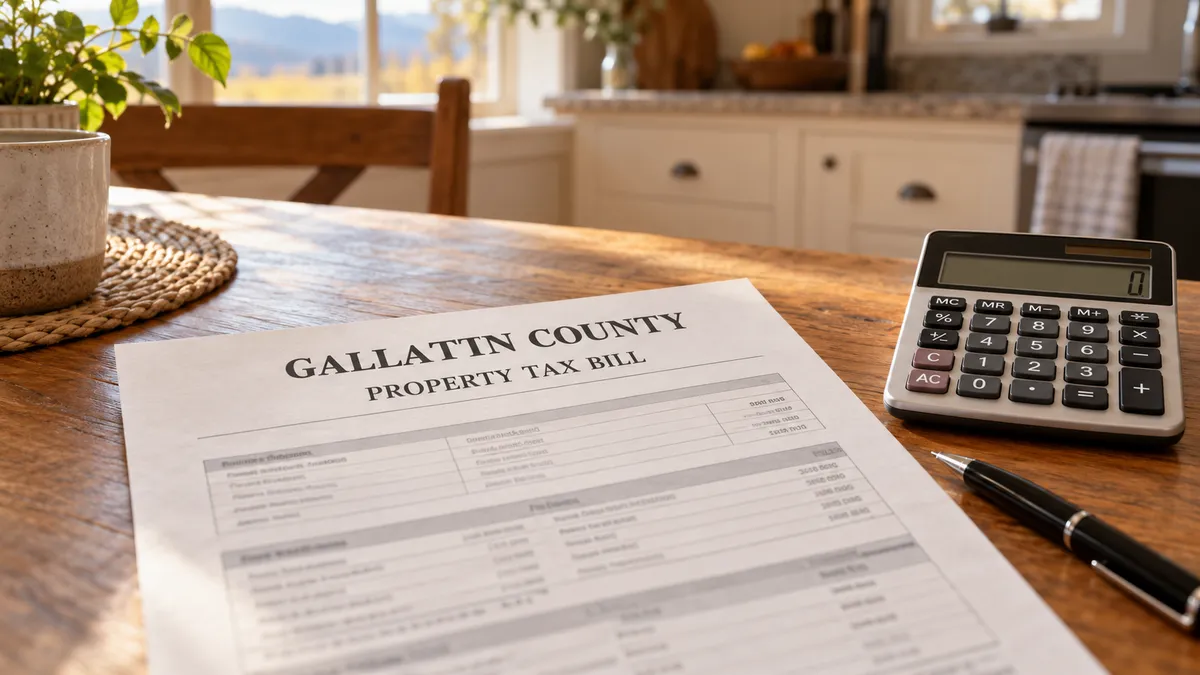
Holding a Gallatin County property tax bill and wondering what all the numbers on it mean? If you own a home here, or you are about to close on one, this guide walks the bill from the top corner to the payment stubs: where the value comes from, how the mills add up, what the special assessments are, and which office to call about each line.
The short version: the Montana Department of Revenue sets the market value and the taxable value. Local governments and voters set the mills. The Gallatin County Treasurer puts both on one bill, adds any special assessments, splits the total into two installments, and collects it. The layout described here is the county's tax year 2025 real estate bill, the most recent one issued. As of October 9, 2026, the county's tax site had not yet posted tax year 2026 real property bills.
What Is on the Front of a Gallatin County Property Tax Bill?
The front of the bill has five parts: an identification block with the parcel number, geocode, and tax district; a value box showing market value and taxable value; a list of every mill levy with its dollar amount; a special assessments box; and two payment stubs with the first-half and second-half amounts and due dates.
State law sets the minimum. Under Montana Code Annotated 15-16-101, the treasurer's notice has to show the taxable value, the total mill levy, itemized special assessments, the school district, and the tax due broken out by city, county, state, school district, and other levies. Gallatin County's bill does that on a single page.
| Part of the bill | What it shows | Who sets it | Who to ask |
|---|---|---|---|
| Parcel number, geocode, tax district | Which property this is and which set of levies applies | State and county property records | Department of Revenue, Bozeman office, 406-582-3400 |
| Market value and taxable value | The appraised value and the smaller figure the mills multiply | Montana Department of Revenue, using rates set by the Legislature | Department of Revenue, Bozeman office, 406-582-3400 |
| General mills | One line per levy, with its mills and its dollars | The city or town, the county, school districts, the state, and voters | The jurisdiction named on the line |
| Special assessments | Fees and district charges, split by half | The district or city that charges them | The district named, or the Treasurer at 406-582-3033 |
| Payment stubs | First-half and second-half amounts and due dates | County Treasurer, under state law | Treasurer, 406-582-3033 |
Both phone numbers come from the Treasurer's Property Tax Division page, which sends questions about value, appeals, mailing address, and legal description to the Department of Revenue and keeps billing and payment questions at the courthouse.
What Do the Parcel Number, Geocode, and Tax District Tell You?
They identify the property and decide which levies apply to it. The parcel number is the county's billing ID and the fastest way to look up a bill online. The geocode is the state's 17-digit property ID. The tax district names the combination of town, school, and other districts the parcel sits in.
The county's online tax site searches by parcel or tax ID, owner name, property address, or geocode, and it says the parcel ID gives the best results. Anyone can look up a parcel's current bill and payment history there, which is why buyers are wise to ask for the parcel number early in a transaction.
The tax district line deserves a second look. Two homes with the same value a mile apart can owe different amounts because one sits inside town limits, or in a different school district or fire district. Classification and special assessments can move the total too. The district code is what tells the county's system which list of levies to apply.
Read the legal description and the physical address too. The county's own bill insert says to examine the bill before paying and states that the Treasurer's Office is not responsible for payments made on the wrong property.
Where Do the Market Value and Taxable Value Come From?
Both come from the Montana Department of Revenue, not the county. The department appraises the property, then applies the tax rate the Legislature set for its class. The result is the taxable value, a much smaller number than market value, and it is the figure each mill levy on the bill multiplies.
On the tax year 2025 bill, the value box lists land, buildings and improvements, and personal property on separate lines, each with a market value and a taxable value, then a total.
The rate that turns one into the other changed between the last bill and the next one. For tax year 2025, residential property was taxed in tiers, each rate applying only to its slice of market value: 0.76 percent on the first $400,000, 1.10 percent from $400,000 to $1.5 million, and 2.20 percent above that, per the Legislative Fiscal Division's 2025 property tax overview. For tax year 2026, the Department of Revenue's rate page lists two main tracks. Principal residences and long-term rentals that qualify pay 0.76 percent on the first $378,000, 0.90 percent on the portion from $378,001 to $756,000, 1.10 percent from $756,001 to $1,511,999, and 1.90 percent on, in the department's words, "any portion over $1,512,000 or greater." Second homes, short-term rentals, and vacant residential lots pay a flat 1.90 percent on the full value. The same page lists a flat 1.10 percent for multifamily long-term rentals. The qualification rules are covered in who qualifies for Montana's reduced homestead rate.
One timing point catches owners every fall. The county's insert says an appeal of market value goes to the Department of Revenue within 30 days of the assessment notice, not the tax bill. State law, Montana Code Annotated 15-7-102, counts the 30 days from the date on the classification and appraisal notice. For class four residential property, the same section lets an owner who missed that window object for the second year of the two-year cycle only, no later than June 1 of that second year. The Legislature's overview says notices go out once each valuation cycle, generally in June, and the date on the notice itself controls. By the time the bill arrives, those dates have usually passed for the year, so the bill is the wrong document to dispute a value on. The Treasurer's page also posts a property tax protest form for payments made under protest. The department's Bozeman office can confirm where a specific parcel stands.
What Is a Mill, and How Do the Mill Levy Lines Add Up?
A mill is one dollar of tax for every $1,000 of taxable value. The bill lists each levy on its own line with its mills and the dollars it produces, then totals them. The county's basic formula is property tax equals mill rate times taxable value, divided by 1,000.
That formula is printed in the county's Understanding Your Property Taxes insert (the edition posted is dated October 2024), and the mill definition matches the Legislature's overview. On the tax year 2025 bill, each levy line starts with a two-letter key: CI for city or rural levies, CO for county, FI for a fire district, PU for public safety, SC for school, ST for state school, and UN for university. Those are that bill's printed labels, not legal categories. A small chart beside the list totals each group.
Here is how the main groups stacked up for a parcel in the Town of Manhattan in tax year 2025, taken from the county's 2025 Mill Levy Information sheet:
| Levy group | Key on the bill | Mills, tax year 2025 |
|---|---|---|
| Town of Manhattan (general, public safety, fire) | CI | 119.25 |
| County base levies, including public safety | CO and PU | 84.27 |
| Manhattan School District 3, elementary and high school | SC | 213.83 |
| Countywide school retirement and transportation | SC | 24.74 |
| State school equalization (33, 22, and 40 mills) | ST | 95.00 |
| University six-mill levy and Gallatin College | UN | 7.50 |
| Total of these groups | 544.59 |
The total is the sum of the county's published figures for those groups. It leaves out mill-based district charges that the bill lists with special assessments: the countywide Open Space Bond (0.90 mills on all but agricultural property), and the town's lighting district (12.32 mills) and street district (20.53 mills) where they apply. The TOTAL under General Mills on your own bill is the authority for your parcel.
Now the arithmetic. Take a home in Manhattan with a market value of $800,000 in tax year 2025. The 2025 rates put its taxable value at $7,440: 0.76 percent of the first $400,000 is $3,040, and 1.10 percent of the next $400,000 is $4,400. Each mill costs that home $7.44. At 544.59 mills, general taxes come to about $4,052 for the year, before special assessments. The Open Space Bond, lighting, and street mills together are 33.75 mills, about $251 more on this home where all three apply. These are illustrations on a round market value; the taxable value the Department of Revenue prints on the bill is the official one, and it can differ from the tier arithmetic by a few dollars.
Run the same six groups for a home inside Bozeman city limits and Bozeman School District 7, and the 2025 total is 559.86 mills: 190.71 for the city, 84.27 for the county, 157.64 for the school district, 24.74 countywide school, 95.00 state school, and 7.50 university. The state lines are identical everywhere in the county. The difference is local: town or city mills, and which school district the parcel sits in.
For tax year 2026 the taxable value step changes. With homestead status, the same $800,000 home comes out at $6,758.80. That is $2,872.80 on the first $378,000 at 0.76 percent, plus $3,402.00 on the next $378,000 at 0.90 percent, plus $484.00 on the last $44,000 at 1.10 percent. At the flat rate, 1.90 percent of $800,000 is $15,200. Both figures are illustrations on a round market value. The taxable value the Department of Revenue prints on the bill is the official one. The 2026 mills were not on the county's annual levy page as of October 9, 2026, so a 2026 bill cannot be computed from that page yet. The wider picture of what changed is in Gallatin County property taxes in 2026.
Some levy lines on the 2025 bill carry asterisks, and the bill prints no legend for them. State law requires the notice to identify voted levies, so the Treasurer's Office is the place to ask what a mark means on a specific line.
What Are the Special Assessments on the Right Side of the Bill?
Special assessments are district charges billed outside the general mill total. Some are flat fees by the lot or the unit. Others are small mill-based levies for a single district. On the tax year 2025 bill they sit in their own box on the right, each split into first-half and second-half amounts, and they are added to general taxes.
The Legislature's overview puts it plainly: many special districts assess fees and not a mill levy. The county's 2025 levy sheet shows the range of flat fees for tax year 2025, each applying only inside its own district. The Gallatin Water Quality District fee was $7.26 per unit on improved property. The Four Corners County Water and Sewer District charged $477.10 per parcel. The Fort Ellis Fire Service Area charged $725 per unit. Street, lighting, and improvement districts in Three Forks and Belgrade appear as fees on separate lists.
The flat fees do not move with value, so two neighbors with very different homes can owe the same fee. The mill-based lines in this box do move with taxable value. The county's sheet codes the Open Space Bond, the Gallatin Conservation District (0.52 mills), and Manhattan's lighting and street districts as mills, and each is multiplied by taxable value the same way a general levy is. Rural improvement district charges for road work show up in the same box, and they are part of what buyers need to know about HOAs and road maintenance.
Bozeman owners have one more wrinkle. The Treasurer's page states that Bozeman city-wide specials are now part of the county tax bill, and that owners could still receive a post card for any other amounts collected by the city.
If you are buying, read this box on the seller's current bill line by line. It names every district charging the parcel, and the amounts feed the tax proration covered in what it costs to close on a home in Montana.
Where Are the First-Half and Second-Half Amounts and Due Dates?
At the bottom of the page. A totals box shows general taxes plus special assessments for each half and for the year. Below it are two tear-off stubs, one for the first half or the full year and one for the second half, each printed with its amount and its due date.
The dates on the stubs follow Montana Code Annotated 15-16-102. The first half is due by 5 p.m. on November 30 or within 30 days after the tax notice is postmarked, whichever is later. The second half is due by 5 p.m. on May 31. When a due date lands on a weekend or a holiday, the statute moves it to the next business day. For tax year 2025, the stubs read December 8, 2025, a date after November 30, as the postmark rule allows, and June 1, 2026, because May 31 fell on a Sunday. The date printed on your stub governs. The same statute also provides an alternative schedule of seven monthly installments, November 30 through May 31, for owners of a primary residence who enroll in it. Enrollment closes September 30 for that tax year, and the plan cannot be paid through a lender's escrow account.
Three points on the bill and its insert are easy to miss and expensive to ignore:
- Gallatin County sends no second-half notice. The insert says this is the only tax bill you will receive this year.
- The insert says a late payment is charged a 2 percent penalty immediately, and the statute adds interest at 5/6 of 1 percent per month until the tax is paid.
- The bill goes only to the owner of record, even when a lender pays from escrow. The insert makes it the owner's job to forward a copy to the mortgage company as needed.
As of October 2026, the Treasurer's page lists a third-party fee of $1.25 plus 1.995 percent for paying online by card and $2 for an electronic check. Fees can change, so confirm the amount on the payment site before paying. Paying in person or by mail with a check carries no fee, and a mailed payment needs its stub. The county also runs a tax reminder service for the second half.
Where Does the Homestead Rate Show on the Bill?
On the tax year 2025 bill format, nowhere by name. The Department of Revenue applies the rate when it computes taxable value, so the rate shows only through that figure. For tax year 2026, a rough screening check is arithmetic: divide taxable value by market value. A second home or short-term rental at the flat rate comes out at 1.90 percent, and a qualifying homestead or long-term rental comes out lower.
The $800,000 home from the earlier example shows the gap. With homestead status, $6,758.80 divided by $800,000 is about 0.84 percent. At the flat rate, $15,200 divided by $800,000 is exactly 1.90 percent. On the highest-value homes, the top tier of the homestead schedule is also 1.90 percent, so the blended figure rises with value and stays below 1.90 percent, though on homes worth several million dollars it comes close.
Montana Code Annotated 15-16-101, as amended in 2025, also lists the homestead and rental reduced rates among the assistance programs the treasurer's notice has to mention. The tax year 2026 mailing had not been issued when this was written, so its exact wording is not described here.
If you own the home and live in it at least seven months of the year and the ratio on your 2026 bill reads 1.90 percent, enrollment is worth checking, and the Department of Revenue's Bozeman office is the call to make. The ratio is a screening clue, not a determination. It works on the land and building lines of a residential parcel in a single class. Agricultural land, homes on qualified agricultural property (1.35 percent for 2026), multifamily rentals, and mixed-use parcels follow different rates.
What Should You Check Before You Pay?
Five checks cover most billing mistakes: the property identity, the ratio of taxable value to market value, the tax district and mill total, each special assessment, and the two due dates. All five are reading steps you can do at the kitchen table with the bill and last year's copy side by side. A line that does not match is a question for the office that owns it.
- Match the parcel number, legal description, and physical address to your property.
- Divide taxable value by market value and compare the result with the rate you expect.
- Compare the tax district and the mill total with last year. The county's tax site has posted a prior-year tax comparison for parcels.
- Read each special assessment by name. Call the district on any line you do not recognize.
- Find both due dates on the stubs and put the second one on a calendar. If a lender escrows your taxes, confirm who is paying before you send money. The county's payment site carries the same warning.
Buyers can run the same list on a seller's bill during due diligence. It takes one parcel number and the county's site.
What Is the Bottom Line on Reading the Bill?
Three numbers explain most of an ordinary bill: taxable value, total mills, and special assessments. The first comes from the state, the second from local budgets and local votes, and the third from the districts the parcel sits in. Knowing which office owns which number is what turns a confusing page into three short phone calls.
After more than a decade of closings from an office in Manhattan, the pattern is consistent: the owners and buyers who read the tax district line and the special assessments box are rarely the ones surprised in November. Questions about where to find a specific Gallatin Valley property's bill and how to read it are always welcome.
Frequently Asked Questions
What is a mill on a Montana property tax bill?
A mill is one dollar of tax for every $1,000 of taxable value. Gallatin County's formula is property tax equals mill rate times taxable value, divided by 1,000. A home with a taxable value of $7,440 pays $7.44 for each mill levied on it.
Who sets the market value on a Gallatin County tax bill?
The Montana Department of Revenue sets both the market value and the taxable value, not the county. The Gallatin County Treasurer prints those figures on the bill and collects the tax. Questions about value go to the department's Bozeman office at 406-582-3400.
What does the tax district on the bill mean?
The tax district is the code for the combination of town or city, school district, and other districts a parcel sits in. It tells the county which list of mill levies to apply, which is why two homes of equal value in different districts can owe different amounts.
What do the letters CI, CO, FI, PU, SC, ST, and UN mean?
On the tax year 2025 Gallatin County bill, they are the keys for each levy group: CI is city or rural, CO is county, FI is a fire district, PU is public safety, SC is school, ST is state school, and UN is university. On that bill, special assessments carry the key OT, for other.
Why are special assessments listed separately from mills?
Special assessments are district charges billed outside the general mill total. Some are flat fees by the lot or the unit and do not move with value. Others, such as the Open Space Bond, are mill-based. The bill lists them in their own box, split into first-half and second-half amounts, and adds them to general taxes.
Does Gallatin County send a second-half tax bill?
No. Gallatin County mails one bill with two payment stubs and sends no second-half notice. The second-half amount and due date are printed on the lower stub. For tax year 2025 the second half was due June 1, 2026. The county offers a reminder service by email or text.
What happens if you pay a Gallatin County tax bill late?
A payment made after the due date printed on the stub is delinquent. The county's insert says a 2 percent penalty is charged immediately, and Montana law adds interest at 5/6 of 1 percent per month until the tax is paid. The Treasurer's Office at 406-582-3033 gives payoff amounts.
Who do you call about a Gallatin County property tax bill?
Call the Gallatin County Treasurer at 406-582-3033 about amounts due, payments, and penalties. Call the Montana Department of Revenue's Bozeman office at 406-582-3400 about market value, classification, mailing address, or the legal description. Call the district named on the line about a special assessment.
This article is general information, not legal, tax, or accounting advice. AmeriMont Broker Group is not a law firm or an accounting firm, and nothing here should be treated as advice from one. Laws, tax rules, and programs change, and they vary by state and by situation. Before acting on anything covered here, consult a licensed attorney and/or a certified public accountant in your state for current guidance on your specific circumstances.
Nancy Clark is the Broker and Owner of AmeriMont Broker Group, serving Manhattan, Amsterdam, Churchill, and communities across southwest Montana. With more than $135 million in closed sales and over a decade of experience in Montana real estate, Nancy brings the care of a neighbor and the skill of a seasoned professional to every transaction. Reach her at [email protected] or visit nancyclarkbroker.com.
Nancy Clark
Broker/Owner, AmeriMont Broker Group
Manhattan, Montana
[email protected]
nancyclarkbroker.com


