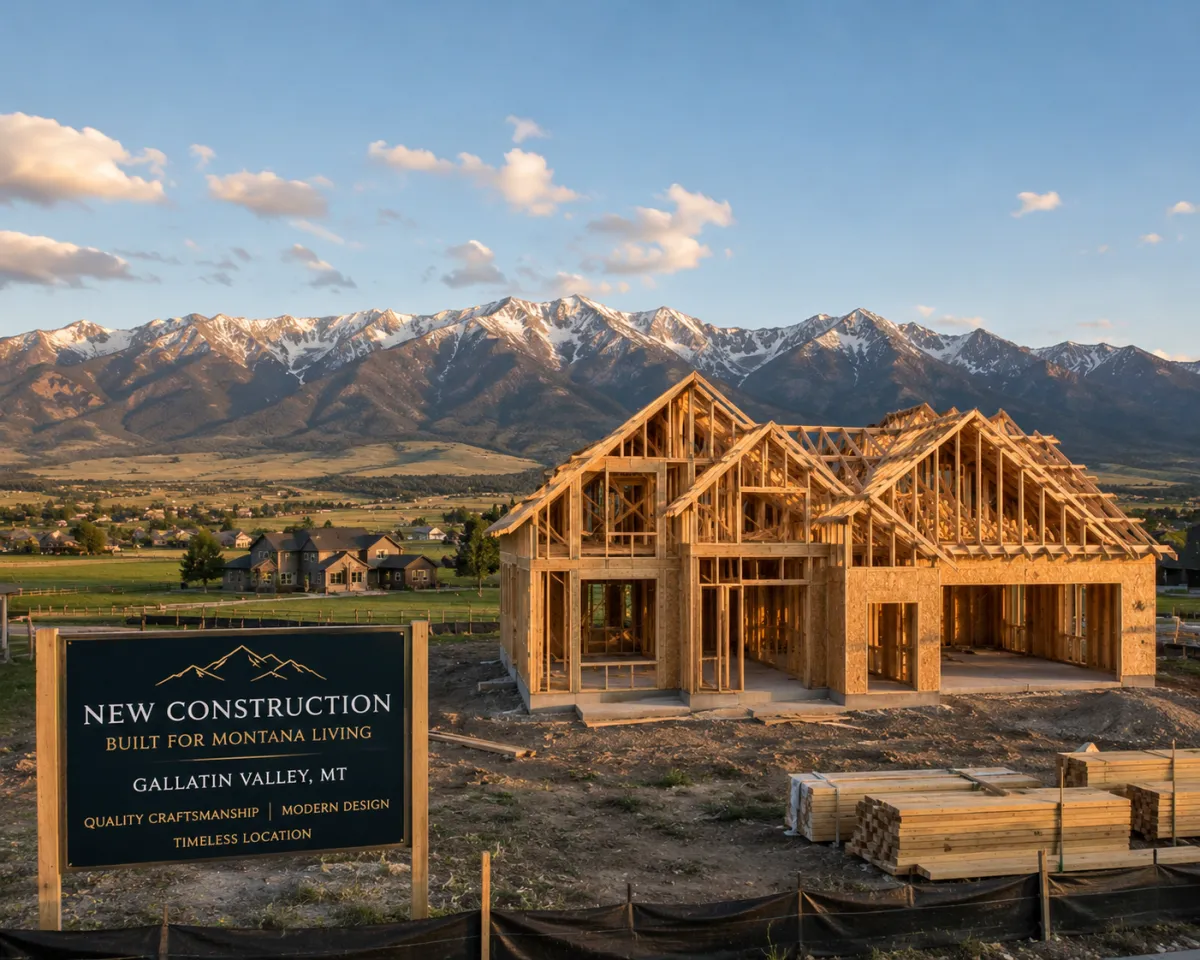
What Should You Know About Buying New Construction in the Gallatin Valley?
The house is new. The contract, the warranty, and the clock you are on are nothing like a resale.
Thinking about a new build in Bozeman or Belgrade instead of competing for a resale? The house may be the easy part. What surprises buyers is that almost every document in a new-construction purchase is different from a resale, including who wrote the contract, what warranty you get, and how long Montana law gives you to raise a problem. Here is what actually changes.
What is genuinely different about buying new construction?
Four things: you are usually signing the builder's contract instead of the standard Montana buy-sell, you get a statutory warranty instead of a seller's disclosure about a house someone lived in, you are on a set of legal clocks that start at completion, and you inherit costs that resale buyers never see. Everything below follows from those four.
New construction is not a worse deal than a resale. For a lot of people in the valley right now it is the better one, because the site work is finished, the systems are new, and builders can offer incentives a private seller cannot. If you are still deciding between this and a raw parcel, our post on whether to buy an existing home or build lays out that comparison. This post assumes you have landed on new construction and want to know what you are signing.
Whose contract are you actually signing?
Usually the builder's, rather than the standard buy-sell most Montana resale transactions use. Some builders will work from a modified or negotiated form, but their paper is the default, and that single fact changes your deposit, your contingencies, and your exit. Builder contracts are written by the builder's counsel to protect the builder, which is normal and expected, but it means the protections you assume are there may not be.
Read three clauses before anything else. First, the termination and deposit clause: what specifically lets you walk, and what happens to your money if you do. Builder contracts often define the exits narrowly and treat deposits differently than a resale contract would. Second, the completion date clause and what remedy you have if the date slips, because most builder contracts build in generous leeway for delay. Third, the change order procedure, which is how every upgrade and substitution gets priced after you sign.
That third one is not optional boilerplate. Montana requires it. Under Montana Code 28-2-2201, a residential construction contract must put in writing the general contractor's general liability coverage, workers' compensation status, the billing cycle and payment schedule, the method for handling owner-requested changes, and a statement of the inspections and tests the contractor will perform. The same statute confirms the owner may conduct their own inspections at their own expense. If a contract in front of you is missing those items, that is worth asking about before you sign, not after.
What warranty does Montana actually require on a new home?
At least one year, in writing, delivered before the sale. Montana Code 28-2-2202 requires that when a builder or developer sells a newly constructed, previously unoccupied residence they built for resale, they provide an express warranty valid for at least one year from the date of sale.
The statute is specific about what that warranty has to tell you. It must describe which components are included and which are excluded, state the length of coverage, spell out any specialty warranty provisions or separate timeframes for particular components, and lay out clearly what you have to do to make a claim, including the time and method for reporting one. Builders commonly layer longer manufacturer coverage on individual systems on top of the one-year minimum, which is why the excluded-components list matters as much as the included one.
There is a second document most buyers never ask for. The same statute requires the builder to give you a statement of all inspections and tests performed before, during, or upon completion of construction. Both documents are due to you before the sale, not after closing.
That statement of inspections is doing real work for you, and it is worth understanding why. On a resale, you get a seller's property disclosure from someone who actually lived in the house and knows that the basement takes water in spring. On a new build, nobody has lived there, so that knowledge does not exist. The inspection and test record is the closest equivalent you get, and it is the paper trail you will want if something surfaces in year two.
How long do you have if something goes wrong?
Six years from completion, and that number is new. Montana cut its construction statute of repose from ten years to six in the 2025 legislative session, by Section 2, Chapter 174, Laws of 2025. Montana Code 27-2-208 now runs six years from completion of the improvement, where completion means the point at which the owner can use the improvement for its intended purpose or a completion certificate is executed, whichever comes first. If an injury occurs during the sixth year, an action may be commenced within one year after that injury.
That is a meaningful shortening, and it applies to the house you are buying now. A defect that takes eight years to show itself sat inside the old window and does not sit inside the new one.
Before you can file suit over a residential construction defect in Montana, there is a process. Under Montana Code 70-19-427, you serve the construction professional a written notice of claim describing the defect in reasonable detail. The contractor then has 21 days to respond in writing, either proposing an inspection, offering a monetary settlement without inspecting, or disputing the claim. If they inspect, they must serve an offer within 14 days of completing that inspection.
Here are the clocks in one place.
| Clock | What it governs | How long you have | Source |
|---|---|---|---|
| Express warranty | The builder's written warranty on a newly built home | At least 1 year from the date of sale | MCA 28-2-2202 |
| Notice of claim | Written notice to the builder, required before filing suit | Served within the 27-2-208 window | MCA 70-19-427 |
| Builder's response | Builder's written answer to your notice | 21 days after service | MCA 70-19-427 |
| Builder's offer after inspecting | Builder's offer once it has inspected | 14 days after the inspection is complete | MCA 70-19-427 |
| Statute of repose | Outer limit to bring a construction claim at all | 6 years from completion, cut from 10 in 2025, plus 1 year if the injury happens in year six | MCA 27-2-208 |
None of that is a reason to avoid new construction. It is a reason to keep your documents, keep the inspection record, and put dates on a calendar.
Should you still pay for your own inspection?
Yes, and Montana law explicitly preserves your right to do it. A city or county building inspector confirms the house meets code. That is not the same as someone working for you, walking the house, and writing down what is wrong.
The state Building Codes Program enforces the code wherever local governments have not adopted their own certified program, and inside Bozeman and Belgrade the cities run their own building divisions. Code compliance is a floor, not a finish standard. Passing inspection does not certify workmanship quality, drainage adequacy, or how the house will perform in five years, and a code inspector is not looking for the trim gaps, the grading that slopes toward the foundation, or the bath fan vented into an attic.
The single most valuable inspection on a new build is the one most people never schedule. Because the statutory warranty runs at least one year from the date of sale, an inspection at month ten or eleven gives you a written list of defects while the builder is still obligated to address them. Walking the house yourself in month twelve and a half is a very expensive way to learn how a warranty deadline works. Our guide to what home inspections cover in Montana walks through scope and add-ons.
What should you know about the builder's lender incentive?
That it is legal, that it is often genuinely worth taking, and that you are not required to accept it. Builders frequently offer a rate buydown or a closing cost credit tied to using their affiliated or preferred lender, and that arrangement is regulated rather than prohibited.
Under the federal rule on affiliated business arrangements, when a referral is made to a settlement service provider the two parties are affiliated with, the person making the referral must give you a written disclosure of the nature of that relationship and an estimated charge or range of charges, no later than the time of the referral. The rule also restricts "required use" of a particular provider, with limited exceptions. So the incentive is an offer, not a condition.
The way to evaluate it is to compare total cost, not the headline rate. Get a written quote from an outside lender and put it next to the builder's offer including the incentive, looking at rate, points, fees, and how long any buydown actually lasts. For reference, Freddie Mac put the 30-year fixed at 6.67% and the 15-year at 5.96% as of August 13, 2026. A two-year buydown that expires while you still own the house is a different product than a permanent rate reduction, and the paperwork will tell you which one you are being offered.
What costs show up that resale buyers never see?
Several, and they tend to land late. A resale price generally includes a finished yard, a fence, window coverings, and appliances. A new build may not, and the base price you were quoted often assumes builder-grade selections you will want to change.
Inside Bozeman city limits, impact fees for water, sewer, fire and EMS, and street capacity are charged at building permit issuance and were adjusted January 1, 2026 for inflation. On a builder's spec home those are typically already inside the price, but on a to-be-built home you want to know in writing who is paying them.
New subdivisions also carry ongoing obligations that established neighborhoods may not. Special improvement districts can add an assessment to your tax bill for infrastructure, and homeowners associations in newer developments are often still controlled by the developer during build-out, which affects who sets the budget and when dues change. Our posts on HOAs in Bozeman and the Gallatin Valley and on Gallatin County property taxes cover both in detail. Ask for the current dues, the budget, and the date the developer expects to turn the association over to owners.
Are you buying a spec home or a to-be-built home?
They are different purchases with different risks, and buyers often use the terms interchangeably until the contract makes the distinction expensive.
A spec home is typically built or near completion before a buyer contracts to purchase it. The price is known, the finishes are chosen, the impact fees are usually settled, and you can inspect the actual house. The tradeoff is that you take the layout and selections as they are. Closing timelines look much more like a resale, generally the 30 to 45 days a financed purchase takes.
A to-be-built home means you are contracting for something that does not exist yet. You get the selections you want and you carry the risks: schedule slip, allowance overruns on flooring and fixtures, change orders that accumulate, and the possibility that your rate lock expires before the house is done. Ask two questions in writing before you sign. What happens if completion runs past the contract date, and when does the lender's rate lock start and how long does it run.
For where these homes are actually going up in Bozeman and Belgrade, our roundup of new developments in 2026 covers the active subdivisions.
When is new construction the wrong call?
When your timeline cannot absorb a delay, when your budget has no room above the base price, or when you need mature trees and an established street. A to-be-built home with a hard move-in deadline is the most common way this goes wrong in the valley, especially with a winter construction season in the middle of it.
It is also the wrong call if you are counting on the base price. Between upgrades, landscaping, window coverings, and a fence, the number you sign at is rarely the number you finish at. Buyers who build in a contingency for that are usually fine. Buyers who assumed the base price was the price are the ones who feel squeezed at the end.
What to do this week
Two things, both concrete.
First, if you are under contract or close to it, ask the builder in writing for the two documents Montana requires before the sale: the express written warranty with its included and excluded components, and the statement of all inspections and tests performed on the house. You are entitled to both under MCA 28-2-2202, before closing. Most buyers never ask, and then go looking for them in year two when they need them.
Second, if you have already closed on a new build, put a calendar reminder at month ten. That gives you time to get an independent inspection and submit a written punch list before the one-year express warranty expires. A reminder costs nothing, and it is the difference between a repair the builder owes you and a repair you pay for.
Frequently Asked Questions
Do builders in Montana have to provide a warranty on a new home?
Yes. Under MCA 28-2-2202, a builder or developer selling a newly constructed, previously unoccupied residence they built for resale must provide an express written warranty valid for at least one year from the date of sale. It must state covered and excluded components, coverage length, and the time and method for reporting a claim.
How long do I have to sue over a construction defect in Montana?
Six years from completion under MCA 27-2-208, reduced from ten years by Chapter 174, Laws of 2025. Completion means when the owner can use the improvement for its intended purpose or a completion certificate is executed, whichever is earlier. If the injury occurs in year six, you have one year from that injury.
Do I have to give the builder notice before filing a lawsuit?
Yes. MCA 70-19-427 requires serving a written notice of claim describing the defect in reasonable detail. The contractor has 21 days to respond in writing, proposing an inspection, offering settlement, or disputing the claim. If they inspect, they must make an offer within 14 days of completing it.
Should I get an inspection on a brand new house?
Yes. A municipal inspector confirms code compliance, which is a minimum standard, not a workmanship review. MCA 28-2-2201 confirms owners may conduct their own inspections at their own expense. The highest-value timing is month ten or eleven, before the one-year express warranty expires.
Do I have to use the builder's lender to get the incentive?
No. Federal rules on affiliated business arrangements restrict "required use" of a particular settlement service provider, with limited exceptions, and require written disclosure of the affiliation and estimated charges no later than the time of referral. Compare the builder's total offer against an outside written quote.
Is a builder's contract the same as a standard Montana buy-sell?
Usually not. Most builders use their own contract, drafted to protect the builder. Deposits, termination rights, completion-date remedies, and change order procedures commonly differ from a resale contract. MCA 28-2-2201 requires specific written disclosures in residential construction contracts.
What is the difference between a spec home and a to-be-built home?
A spec home is already built or nearly complete, so the price and finishes are known and you can inspect the actual house. A to-be-built home is contracted before construction, giving you selections but carrying schedule, allowance overrun, change order, and rate lock expiration risk.
What extra costs do new construction buyers miss?
Landscaping, fencing, window coverings, and appliances are often excluded from a base price. Inside Bozeman city limits, impact fees are charged at building permit issuance. New subdivisions may also carry special improvement district assessments and developer-controlled HOA dues during build-out.
This article is general information, not legal, tax, or accounting advice. Nancy Clark and AmeriMont Broker Group are not a law firm or an accounting firm, and nothing here should be treated as advice from one. Statutes, warranty rules, lending regulations, and contract terms change, and they vary by state and by situation. Before signing a construction contract or acting on anything covered here, consult a licensed attorney, a certified public accountant, and a licensed lender in your state for current guidance on your specific circumstances.
Nancy Clark is the Broker and Owner of AmeriMont Broker Group, serving Manhattan, Amsterdam, Churchill, and communities across southwest Montana. With more than $135 million in closed sales and over a decade of experience in Montana real estate, Nancy brings the care of a neighbor and the skill of a seasoned professional to every transaction. Reach her at [email protected] or visit nancyclarkbroker.com.
Nancy Clark
Broker/Owner, AmeriMont Broker Group
Manhattan, Montana
nancyclarkbroker.com


