Should You Buy an Existing Home or Build in the Gallatin Valley?
The build math often looks better on paper than it does on a raw parcel, and the difference is usually the land.
Is it cheaper to build a house in the Gallatin Valley than to buy one? That question comes up almost every week now, usually from someone who has watched the median price climb and started wondering whether a lot and a builder would get them further. The honest answer depends on three things: what the land already has, how long you can wait, and how much price certainty you need.
Here is the comparison, then the parts that actually decide it.
| Buying an existing home | Building | |
|---|---|---|
| Starting point | Gallatin County median of $800,000 in the 2026 housing report | Land plus construction, priced separately |
| Time to move in | Roughly 30 to 45 days from accepted offer | Around 9 months nationally from permit to completion, closer to 12 for a contractor-built home |
| Price certainty | Fixed at contract | Estimated at signing, known at completion |
| Site unknowns | Inspected before you close | Well, septic, power, and driveway priced after you own the land |
| Financing | One mortgage | Construction loan that converts, with a 12 to 18 month construction window |
| Approvals needed | None | Land Use Permit, septic authorization, water right notice, building permit |
| What you control | What is already standing | Layout, systems, insulation, orientation |
What does it actually cost to build here compared to buying?
Buying is a single number. Building is at least four. Local coverage of the 2026 Gallatin Valley housing report, produced by the Southwest Montana Association of Realtors with the University of Montana's Bureau of Business and Economic Research, puts the county median at $800,000, double the $400,000 median the report gives for 2019. A build starts with land, then adds construction, then adds everything that connects the house to the ground it sits on.
For local numbers, one Bozeman builder published a working range in April 2025: land generally $200,000 to $400,000, construction north of $200 per square foot, and $500,000 to $800,000 to build a 2,500 square foot home. Stack those and a custom build lands somewhere between $700,000 and $1.2 million before site work. Those are one builder's estimates from April 2025, they are more than a year old, and construction pricing moves. Treat them as a rough frame only and get current written bids before you plan around any of it.
The piece buyers underestimate is not the house. It is the site. As a national benchmark, the National Association of Home Builders puts site work at about 7.6% of construction cost and foundations at another 10.5%. Those are national averages across every kind of lot, and valley conditions can diverge from them sharply. On a finished lot in a subdivision, most of that work is already handled. On a raw parcel out toward Amsterdam or Three Forks, you are paying separately for a well, a septic system, a power run, and a driveway, and none of those costs exist in an existing-home purchase. That is the whole reason the build math often looks better on a spreadsheet than it does on dirt. A well that costs one number on a parcel near Manhattan can cost several times that a few miles away, depending on how deep the drillers have to go.
If a lower entry price is what you are after, it is worth reading where you can find acreage near Bozeman without Bozeman pricing before you assume building is the cheaper path to land.
How long does building take, start to finish?
Longer than most people plan for. Census Bureau construction survey data shows single-family homes took about 9.1 months from authorization to completion in 2024, broken into 1.4 months from permit to start and 7.6 months of construction. Homes built for sale by a builder finished fastest. Contractor-built homes averaged closer to 12 months, and owner-built homes averaged 15.1 months.
Those are 2024 national benchmarks, not valley timelines, and they start counting at the permit. Here the clock starts well before that. Septic review at the county has been running around 40 days against a normal 30-day target. A county Land Use Permit is its own separate submittal. Winter shortens the working season on excavation and foundation work. Add it up honestly and a valley build from parcel purchase to move-in is often a year and a half.
Compare that to an existing home, where a financed purchase closes in roughly 30 to 45 days. If you have a lease ending, a school year starting, or a house already under contract somewhere else, the timeline difference matters more than the price difference.
What does the land require before you can build on it?
Three approvals that most buyers have never heard of, any of which can delay or block a project depending on the site. Which ones apply depends on the parcel, and the water rules in particular changed recently.
Water. If your parcel is not on a public system, you need a well, and as of January 1, 2026 a project relying on the groundwater permit exception must file a Notice of Intent with the Montana Department of Natural Resources and Conservation before using the water. The exception covers wells producing 35 gallons per minute or less, up to 10 acre-feet per year, under Section 85-2-306 of Montana Code. Once DNRC authorizes it, you have five years to finish the water development and file a Notice of Completion. Other water-right obligations can still apply depending on your source and intended use, which is a question for DNRC or a water-rights attorney. The mechanism matters: the notice exists so the state can confirm your project qualifies before you spend money drilling, not after.
Septic. Gallatin County requires a wastewater treatment system permit through its environmental health process, and that approval is separate from both zoning and building-code review. The application needs a completed Wastewater Treatment System form, a Property Information Request form, a scaled site plan, and the fee. The system has to be installed by a credentialed installer and evaluated by a qualified site evaluator or a Montana-registered professional engineer. Soil conditions decide the design, and the design decides the cost. Our post on well and septic systems in the valley walks through what these systems cost to install and maintain.
Zoning. Land Use Permits are required in every zoning district in Gallatin County, and submittals now go through the county's online portal. The county planning department publishes the applications and instructions, and a planner conducts a site inspection to confirm where the structures will actually sit.
Who issues the building permit, and why does that surprise people?
Gallatin County does not issue them at all. That single fact reorganizes how a lot of valley builds get scheduled, and almost nobody knows it going in.
Per the county's own guidance, Gallatin County does not issue building permits; that function sits with the cities or the state. Inside Bozeman city limits, the permit comes from the city's Building Inspection Division. Inside Belgrade, it comes from the Building Division of the Community and Economic Development Department, which is a different office than city planning and zoning. For a project anywhere else in the county, you are working with the State Building Codes Program in Helena, which administers enforcement wherever local governments have not adopted their own certified program.
There is also a cost that only applies inside city limits. Bozeman charges one-time impact fees for water, sewer, fire and EMS, and street and transportation capacity, due at building permit issuance, and those fees were adjusted January 1, 2026 for inflation. The city publishes a fee estimator on that same page. Building outside city limits generally avoids those impact fees but adds well, septic, and other site-specific costs, and rural parcels can carry their own connection or access charges. Neither path is free. They are just different bills.
How is the financing different?
You are not getting a normal mortgage during construction, because there is nothing to mortgage yet. Construction financing pays the builder in stages as work is completed, then converts to a permanent loan when the house is done.
There are two structures. A single-closing construction-to-permanent loan closes both pieces at once. For loans written to Fannie Mae's guidelines, that structure allows no single construction period longer than 12 months, with the total not to exceed 18 months; portfolio lenders and government programs set their own terms, so ask what applies to yours. A two-closing structure means closing once for the interim construction loan and again for the permanent financing when the work is finished, which means two sets of closing costs.
The rate exposure is the real difference. A buyer purchasing an existing home locks a rate now. Freddie Mac put the 30-year fixed at 6.69% the week of August 6, 2026. A buyer building on a two-closing structure is taking whatever rate exists when the house is finished, which could be a year or more out. Ask your lender specifically which structure they offer and whether the permanent rate can be locked at the start. That question changes the answer for a lot of people.
Which one makes sense for you?
Neither option is better. They solve different problems, and the right choice comes down to what you are actually optimizing for.
Build if site control is the point. If you need a specific layout, a shop, single-level living, particular acreage, or a house built to a standard the existing inventory does not offer, building is the only way to get it. You are paying in time and uncertainty for a house that matches what you wanted.
Buy if certainty is the point. A contract price is a real number. An inspection tells you what you are getting. A closing date can be planned around. If your budget has no room for an overrun, or your timeline has a hard edge, buying protects you from both.
Buy if you want the land already solved. A house that has been standing for fifteen years usually has a well that produces, a septic that functions, a driveway that drains, and power at the meter. Those systems still need to be inspected and verified, because existing ones do fail. But on a raw parcel every one of them is an unpriced line item instead of a known quantity.
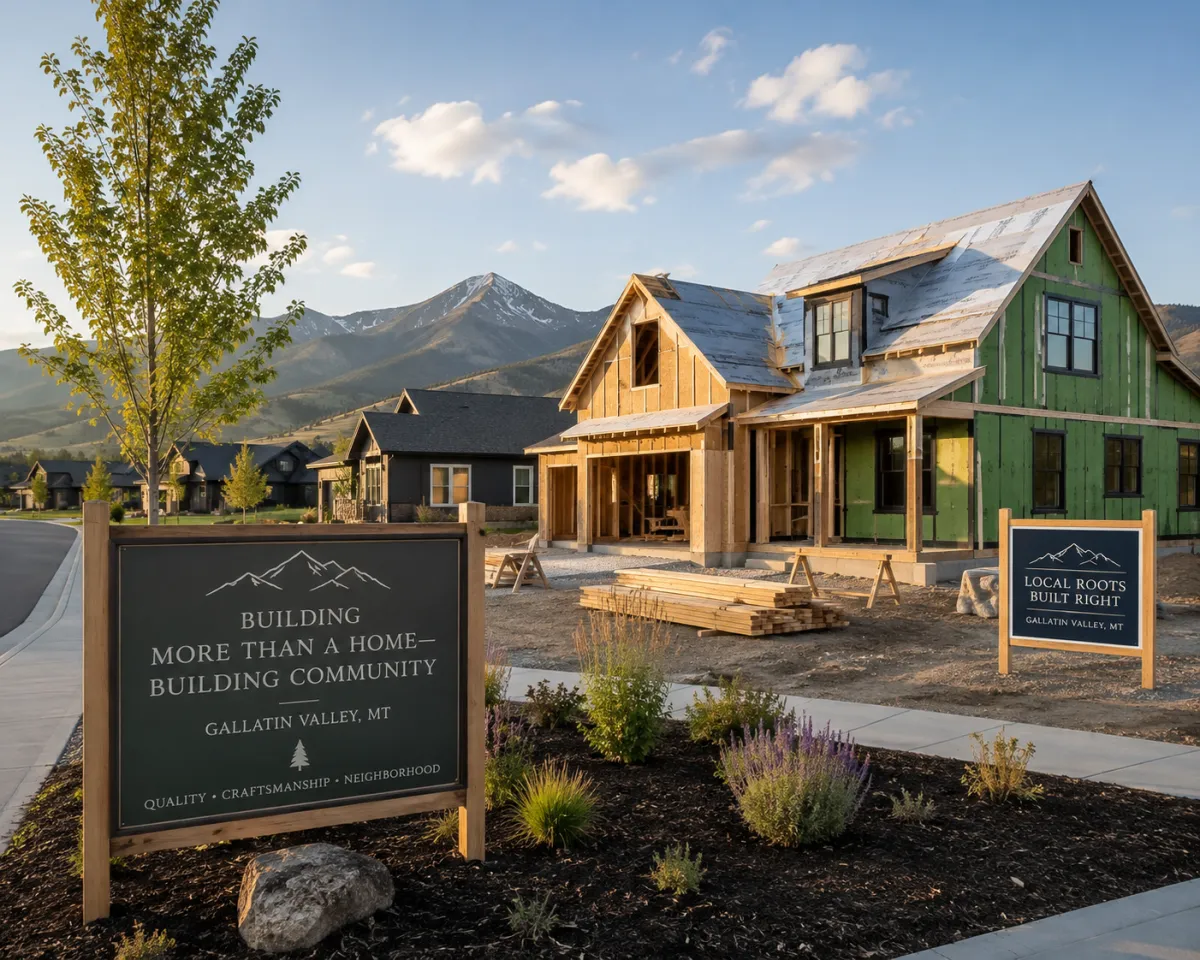
Consider new construction already underway. There is a middle path people forget. Builders in Bozeman and Belgrade have homes at various stages in active subdivisions, which gets you a new house with the site work finished and a known price. Our roundup of what is being built in Bozeman and Belgrade covers where those are.
When is neither one the right move?
Sometimes the answer is to wait, and a broker who tells you otherwise is not being straight with you. If your financing is not solid, building will expose that faster than buying will, because a construction budget has no floor when the site surprises you. If you are not sure which part of the valley you want, buying an existing home in a town you have not spent a season in is an expensive way to find out. Renting through one winter has saved more than one buyer from a purchase they would have regretted.
And if the property tax picture is part of your math, run it before you commit either way. Land and improvements are assessed differently, and what property taxes look like in Gallatin County has changed enough recently to be worth understanding first.
What to do this week
If you are seriously looking at a parcel, do this before you write an offer. Ask the seller's agent, in writing, two questions: has a DNRC Notice of Intent been filed for a well on this parcel, and is there an approved septic permit on file with the county. If the answer to both is no, treat the parcel as unproven and price it accordingly, because those two documents are much of the difference between a lot you can build on and a lot you hope you can build on.
Then, if you are looking inside Bozeman city limits, open the city's impact fee estimator and run your numbers. It takes about ten minutes and it will tell you a real figure that most buyers do not learn until permit issuance.
Frequently Asked Questions
Is it cheaper to build or buy in the Gallatin Valley?
Usually buying, once site costs are counted. The county median was $800,000 in the 2026 Gallatin Valley housing report. A custom build combining land at $200,000 to $400,000 with April 2025 construction estimates from one Bozeman builder lands roughly between $700,000 and $1.2 million, before a well, septic, driveway, or power run. Get current bids, because those figures are dated.
How long does it take to build a house in the Gallatin Valley?
As a national 2024 benchmark, single-family homes took about 9.1 months from permit to completion, and contractor-built homes averaged closer to 12 months. Valley builds add local permitting time and a shortened winter working season on top of that. Parcel purchase to move-in commonly runs a year and a half.
Do I need a permit to drill a well in Montana?
A project relying on the groundwater permit exception must file a Notice of Intent with DNRC before using the water, a requirement that took effect January 1, 2026. The exception covers wells producing 35 gallons per minute or less and up to 10 acre-feet per year under Section 85-2-306, MCA. Other water-right rules can still apply depending on your source and use.
Who issues building permits in Gallatin County?
Not the county. Gallatin County does not issue building permits at all. Bozeman's Building Inspection Division and Belgrade's Building Division issue them within their city limits, and everywhere else in the county the State Building Codes Program in Helena handles permitting and enforcement.
What are Bozeman impact fees and do they apply to me?
They are one-time fees for water, sewer, fire and EMS, and street capacity, charged at building permit issuance inside Bozeman city limits. They were adjusted January 1, 2026 for inflation. Building outside city limits avoids them but adds well and septic costs instead.
How does a construction loan work?
It funds the build in stages as work is completed, then converts to a permanent mortgage. A single-closing loan handles both at once, and under Fannie Mae guidelines construction periods are capped at 12 months with 18 months total. Other lenders and government programs set their own terms. A two-closing structure means two closings and two sets of costs.
Can I lock a mortgage rate while my house is being built?
It depends on the loan structure, which is why the question is worth asking upfront. A single-closing construction-to-permanent loan sets the permanent financing at the start. A two-closing structure leaves you exposed to whatever rates exist when construction finishes, potentially a year or more later.
This article is general information, not legal, tax, or accounting advice. Nancy Clark and AmeriMont Broker Group are not a law firm or an accounting firm, and nothing here should be treated as advice from one. Laws, tax rules, permitting requirements, and lending programs change, and they vary by state and by situation. Before acting on anything covered here, consult a licensed attorney, a certified public accountant, and a licensed lender in your state for current guidance on your specific circumstances.
Nancy Clark is the Broker and Owner of AmeriMont Broker Group, serving Manhattan, Amsterdam, Churchill, and communities across southwest Montana. With more than $135 million in closed sales and over a decade of experience in Montana real estate, Nancy brings the care of a neighbor and the skill of a seasoned professional to every transaction. Reach her at [email protected] or visit nancyclarkbroker.com.
Nancy Clark
Broker/Owner, AmeriMont Broker Group
Manhattan, Montana
[email protected]
nancyclarkbroker.com


