How Do You Appeal a Property Tax Assessment in Gallatin County?
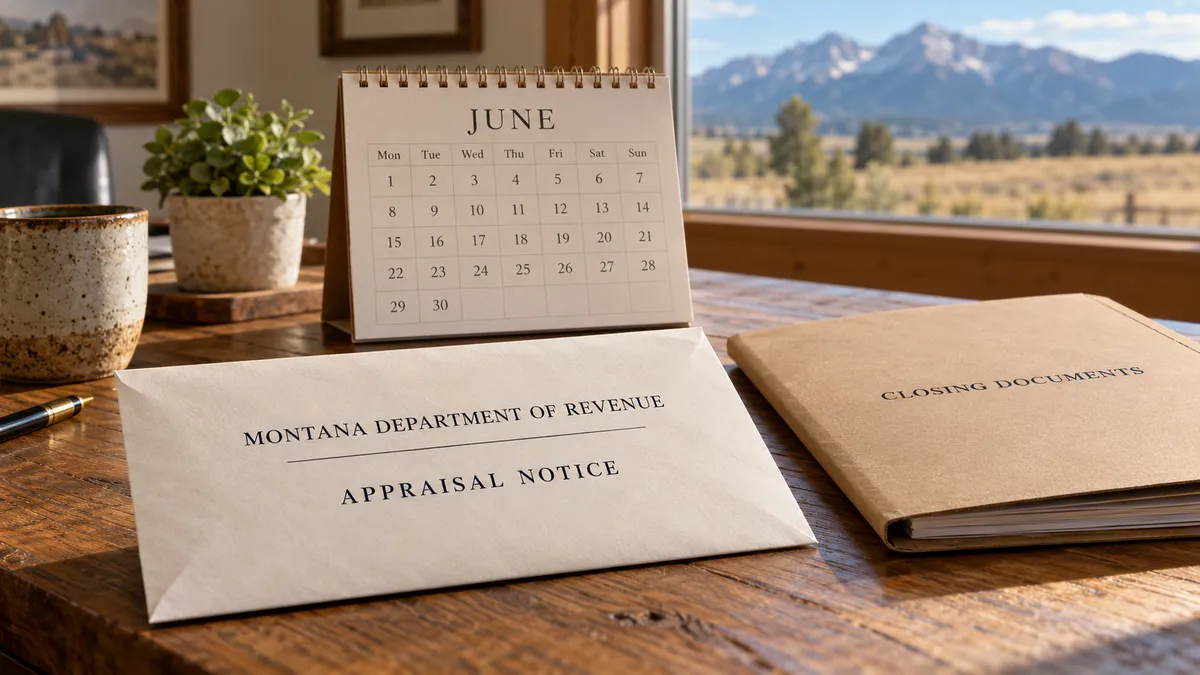
The value on your bill was set by the state, and the window to challenge it opens with a June notice, not the November bill. The three levels, the deadlines, and the evidence that moves a value.
Think the value on your Gallatin County property tax bill is too high, and wondering how to appeal it? If you own a home in Manhattan, Belgrade, Bozeman, or anywhere in the county, this guide walks the three levels of appeal under Montana law, the deadline at each one, what counts as evidence, and why most of the work happens before the next notice arrives.
The short version: the value on a Gallatin County bill comes from the Montana Department of Revenue, not the county, and the clock to challenge it starts on the date printed on the department's classification and appraisal notice. An owner has 30 days from that date to request an informal review on Form AB-26 or to go straight to the County Tax Appeal Board. Past that, the state board and then district court. For the current 2025 to 2026 cycle, the late-filing window closed on June 1st, 2026, so for most owners the next real opportunity is the notice for the 2027 cycle. Everything below was read at the source on October 21st, 2026.
Who Sets the Value on a Gallatin County Property Tax Bill?
The Montana Department of Revenue sets it. The department reappraises residential property every two years and mails each owner a classification and appraisal notice. Gallatin County's Treasurer bills and collects the tax, but cannot change the value. Any challenge to the value goes to the department first, or to the county's appeal board.
The two-year cycle is in Montana Code Annotated 15-7-111, which requires all residential (class four) property to be revalued every two years. The current cycle covers tax years 2025 and 2026. Under the department's 2025 to 2026 Montana Reappraisal Plan, every residential property for that cycle is valued as of January 1st, 2024.
That date explains a common surprise. The market value on a 2026 bill is the department's estimate of what the property was worth on January 1st, 2024. It is not the price a buyer paid this year, and a sale does not reset it on its own. In Gallatin County, the department's 2025 property value change summary put the median residential value at $685,000 for the new cycle, up from $630,000, a 9 percent increase, against 22 percent statewide.
The split between the two offices is the first thing to get straight. The Treasurer's Property Tax Division handles the bill and the payment. The department's Bozeman field office, at 2273 Boot Hill Court, Suite 100, 406-582-3400, handles the value. For a line-by-line look at how that value becomes the dollar figure on the bill, see Gallatin County property taxes in 2026.
When Can You Appeal, and Has the 2026 Window Closed?
You can appeal within 30 days of the date on the department's classification and appraisal notice, and a timely appeal covers both years of the cycle. A late request filed by June 1st of the second year covers the second year only. For the 2025 to 2026 cycle, both windows have closed for most owners.
The rule is in Montana Code Annotated 15-7-102. An objection made within 30 days from the date on the notice is considered for both years of the cycle. An objection made later applies only to the second year, and it has to arrive no later than June 1st of that second year. The statute allows one objection per valuation cycle.
The department's Form AB-26 page spells out what that meant this cycle: an owner who missed the 30 days had until June 1st, 2026 to request an informal review or appeal to the county board, and any adjustment would apply only to tax year 2026. The Montana Tax Appeal Board notes that the appraisal notice is usually mailed in June, and the Montana Free Press reported on July 1st, 2025 that the new valuations were on their way to owners.
Two situations still open a window this year. An owner who receives a new notice during 2026, for instance after new construction or a remodel is added to the roll, has 30 days from the date on that notice. And a separate question, whether a home is enrolled at the homestead rate, has its own review process, covered further down.
Everyone else is waiting for the next cycle. Under 15-7-111, property is revalued by January 1st of the second year of a cycle, effective the following January, which points to new values for tax year 2027 and notices in mid-2027. As of October 21st, 2026, the department had not published a 2027 to 2028 reappraisal plan or its valuation date.
One caution from reading the county's pages: Gallatin County's own tax appeal information page, read October 21st, 2026, still describes the 2023 reappraisal and its January 1st, 2022 valuation date. The statute and the department's pages carry the current dates.
What Are the Steps in a Gallatin County Property Tax Appeal?
There are three administrative levels, then court. The informal review with the Department of Revenue is optional. The County Tax Appeal Board hears the first formal appeal, the Montana Tax Appeal Board hears the next, and district court reviews the state board's decision. Each step has its own deadline, counted from a specific notice.
| Step | Deadline | Who decides | Where it is filed |
|---|---|---|---|
| Informal review, Form AB-26 (optional) | 30 days from the date on the classification and appraisal notice, for both years. Late requests by June 1st of the second year, for that year only. | Montana Department of Revenue | Online with a state sign-in account, or the Bozeman field office, 2273 Boot Hill Court, Suite 100 |
| County Tax Appeal Board, Form MTAB-401 | 30 days from the date on the department's AB-26 determination, or 30 days from the date on the notice when skipping AB-26 | Three members of Gallatin County's board at each hearing | Gallatin County Clerk and Recorder, 311 West Main, Room 304, Bozeman |
| Montana Tax Appeal Board, Form MTAB-801 | The later of 45 days after the county board hearing or 30 days after the county board mails its decision (statute amended in 2025) | The state Tax Appeal Board, in Helena or at the county seat | Montana Tax Appeal Board |
| District court | 60 days after service of the state board's final decision | A district judge | The county where the property sits, or the First Judicial District |
The sources for each row: MCA 15-7-102 for the AB-26 and county board deadlines, MCA 15-15-102 for filing with the clerk and recorder, Gallatin County's Tax Appeal Board page for the room number and the three-member panels, MCA 15-2-301 for the state board, and MCA 15-2-303 for judicial review.
How Does the Informal Review on Form AB-26 Work?
Form AB-26 asks the Department of Revenue to take a second look at its own value. You file it online or with the Bozeman field office, state the value you think is right, and attach evidence. An appraiser may inspect the property, and the department sends a written determination.
The AB-26 form (version dated March 2026) is direct about what does not work: a reason such as taxes being too high is not enough information. It also says the department may decide an on-site inspection is needed, and that if its employees are denied access to the property, the value cannot be adjusted. One form covers one parcel, so an owner with a house and a separately assessed lot files two.
The form has a useful box most owners skip. Part V requests the department's information packet, which includes a sales report with the three to five sales the department's model treated as most comparable to the property. Getting it requires signing a confidentiality agreement. Under 15-7-102, when an owner asks for the department's valuation methodology, the department provides it within eight weeks of the objection. That packet shows the reasoning behind the number, which is the thing an appeal has to answer.
The statute also limits the downside. Under 15-7-102, the department may not set a value higher than the one under objection unless the increase comes from a physical change to the property or a data error. Gallatin County's tax appeal forms page is a reminder of where the form goes: AB-26 forms are submitted to the Department of Revenue, not to the county.
What Happens at the Gallatin County Tax Appeal Board?
The County Tax Appeal Board is a citizen board appointed in Gallatin County that hears appeals of the department's value. You file Form MTAB-401 with the Clerk and Recorder, attend a hearing before three members, and present evidence. The board can change the value, and it mails its decision within three days.
The county's Tax Appeal Board page says the board has up to nine members, only three sit at each hearing, and every appeal form goes to the Clerk and Recorder's Office at 311 West Main, Room 304, in Bozeman. The board's secretary is at 406-582-3269. The AB-26 instructions confirm the informal review is optional: an owner can appeal the value on the notice straight to the county board within 30 days of the date on that notice.
Three rules govern the hearing. Under MCA 15-15-101, the board sits from July 1st of the tax year until December 31st and may change an assessment or fix it at another level. Under MCA 15-15-103, a reduction may not be made unless the applicant attends the hearing or the board waives attendance on the owner's written request with the department's written agreement, and the board must mail its decision within three days. The same section says that if the board fails to hear a timely application, the application is considered granted, with exceptions the section lists.
The appeal form itself, MTAB-401, states the standard plainly: the taxpayer has the burden to show how the department valued the property incorrectly, and a late appeal will not be considered. The state board's appeal process page asks for five copies of printed materials and two copies of any photographs at the hearing.
What If You Disagree With the County Board's Decision?
The next step is the Montana Tax Appeal Board, a state board that holds hearings in Helena or at the county seat. The deadline is the later of 45 days after the county hearing or 30 days after the county board mails its decision. After the state board, a petition for judicial review goes to district court within 60 days.
The deadline is newer than most of the paperwork. MCA 15-2-301, as amended in 2025, sets the later-of rule. The state board's forms and its appeal process page still print the older 30-day wording, so the cautious calendar counts 30 days from the county board's decision and treats the statute as the backstop.
The 2025 Legislature also added an informal review at the state board for class four residential property. The section is specific about the trade: a decision on that track is final and binding on all parties and cannot be reconsidered or appealed to district court. It is faster and narrower, and the choice belongs with the owner and their advisor.
Two more points from the same section matter to anyone weighing the cost of going this far. Under 15-2-301, for residential property, an independent appraisal the taxpayer provides is presumed to establish assessed value at the state board unless the department provides enough evidence to rebut it. And under MCA 15-2-303, the petition for judicial review is due within 60 days after service of the final decision, filed in the county where the property sits or in the First Judicial District.
Do You Still Pay Your Property Taxes While an Appeal Is Pending?
Yes. The bill comes due on its normal schedule whether or not an appeal is open. To get money back if the appeal succeeds, the disputed portion has to be paid under protest when it is due. A refund comes back with interest at the state's pooled investment rate.
The rule is MCA 15-1-402: a taxpayer who wants a refund pays the tax under protest when due. If the tax is not paid under protest, the appeal may continue, but no refund can be made. A successful protest is refunded with interest from the date of payment, at the rate earned by the pooled investment fund.
Gallatin County's property tax protest form goes to the Treasurer at 311 West Main, Room 103, 406-582-3033. It notes that the entire bill may not be protested, only the disputed portion, and that a payment cannot be made under protest unless one of the form's reason boxes is checked. A protest rests on an AB-26 or an appeal that has been filed, so paying under protest without a timely appeal does nothing. The form is marked revised November 2020, and some deadlines printed on it predate current law. The Treasurer's page said on October 21st, 2026 that the tax year 2026 bills would be coming out soon, with the first half due 30 days from the date of the bill. The full calendar, penalty, and interest are in the anchor guide to Gallatin County property taxes in 2026.
What Evidence Changes a Department of Revenue Value?
Evidence tied to the valuation date and to the property's own features. The department lists a purchase price, fee appraisal, or comparable sales or listings within six months of January 1st, 2024, and a builder's cost worksheet for new work. Errors in square footage, bedrooms, or bathrooms are the first thing it says to check.
Under Montana law, the department's value is presumed correct, and the owner carries the burden of proving otherwise, according to the AB-26 instructions. The department's informal review and appeal page lists what it accepts: the owner's own estimate of market value as of January 1st, 2024, the purchase price or a fee appraisal or comparable sales or listings within six months of that date, and a builder's cost breakdown for construction or remodeling. It also tells owners to check the basic characteristics first: square footage, number of bedrooms, number of bathrooms.
The mechanism explains why the characteristics come first. The department values residential property with a model that compares each home to recent sales of similar ones. The model only knows the property through its record. If the record shows a finished basement that is unfinished, an extra bathroom that was never built, or 400 square feet more than the house has, the model prices a house that does not exist, and the comparable sales it picks are built around that wrong house. Fix the record and the comparison moves with it.
An appraisal carries weight in statute, with conditions. Under 15-7-102, the department considers an independent appraisal if it meets the standards of the Montana Board of Real Estate Appraisers and was completed within six months of the valuation date. The same section lets the county and state boards weigh negative features that set a property apart from the department's comparable sales, a power line across the lot or a difficult access road, for example. An appraisal dated this fall, two years after the valuation date, does not meet the six-month condition for the current cycle.
The 2025 rule change made one kind of evidence easier. The department amended its sale-price rule effective May 10th, 2025, so that an owner relying on a recent purchase price submits the AB-26 with the department's sale verification form, without the affidavit and the two comparable sales the older rule required. The change was proposed in MAR Notice 2025-42 and adopted as proposed. If the department cannot verify the sale as an arm's-length transaction, the buy-sell agreement and two comparable sales can still be submitted.
Is an Appeal Worth the Time on a Gallatin Valley Home?
It depends on the size of the error and the tax rate the home pays. The department reported a statewide median adjustment of $14,800 on informal reviews from the 2025 cycle. On a homestead, that is about $73 a year in tax at Manhattan's levies. A data error worth $100,000 is worth about $490 a year, and more on a second home.
The department's February 2026 report to the Legislature's Revenue Interim Committee gives the scale. Statewide, owners filed 14,115 AB-26 reviews, 539 county board appeals, and 12 state board appeals from the 2025 values. Of the 11,577 closed AB-26 reviews, 56.05 percent were adjusted, and the statewide median adjustment was $14,800. At the county boards, 41.14 percent of the 299 closed appeals were adjusted, with a median adjustment of $69,671. Appeals came to 1.78 percent of parcels, down from 3.03 percent in the 2023 cycle. Gallatin County accounted for 2,245 appeals in that report, dated February 23rd, 2026, with about 61 percent of them closed.
The table converts a lower value into tax, using the Department of Revenue's 2026 rates and the 2025 total of 544.59 mills for a parcel in the Town of Manhattan, from the county's 2025 Mill Levy Information sheet. The homestead column assumes the whole reduction falls inside the 0.90 percent band, the slice of value from $378,001 to $756,000. The flat-rate column is the 1.90 percent rate that applies to second homes and short-term rentals.
| Lower value | Homestead, 0.90 percent band: tax saved per year | Flat 1.90 percent rate: tax saved per year |
|---|---|---|
| $14,800 (the 2025 cycle median adjustment) | About $73 | About $153 |
| $50,000 | About $245 | About $517 |
| $100,000 | About $490 | About $1,035 |
These are estimates of scale, not a bill. The 2026 mills had not been posted on the county's levy page as of October 21st, 2026, and the 2027 rates and mills are not set. An adjustment from a timely request applies to both years of a cycle, so the yearly figure roughly doubles. The arithmetic: a $50,000 reduction at 0.90 percent lowers taxable value by $450, and at 544.59 mills each dollar of taxable value carries about $0.54 of tax.
The position that follows from the numbers is plain. An appeal built on a feeling that the value is high rarely pays for the evening it takes. An appeal built on a record error, a fee appraisal near the valuation date, or a feature the department's model cannot see often does, and on a second home at the flat rate, it pays about twice as well. For more on how the flat rate works for owners who live elsewhere part of the year, see owning a second home in Montana from out of state.
What Is Not an Appeal, Even Though It Lowers the Bill?
Several state programs lower a bill without challenging the value. The homestead reduced rate, the Property Tax Assistance Program, the disabled veteran program, and the elderly homeowner and renter credit each have their own application and deadline. A missed homestead enrollment is fixed by applying, not by appealing the value.
The most common mix-up this year is the homestead rate. Under 2025 legislation, a qualifying primary residence pays a tiered rate starting at 0.76 percent, and the department runs enrollment for tax year 2027 from May 4th, 2026 to March 1st, 2027, per its homesteads and long-term rentals page. A denial can be objected to within 30 days of the denial notice under Montana Code Annotated 15-6-418. Who qualifies, and how the rate shows on the bill, is covered in Montana's reduced homestead tax rate.
The others, each with an April 15th application deadline or its own schedule: the Property Tax Assistance Program reduces the rate on a home for owners on a fixed or limited income; the Montana Disabled Veteran program reduces the rate for a veteran rated 100 percent disabled or an unmarried surviving spouse; and the Elderly Homeowner/Renter Credit is a refundable income tax credit of up to $1,150.
What Should You Do Before the Next Notice Arrives?
Check the record now, while nothing is due. Look up the property on the state's property data site, compare its square footage, bedrooms, bathrooms, and improvements to the house itself, and save a dated copy. When the next notice arrives, the 30 days go to gathering evidence, not to discovering the problem.
The state's property data portal lets anyone enter an address, name, or property number to see the characteristics the department has on file. The notice guide explains the fields on the notice itself: the 17-digit geocode, the prior and current values, and a value increase reason that prints when the value rose more than 10 percent. This week's task takes about fifteen minutes:
- Look up the property on the state portal by address and save the page as a PDF with today's date in the file name.
- Compare the finished square footage, bedrooms, bathrooms, garage, outbuildings, and land size to the house and the deed.
- Write down anything that does not match, with a photo of the room or feature in question.
- Keep the closing statement and any appraisal from a recent purchase in the same folder.
- Put a reminder on the calendar for June and July 2027 to watch for the department's notice, and count 30 days from the date printed on it.
If the pattern of the last two cycles holds (January 1st, 2022 for the 2023 cycle, January 1st, 2024 for the current one), the next valuation date will fall before the cycle begins, which means the sales that will matter for a 2027 appeal may already be on the books. The department had not announced that date as of October 21st, 2026, so the notice itself will settle it.
What Is the Bottom Line on Appealing a Gallatin County Assessment?
The appeal runs on the department's notice, not the county's bill, and it rewards owners who show up with a specific error and dated evidence. For the 2025 to 2026 cycle, the windows have closed for most owners. The record check takes fifteen minutes, and it is the part of the next appeal that can be done today.
The question tends to arrive in November, with the bill, when the regular window to challenge the value on it has usually closed. The owners who come out ahead are the ones who read the June notice as carefully as the November bill, keep their closing papers where they can find them, and know that the Treasurer and the Department of Revenue are two different offices with two different jobs. Questions about how a specific Gallatin Valley property was valued, or what a recent sale might mean for the next notice, are always welcome.
Frequently Asked Questions
Can you still appeal the value on a 2026 Gallatin County property tax bill?
For most owners, no. The 30-day window after the 2025 classification and appraisal notice has passed, and late requests for tax year 2026 had to be filed by June 1st, 2026. An owner who received a new notice during 2026, such as after new construction, has 30 days from the date on that notice. Everyone else waits for the 2027 notice.
Is the property tax bill the document you appeal?
No. The Gallatin County Treasurer bills and collects the tax but cannot change the value. The value comes from the Montana Department of Revenue, and the 30-day appeal window runs from the date on the department's classification and appraisal notice, which is usually mailed in June, months before the bill.
What is Form AB-26?
Form AB-26 is the Department of Revenue's request for an informal classification and appraisal review. It is filed online or with the Bozeman field office at 2273 Boot Hill Court, Suite 100, within 30 days of the date on the notice. It needs a proposed value and evidence; taxes being too high is not enough. One form covers one parcel.
Do you have to file Form AB-26 before going to the County Tax Appeal Board?
No. The informal review is optional. An owner can appeal the value on the notice straight to the Gallatin County Tax Appeal Board within 30 days of the date on the notice. After an AB-26, the county board appeal is due within 30 days of the date on the department's determination.
Where do you file a Gallatin County Tax Appeal Board appeal?
File Form MTAB-401 with the Gallatin County Clerk and Recorder, 311 West Main, Room 304, in Bozeman. The board's secretary is at 406-582-3269. Three board members hear each appeal, and state law allows no reduction unless the owner attends the hearing, or the board waives attendance on the owner's written request with the department's written agreement.
What evidence helps a property tax appeal in Montana?
The department lists the owner's estimate of value as of January 1st, 2024, a purchase price, fee appraisal, or comparable sales or listings within six months of that date, and a builder's cost breakdown for new work. Errors in square footage, bedrooms, or bathrooms are the first thing to check.
Do you have to pay property taxes while an appeal is pending?
Yes. The bill comes due on schedule. To receive a refund if the appeal succeeds, the disputed portion must be paid under protest when due, using the county's protest form with the Treasurer. A successful protest is refunded with interest at the rate earned by the state's pooled investment fund.
Can the Department of Revenue raise your value if you appeal?
Generally no. Under Montana Code Annotated 15-7-102, the department may not set a value higher than the one under objection unless the increase comes from a physical change to the property or a data error. Inviting an inspection can surface such an error, so check the record before filing.
This article is general information, not legal, tax, or accounting advice. AmeriMont Broker Group is not a law firm or an accounting firm, and nothing here should be treated as advice from one. Laws, tax rules, and programs change, and they vary by state and by situation. Before acting on anything covered here, consult a licensed attorney and/or a certified public accountant in your state for current guidance on your specific circumstances.
Nancy Clark is the Broker and Owner of AmeriMont Broker Group, serving Manhattan, Amsterdam, Churchill, and communities across southwest Montana. With more than $135 million in closed sales and over a decade of experience in Montana real estate, Nancy brings the care of a neighbor and the skill of a seasoned professional to every transaction. Reach her at [email protected] or visit nancyclarkbroker.com.
Nancy Clark
Broker/Owner, AmeriMont Broker Group
Manhattan, Montana
[email protected]
nancyclarkbroker.com


